

Subscribe for daily free DeFi news covering launches, tradable catalysts, and actionable farming opportunities.
Today’s News Headlines:
Base Denim goes live on mainnet with 200ms blocks
Aave sets vote on native BTC as V4 collateral
Payward reportedly acquires AAVE
Stacks opens Bond 3 with Bullish and 21Shares
Loopscale partly reopens loans, vault withdrawals frozen
Anza urges Solana patch, unpatched nodes risk forking
Hyperliquid files for US approval for perps futures trading
Hyperliquid Strategies reports $620.6M Q3 profit from HYPE gains
US crypto policy: White House reviews SEC broker rules, CLARITY Act looks dead

Find and execute the 15%+ stablecoin yields in minutes
Save time without checking every protocol manually. DeFi Saver’s Discover page surfaces rates across Aave, Morpho, Spark, and more, lets you simulate leverage before committing, and handles the full loop in one click. Stop leaving yield on the table.
<Discover Yields on DeFi Saver> | Today in DeFi is Supported by DeFi Saver
TL;DR
LlamaLend is Curve’s lending protocol. You deposit a yield-bearing stablecoin, borrow crvUSD against it, buy more of the stablecoin, and repeat. That’s a loop.
The yield on a loop comes from a small spread multiplied by leverage. sfrxUSD earns 4.93% and borrowing crvUSD against it costs 3.67%. At 3x, that’s about 7.5%; at 10x, it’s about 16%.
Instead of liquidating you all at once, LlamaLend’s “soft liquidation” sells your collateral gradually as the price falls and buys it back as the price recovers. That’s kinder in a short dip, but it costs you a little each time the price moves through your range.
Each market is isolated. The CRV market’s bad debt in 2025–26 never touched the stablecoin markets. But a March 2026 attack on the sDOLA market cost its own borrowers about $822K.
Why LlamaLend
LlamaLend also has markets for volatile collateral (WETH, wstETH, WBTC, tBTC, CRV). This guide focuses on yield-bearing stablecoins, where price risk is lowest and the loop math is simplest.
1. A mechanism that helps keep the spread positive
On most lending protocols, popular loops get crowded. Everyone borrows, utilization (the share of deposits that are lent out) jumps, the borrow rate spikes, and the trade stops paying. LlamaLend has two things working against that:
CRV rewards for lenders. Curve’s governance (veCRV holders, through “gauge” votes) can send CRV emissions to lenders in a market. In the sDOLA market, lenders earn 3.7% base plus 1% in CRV. Because the CRV makes up the difference, lenders accept a lower base rate, so borrowers pay less. In effect, CRV is subsidizing your spread. You get it as a lower borrow rate, so there’s nothing to claim.
Rate models built for yield-bearing collateral. Some newer markets set the borrow rate by reference to the collateral’s own yield. That keeps the spread small but positive instead of letting it swing.
It isn't guaranteed. Three of the six markets below have a negative spread today
2. Collateral you can’t easily loop elsewhere
Aave lists sUSDe. It doesn’t list sDOLA, fxSAVE or svZCHF. LlamaLend’s menu is built around exactly this kind of collateral, and according to LlamaRisk, Curve’s risk manager, yield-bearing stablecoin markets attract the most organic borrowing demand on the platform. [EDITOR: double-check current Aave/Morpho listings for sfrxUSD and sDOLA.]
3. Isolation
Each market has one collateral and one borrowable asset (almost always crvUSD). Lenders deposit only crvUSD, and your collateral is never lent to anyone else. If one market goes bad, the others don’t feel it. We’ll see below that this held up in practice.
4. High leverage, and why you shouldn’t use all of it
The sfrxUSD and sDOLA markets allow up to about 50x. That’s the protocol’s limit, not a recommendation. Past about 10x, a small rate change or depeg can wipe out a year of yield.
How the Loop Works
A loop is: deposit collateral → borrow crvUSD → swap it into more collateral → deposit → repeat.
Curve’s interface does all of this in one transaction when you choose a leverage level.
Your net yield = collateral yield × leverage − borrow rate × (leverage − 1)
Worked example: $10,000 of sfrxUSD at 3x
$30,000 of sfrxUSD earning 4.93% = $1,479 a year
20,000 of crvUSD debt at 3.67%=-734 a year
Net: $801 on $10,000 = 8.0%
Leverage cuts both ways. At 10x, every 0.1% rise in the borrow rate takes about 0.9% off your yield. If the spread turns negative, more leverage means losing money faster.
Native yield vs. reward tokens. All the yields in the table below are native: they build up in the token’s exchange rate and compound automatically. Some markets also advertise borrower rewards (CRV, OP or Merkl campaigns) that make the headline APR look higher. Those are good on paper, but you can’t set and forget them:
Your debt grows every block, but reward tokens sit unclaimed until you claim them. Until you claim, sell and put them back into the position, the borrow cost is eating into your equity.
Reward tokens are volatile. If you wait a month to harvest and the token drops 30%, your real APR drops with it.
Each harvest costs gas, so on small positions frequent harvesting can wipe out the gain.
If a loop only works with rewards included, plan to harvest and compound at least weekly, and work out the APR without the rewards too.
Live LlamaLend stablecoin markets:

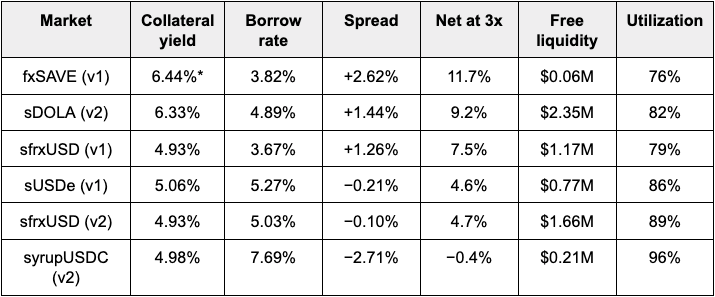
Free liquidity matters. With only $0.06–2.35M available to borrow per market, a large loop can push the borrow rate up on its own. Check the rate again after you enter.
Soft Liquidation: The Good and the Bad
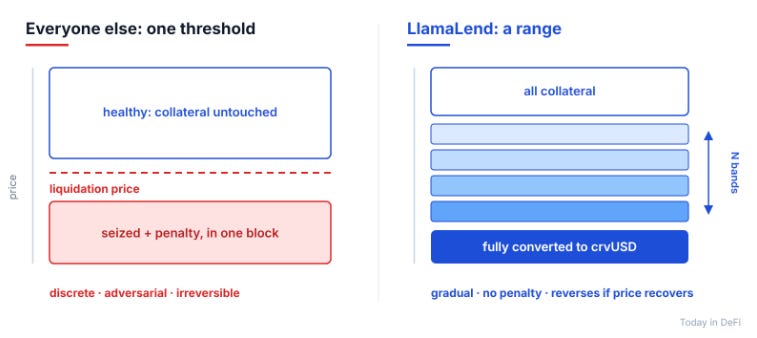
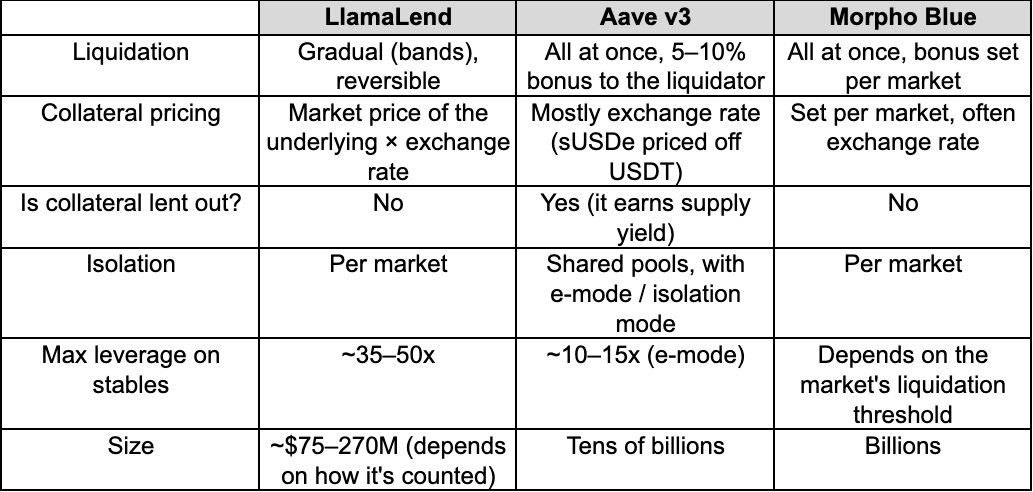
This is the biggest difference between LlamaLend and Aave or Morpho.
On Aave or Morpho, liquidation is a single event. Once your health factor drops below 1, a liquidator repays part of your debt and takes your collateral plus a 5–10% bonus.
On LlamaLend, your collateral sits in a built-in market maker called LLAMMA, spread across a price range divided into “bands” (you choose 4–50 when you open the loan). If the price falls into your range, arbitrageurs gradually swap your collateral into crvUSD. If the price recovers, they swap it back. You’re only fully (”hard”) liquidated when your remaining equity runs out.
[EDITOR: a diagram here would help: price falling through bands, collateral turning into crvUSD band by band.]
The good
A short dip doesn’t end your position. A brief depeg might convert some collateral, but you get it back when the price recovers.
Losses come gradually, with no single 5–10% liquidation penalty.
You can self-liquidate. If you’re in soft liquidation, you can close the position yourself, repaying only the net debt (the crvUSD already sitting in your bands counts toward it), and keep the remaining collateral. That beats waiting for a hard liquidation.
The bad
A price that hovers in your range bleeds you. Each trip through your bands sells low and buys back high. Over days, those small losses add up, even though you were never “liquidated.”
Once you’re in soft liquidation, your options narrow. You can’t add collateral, withdraw or borrow more. You can still repay, but repaying doesn’t move your range, even if you repay 99% of the debt. On Aave, adding collateral fixes things instantly. Here, only a price recovery or closing the loan gets you out.
You can’t change your band count on an open loan. The number of bands you choose when you open is your main risk decision.
High leverage cancels out the benefit. At high leverage the range is narrow with few bands, so soft liquidation behaves much like a normal one.
How LlamaLend compares
Oracles: Why a Depeg Counts Here
To value your sfrxUSD, LlamaLend combines two numbers: the market price of the underlying stablecoin (frxUSD, taken from Curve pools and smoothed over time) × the vault’s exchange rate (how much frxUSD one sfrxUSD is worth).
Aave and many Morpho markets lean mostly on the exchange rate and treat the underlying as $1. In practice:
If DOLA, frxUSD or USDe trades at $0.98, LlamaLend sees it. Your health drops and soft liquidation can start. On Aave, the same depeg might not register at all. LlamaLend’s pricing is more honest, and more sensitive.
The smoothing filters out brief wicks, so a one-block dip won’t trigger anything.
The exchange-rate half can be manipulated, as the sDOLA incident below showed.
Track Record: Isolation Has Held
LlamaLend has had problems, and each one stayed inside its own market:
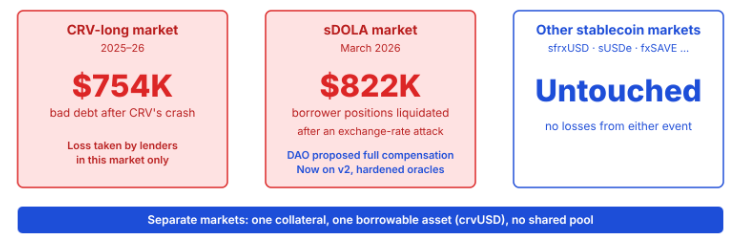
CRV market bad debt (2025–26): CRV’s crash left the CRV-long market with about $754K of bad debt. Lenders in that one market took the loss; the stablecoin markets were untouched.
sDOLA oracle attack (March 2026): an attacker manipulated sDOLA’s exchange rate and liquidated about $822K of borrower positions. The DAO proposed full compensation, and today’s sDOLA market runs on v2 with hardened oracles.
The takeaway: isolation protects you from other markets, not from your own, so pick collateral you trust and keep leverage moderate.
Risk Checklist
Spread turns negative: sUSDe’s yield swings with funding rates, and borrow rates rise with utilization.
CRV rewards move: if gauge votes send CRV elsewhere, lenders leave, rates rise and your spread shrinks.
Unharvested rewards: if your APR depends on borrower reward tokens, they must be claimed and compounded regularly, and their price can fall while you wait.
Collateral depegs: it shows up in your health right away (see the oracles section).
crvUSD peg: every loop here borrows crvUSD, so if it trades above $1, your debt costs more to repay. A slow PegKeeper response briefly caused that in June 2024. It has since been fixed, and crvUSD has traded between $0.998 and $1.000 over the past 30 days.
Shallow markets: $0.06–2.35M of free liquidity per market.
Contract version: v1 is older and battle-tested but has the older oracle design; v2 is newer and curated by LlamaRisk.
General smart contract risk across Curve, the collateral’s issuer and any interface you use.
How To: Open and Manage a Loop
Opening a loop on Curve
Go to Curve’s LlamaLend page and filter for stablecoin collateral. [SCREENSHOT: market list]
Pick a market and choose Borrow, then switch on leverage.
Enter your collateral amount and the leverage you want. Curve shows your total position and debt.
Choose the number of bands. More bands give you a wider range and smaller losses per band, but lower maximum leverage. You can’t change this later.
Check the liquidation range and health before you confirm. The top of the range is the price at which soft liquidation starts. [SCREENSHOT: create-loan screen with leverage, bands, liquidation range]
Approve and confirm. The whole loop runs in one transaction.
Managing it on Curve
To reduce leverage: use Repay → with collateral. It sells some collateral to pay down debt, in any amount, and moves your liquidation range lower.
To increase leverage: Curve doesn’t have a one-click option for existing loans. “Borrow more” adds debt, but it doesn’t buy more collateral for you.
If you’re in soft liquidation: you can only repay or self-liquidate (see above).
One-click leverage increases : if you run an sUSDe or volatile pair(btc,eth) loop and want to raise leverage without closing and reopening, DeFi Saver supports LlamaLend’s sUSDe markets. Its Boost does Borrow crvUSD → Swap → Supply sUSDe in one transaction, and you can simulate the result first.
Bottom Line
LlamaLend is the best place right now to loop yield-bearing stablecoins, as long as you go in knowing what the trade is: a 1–2.6% spread, multiplied by leverage, partly paid for by CRV, and protected by a liquidation system that’s gentler than Aave’s but has its own costs. Start at 3x, check the spread weekly, and never assume the rate you entered at is the rate you’ll keep. If you hold sDOLA from our FiRM guide, LlamaLend’s sDOLA market is a natural next step.