

Subscribe for daily free DeFi news covering launches, tradable catalysts, and actionable farming opportunities.
Today’s News Headlines:
- Ledger wallet drains likely linked to malware
- Aurora recovers from brief outage
- Hinkal starts fund returns
- Staked DAO launches Morpho LP market
- Hylo launches yield-bearing BTC and stablecoin token
- Arcus gives 50% taker fee discounts during beta.
Key Takeaways:
1. The war escalated — and crypto didn’t flinch.
The US blockade of Iran came back, yet liquidity kept expanding, BTC/NQ turned up for a second straight week, and ETF flows stayed positive. Real strength building underneath a hostile macro backdrop.
2. Solana, Monad, and Robinhood Chain led stablecoin flows last week.
Offering double-digit looping APYs, all three are being driven by the same mechanism — incentivized lending markets that keep borrowing costs down, making leveraged positions profitable enough to pull in fresh deposits. The chain-by-chain breakdown, in Section 3.
3. Ondo’s abundant catalysts this week.
Ondo shipped the first tokenized stocks built on DTC entitlements and struck a partnership with Japan’s SBI Group, landing in a week the broader tokenization narrative accelerated across regulators and institutions. What else moved, in Section 4.

Find and execute the 15%+ stablecoin yields in minutes
Save time without checking every protocol manually. DeFi Saver’s Discover page surfaces rates across Aave, Morpho, Spark, and more, lets you simulate leverage before committing, and handles the full loop in one click. Stop leaving yield on the table.
<Discover Yields on DeFi Saver> | Today in DeFi is Supported by DeFi Saver
1A. Traditional Macro
The war escalated into a full blockade — and this time crypto didn’t flinch.
The US resumed its naval blockade of Iranian ports and continued strikes around the strait, while Iran struck US assets in Jordan. Trump also floated then reversed a cargo toll through the strait. It’s the same standoff that’s run since spring — on the ground, the situation is worse; on the market, it’s priced as familiar rather than new. Unlike the sharp risk-off two weeks ago, this escalation didn’t break the tape — crypto held and even gained ground.
The war is now a known quantity, not a new shock.
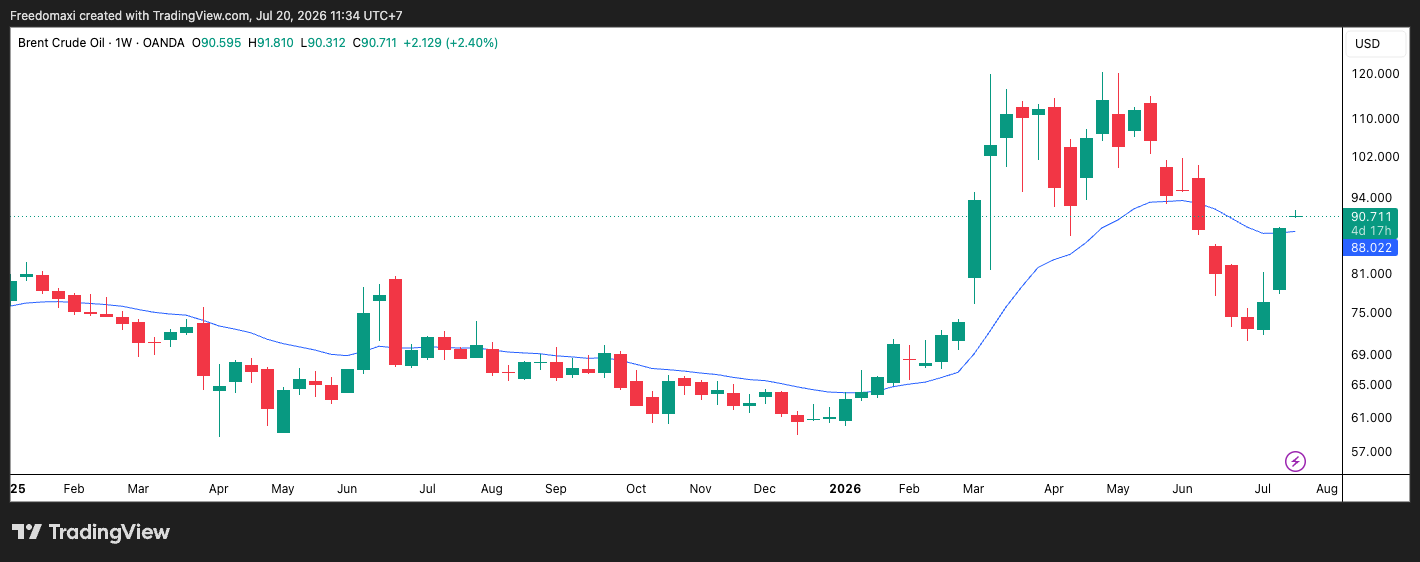
This is the same blockade the US ran from April to June. Markets have seen this playbook, which is why — unlike the sharp risk-off two weeks ago — the escalation didn’t necessarily break risky assets. Although oil spiked to new highs, crypto actually gained ground. The war is still the dominant driver, but it’s being priced as a persistent condition rather than a fresh crisis.
FRED:WALCL-(FRED:RRPONTSYD+FRED:WTREGEN)
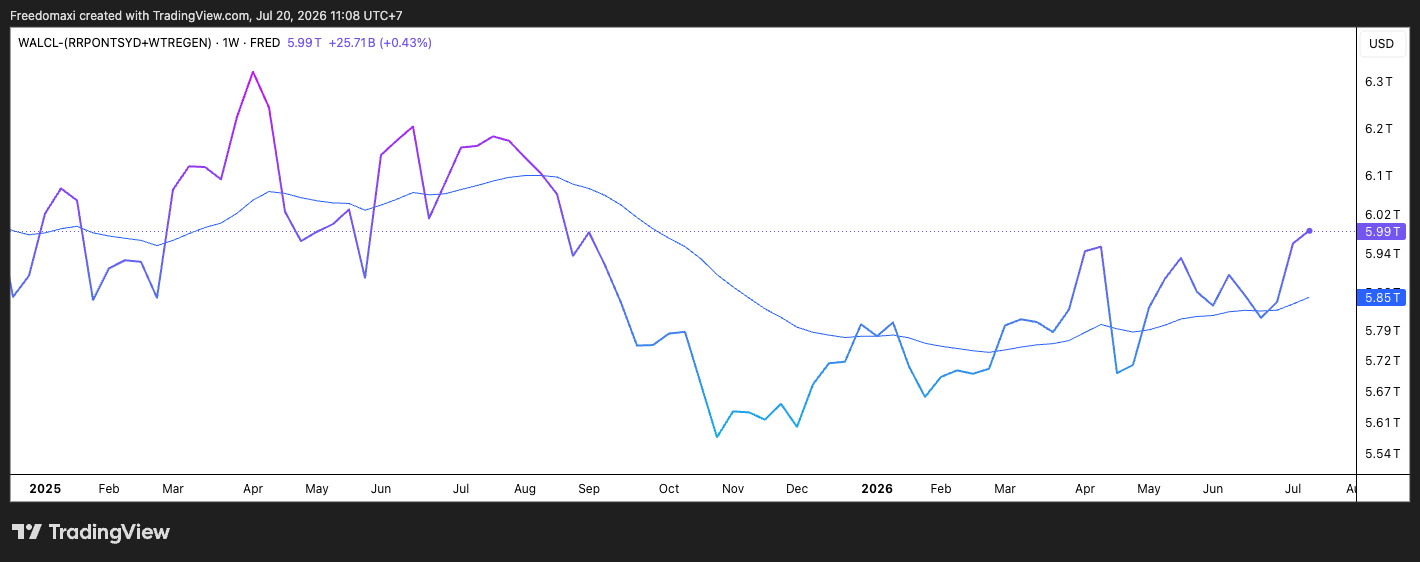
Net liquidity: ~$5.99T, +$25.7B WoW (+0.43%). SUPPORTIVE — and the through-line of the week. A third straight weekly expansion, holding above the moving average. This is the single reason risk assets are absorbing continuous geopolitical escalation without breaking. Liquidity is what’s keeping the bid alive.DXY
BTC/NQ ratio

BTC/NQ ratio: closed green — crypto outperformed equities again. IMPROVING. The standout. The relative-strength turn isn’t only a crypto-strength story — it’s partly an AI-unwind story.
The semiconductor trade that led equities all year is rolling over: a key chip index has fallen into a bear market, down ~20% from its record, and South Korea’s KOSPI — one of the purest AI proxies — has swung violently, with multiple 6–9% down days as Samsung and SK Hynix sold off despite record earnings.

Why does it matter for crypto?
AI has been the market’s dominant capital magnet for two years, pulling money away from everything else. As that trade unwinds, it releases liquidity back into the rest of the market — and some of it is finding crypto.
That’s a meaningful part of why BTC/NQ is turning up: it’s less that crypto broke out, more that the thing crushing it relatively is finally losing steam.
Composite: liquidity supportive, the dollar firm, rates the lone clear headwind — and crucially, crypto outperforming into all of it. The regime has shifted from “escalation breaks the tape” to “escalation priced, liquidity wins.” The war is the driver, but liquidity is the stronger force right now.
1B. Crypto Capital On-Ramp
Total stablecoin supply 7d change (level + WoW)
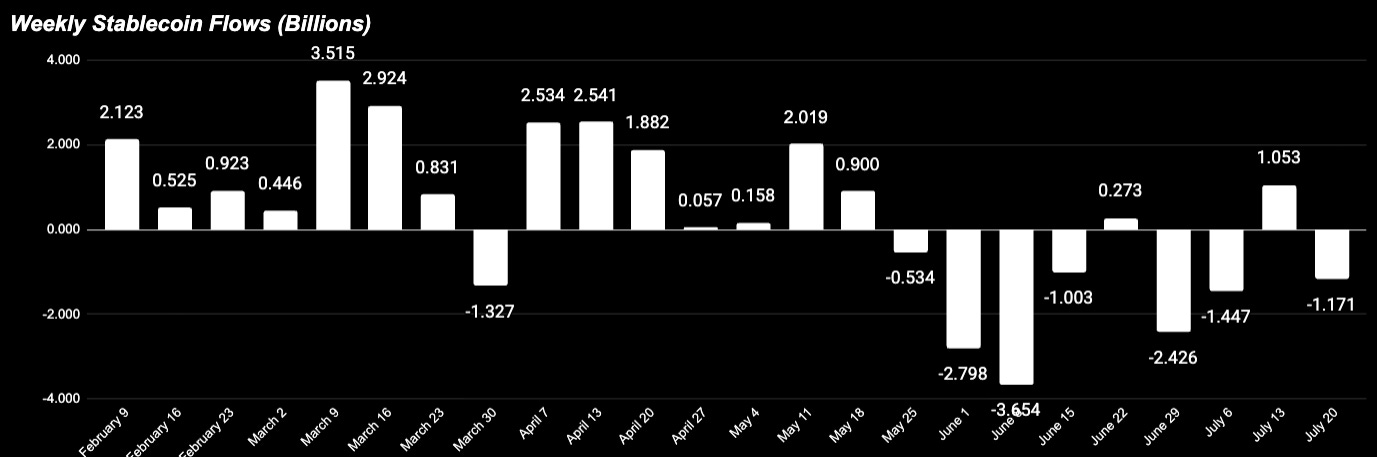
Total stablecoin supply: −$1.17B WoW (−0.38%). CONTRACTING. The base shrank again, extending the choppy outflow pattern that’s run since late May. Last week’s +$1.05B inflow didn’t hold — the on-ramp is still struggling to sustain positive prints for more than a week at a time. Notably, this contraction happened while price rose, so the week’s strength was not funded by fresh stablecoin capital entering the system.
BTC and ETH Exchange Flows
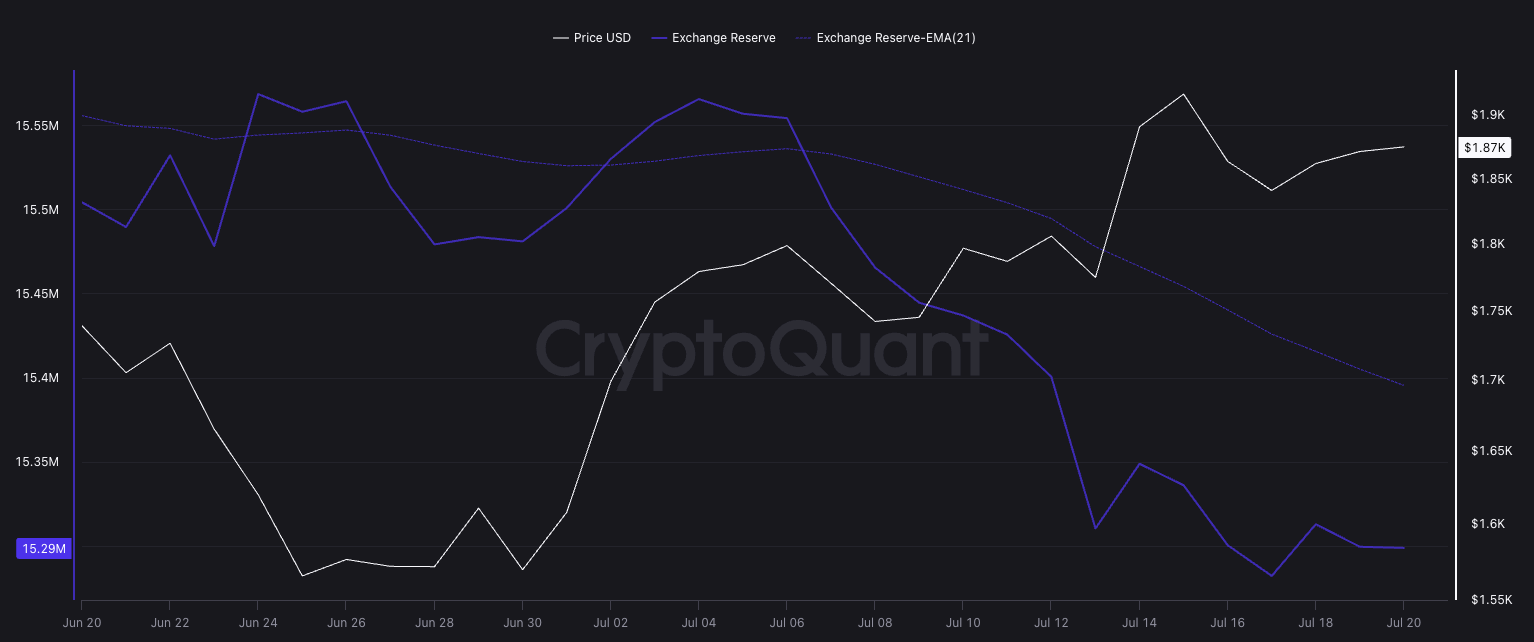
Ethereum’s exchange flow is the interesting read. Reserves fell sharply through the week even as price climbed toward $1.87K, a steeper drawdown than Bitcoin’s. Coins leaving exchanges into a rising price is accumulation — and on ETH specifically, it’s pronounced enough to be worth flagging quietly alongside the ETHBTC strength in Section 2.
ETF flows
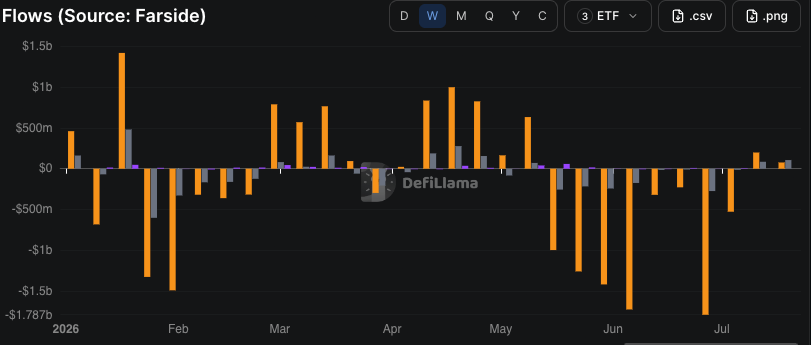
ETF flows — positive, but cooling. Spot ETF flows returned to net inflows this week, a constructive sign after the volatility of recent weeks — but the magnitude was lower than the prior week’s. Interestingly, ETH flows are slightly higher than BTC. Flow is there; but it isn’t accelerating.
1C. Week-Ahead Catalysts
FOMC decision — July 28–29.
The dominant event is happening later this week.
Warsh’s second meeting as Chair, and the first real test of the hike markets have priced for year-end amid the oil-driven inflation risk. With forward guidance removed, the statement and press conference carry all the weight — this is the one that can reprice the front end in either direction.
Q2 GDP (advance). The first read on second-quarter growth, feeding directly into the data-dependent Fed’s calculus.
Onchain: the Curve DAO vote to activate LlamaLend 2 markets on Ethereum mainnet closes July 21, and ETHGlobal’s Pragma Lisbon runs July 23 — worth noting for the DeFi calendar, though neither is a macro mover.
Section 2 — Onchain Risk Regime
Individual Stablecoins Flows

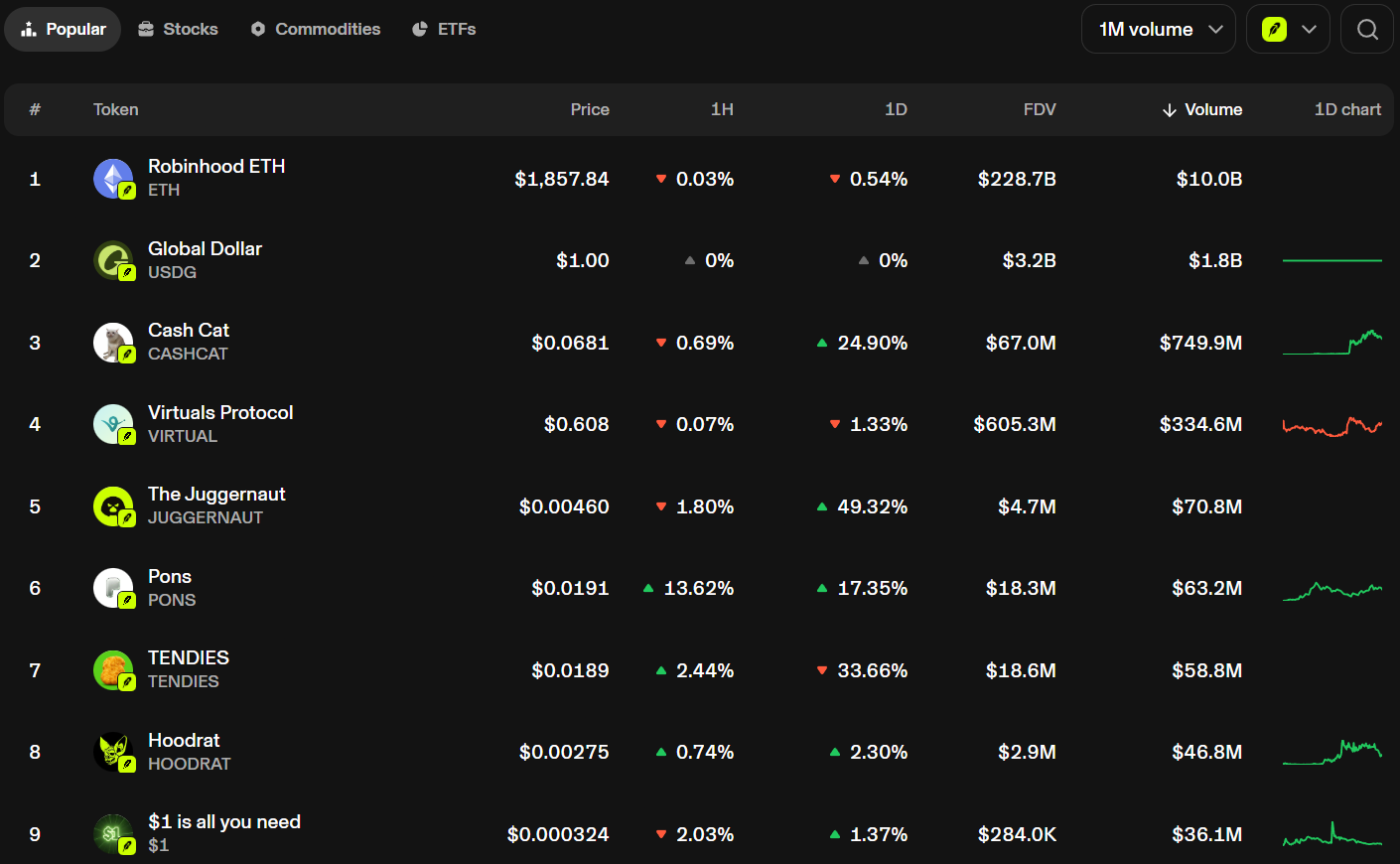
USDG led again at +$256.2M, extending the Global Dollar rail’s run for a third straight week. The important nuance: this isn’t only yield-farming demand. On Robinhood Chain, USDG is the settlement asset for Lighter and other perps DEXs, so its growth reflects trading activity, not just deposit-chasing — a healthier, stickier form of demand than incentive farming alone.
Meanwhile on outflows:
USDS −$915.2M (−$1.31B over 30d), with BUIDL −$250.2M and USDtb −$273.4M. On the surface that looks bearish, but these three are the market’s conservative-yield instruments — USDS for the ~3.5% sUSDS savings rate, BUIDL and USDtb for Treasury yield.
Capital leaving the safest, lowest-return dollars is a mild risk-on signal — money stepping out of parked-and-earning positions rather than fleeing the system. USDC (−$75.1M) and USDT (−$108.7M) were modestly negative, consistent with the total-supply contraction in 1B.
Aave / Sphere Rates

Sphere rates: funding 6.42%, +0.04% — essentially flat but still elevated, and well above the 4.12% borrow rate (supply 3.12%). Both borrow and supply ticked down slightly. So funding is holding high while lending rates soften — leverage stays expensive and crowded.
ETH to BTC Comparison

ETHBTC: closed +0.11%, a third consecutive green weekly candle, now sitting right on / just above the 20W MA. For the 3rd consecutive week, ETH outperformed Bitcoin. Giving room for alts to rise.
3A. Stablecoin flows by chain — table with 7d flow, 7d %, 30d %
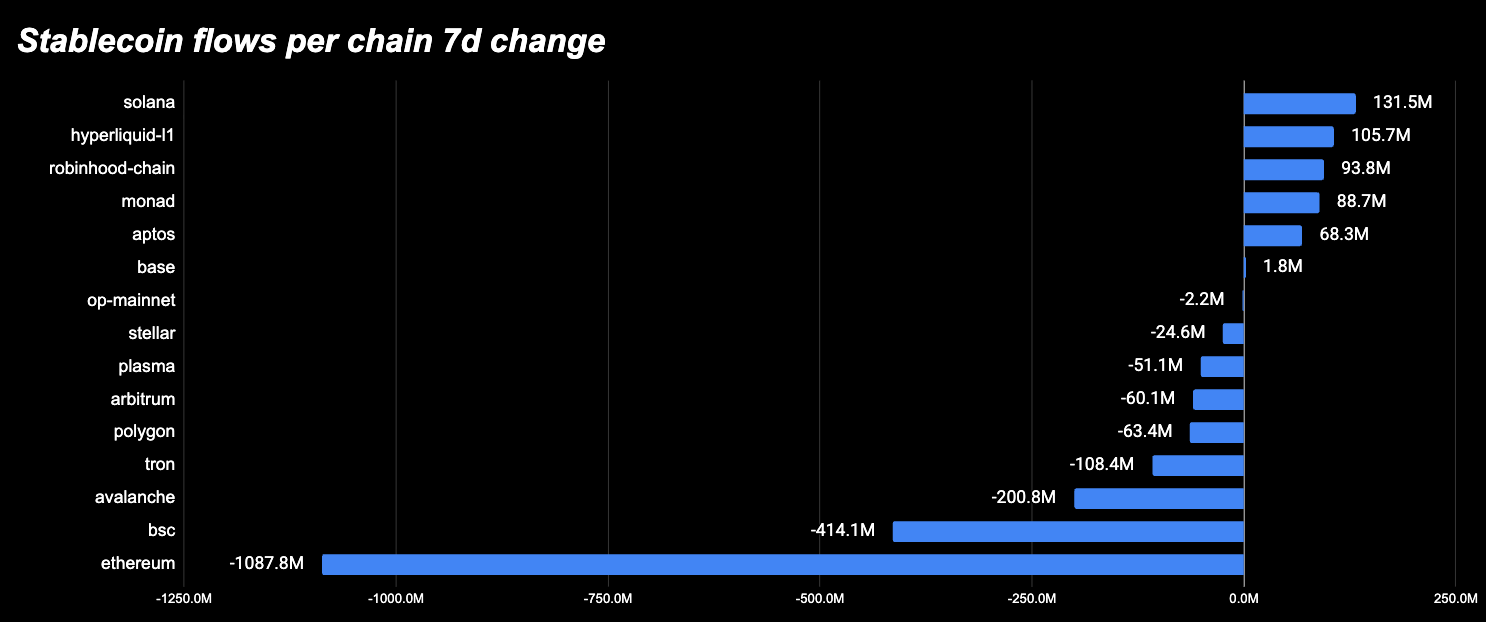
Solana
$14.01B, +$137.1M (7d, +0.99%), −$279.2M (30d). Growth is reallocation, not net inflow. Kamino’s curated vaults (Steakhouse ~7.4%, RockawayX ~5.9%) keep drawing deposits, while the base lending market shrinks.

Curated Yield Vaults on Kamino
Curated lending and looping venues on Solana continue to attract deposits over the trailing 30 days. This is distinct from the chain-level supply metric above — it measures protocol deposits, not total on-chain stablecoin issuance:
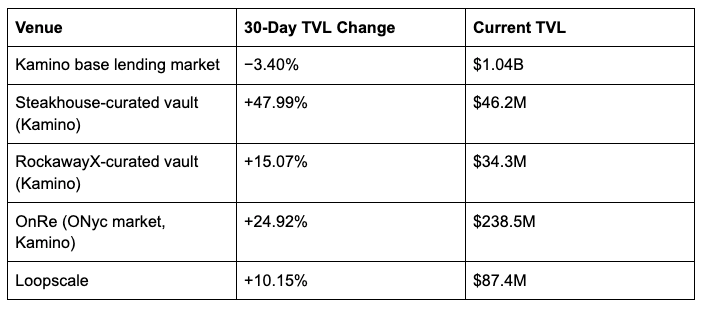


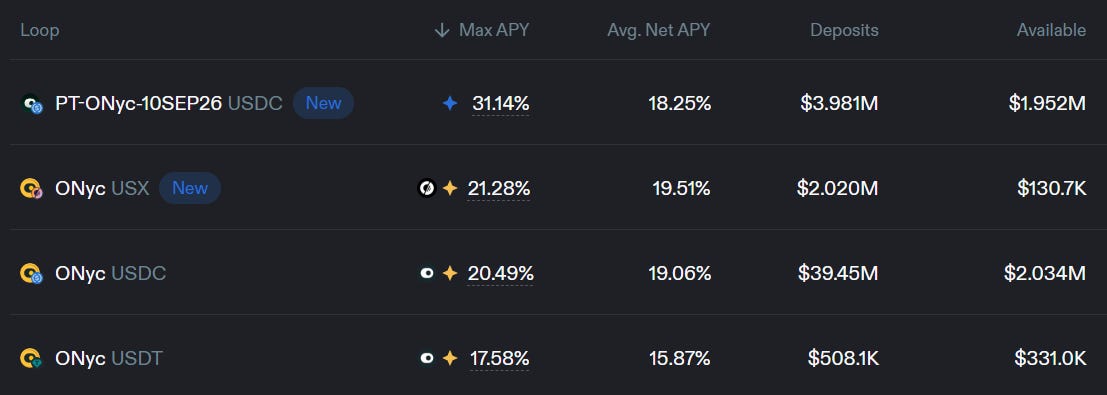
OnRe raised its ONyc supply cap 25M on July 17 and filled it immediately — loop APYs run 18–22%, or up to ~31% via Exponent’s fixed-rate PT-ONyc.
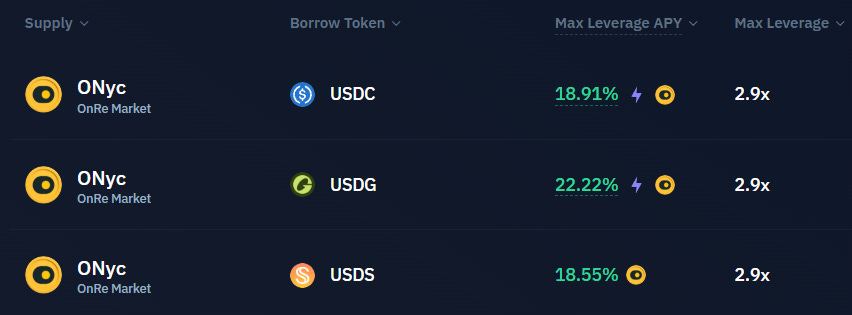

In parallel, Loopscale added new round of incentive for USDC lending to OnRe market.

For users willing to take a fixed-rate position, looped PT-ONyc yields up to ~30.92% APY via Exponent’s fixed-rate conversion, versus up to ~20.31% for direct ONyc looping (plus 6x Points). In short: both lending against ONyc and looping ONyc currently offer attractive yield, and the cap expansion plus new Loopscale liquidity has re-opened capacity that had previously been fully subscribed.
Robinhood Chain
Robinhood Chain’s tracked stablecoin market capitalization is $393.4M, up 31.33% (+$93.8M) over 7 days. A 30-day comparison is not applicable: the chain launched July 1, 2026, and the 30-days-prior reading predates its existence. USDG, the chain’s native stablecoin, increased from $204.6M to $295.5M over the period (+$90.8M); USDe added $3.0M.
Incentive Structure — the Merkl-Boosted Morpho USDG Market
Growth is almost entirely USDG, up from $204.6M to $295.5M, pulled in by a Merkl-boosted Morpho vault paying roughly 7% total (1.6% native lending plus a 5.4% incentive, paid in steakUSDG) — and the campaign has close to a year of runway left, which reads as a durable subsidy rather than a short-term push.

The vault also accepts USDe, syrupUSDG, and spUSDG as collateral against USDG borrowing, so each of those assets is being pulled in as looping collateral alongside direct deposits.

Robinhood's choice of USDG over USDC or USDT has been linked to revenue-sharing terms, consistent with the chain funding an incentive program this size.
Monad
Monad’s tracked stablecoin market capitalization is $526.2M, up 19.52% (+$85.9M) over 7 days and 43.90% (+$160.5M) over 30 days, distributed across multiple tokens rather than concentrated in a single asset.
Aave V3 — Merkl Supply Incentives Compressing the Cost of Leverage
Aave V3 launched on Monad on July 2, 2026, backed by a combined $15.5M incentive commitment from the Monad Foundation and Aave DAO. The initial market listed USDT0, USDC, GHO, USDe, mUSD, AUSD, WETH, cbBTC, wstETH, weETH, syrupUSDC, and sUSDe. Aave V3’s TVL on Monad is $262.6M (insufficient history for a 30-day comparison).
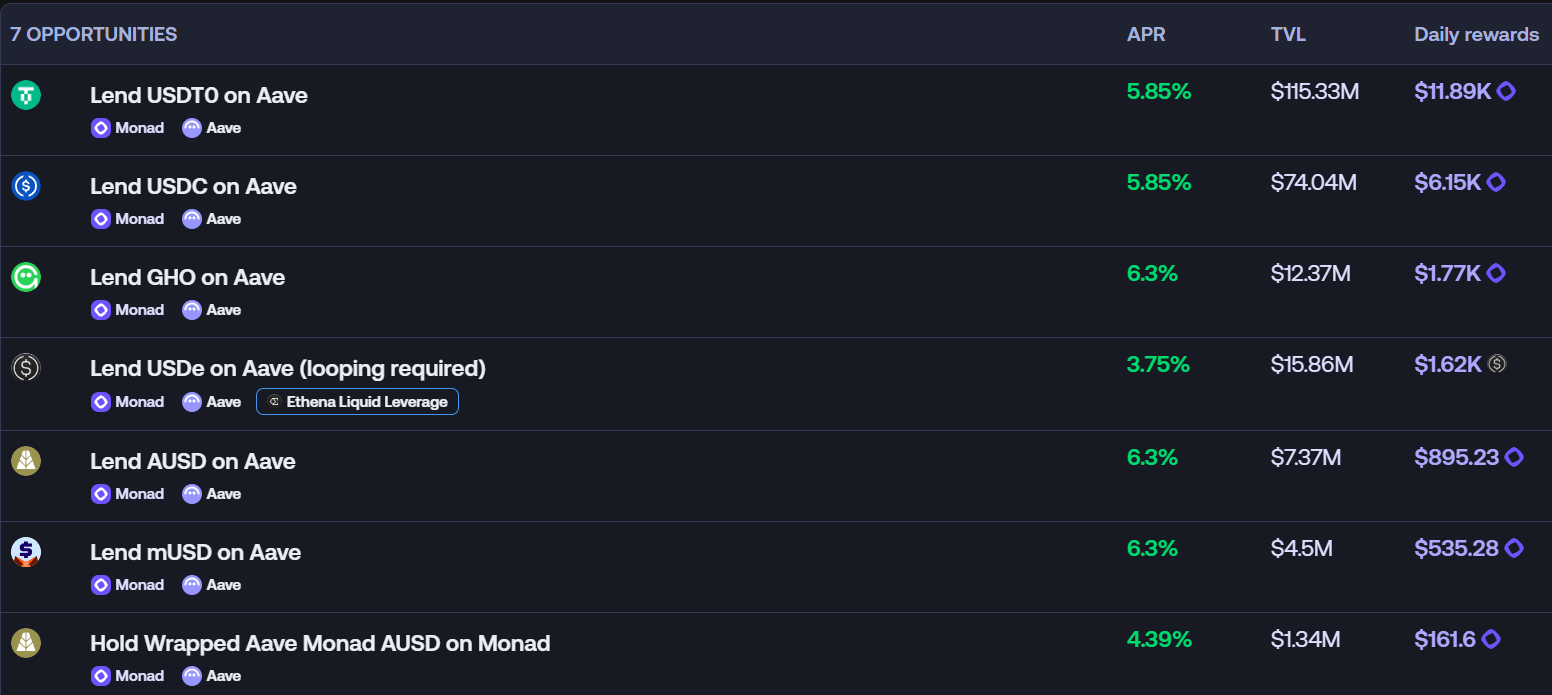
Those incentives are being distributed through Merkl, paid in WMON on the stablecoin supply markets. Live campaign parameters:

Mechanism:
Subsidized supply yield holds utilization — and therefore borrow costs — down, which is what makes looping yield-bearing collateral (like Maple's syrupUSDC) profitable.

The GHO listing is further backstopped by a Monad Foundation commitment to acquire and retain 10M GHO for a minimum of six months, alongside a 500,000 GHO incentive allocation from Aave DAO.
Ethena — USDe Expansion, Liquid Leverage, and LP Seeding
USDe launched on Monad in the last 7 days, rising from near-zero to $17.2M in tracked market capitalization, bridged via Stargate and enabled as Aave collateral for recursive borrowing. This is paired with Ethena’s Liquid Leverage program — the mechanism previously deployed on Ethereum mainnet, maintaining a 50/50 USDe/sUSDe collateral mix to offset the 7-day sUSDe unstaking constraint and target a blended yield approximating a full sUSDe position — now extended to Monad. The live Merkl campaign for it:
“Lend USDe on Aave (looping required)” — part of Ethena’s Liquid Leverage program, with Merkl as distribution partner in collaboration with the ACI.
Target APR 3.75%, ~$15.86M TVL, ~$1.62K/day in aMonUSDe rewards, ~36.8K aMonUSDe total, running 17–24 July 2026.
Eligibility requires borrowing and maintaining a health factor below 2.5, i.e. the reward is explicitly conditioned on holding a levered (looped) position.

On top of the lending-side incentive, Ethena is also seeding direct DEX liquidity on Monad via Uniswap v4, with active Merkl-distributed campaigns on the sUSDe-USDT0 pool (0.05% fee tier, 12.47% APR, $2.98M TVL) and the USDe-USDT0 pool (0.01% fee tier, 11.8% APR, $3.15M TVL), both with ~7 days remaining at observation.

This is liquidity-side subsidization layered on top of the lending-side rewards: seeding pool depth reduces slippage on the swaps a looper executes when entering, rebalancing, or unwinding, and therefore directly facilitates the looping process the Liquid Leverage program is designed to drive.
3B. Structural Shifts- DEX Volumes
Robinhood Chain is the loudest narrative in crypto this week by every attention metric we track. On-chain, the picture splits: top-five DEX volume built on a gas subsidy and a memecoin launchpad cycle, a lending core that is genuinely organic, and a tokenized-RWA flagship that remains a rounding error.
This section separates what the market is farming, what it is trading, and where it is positioning with sticky capital.
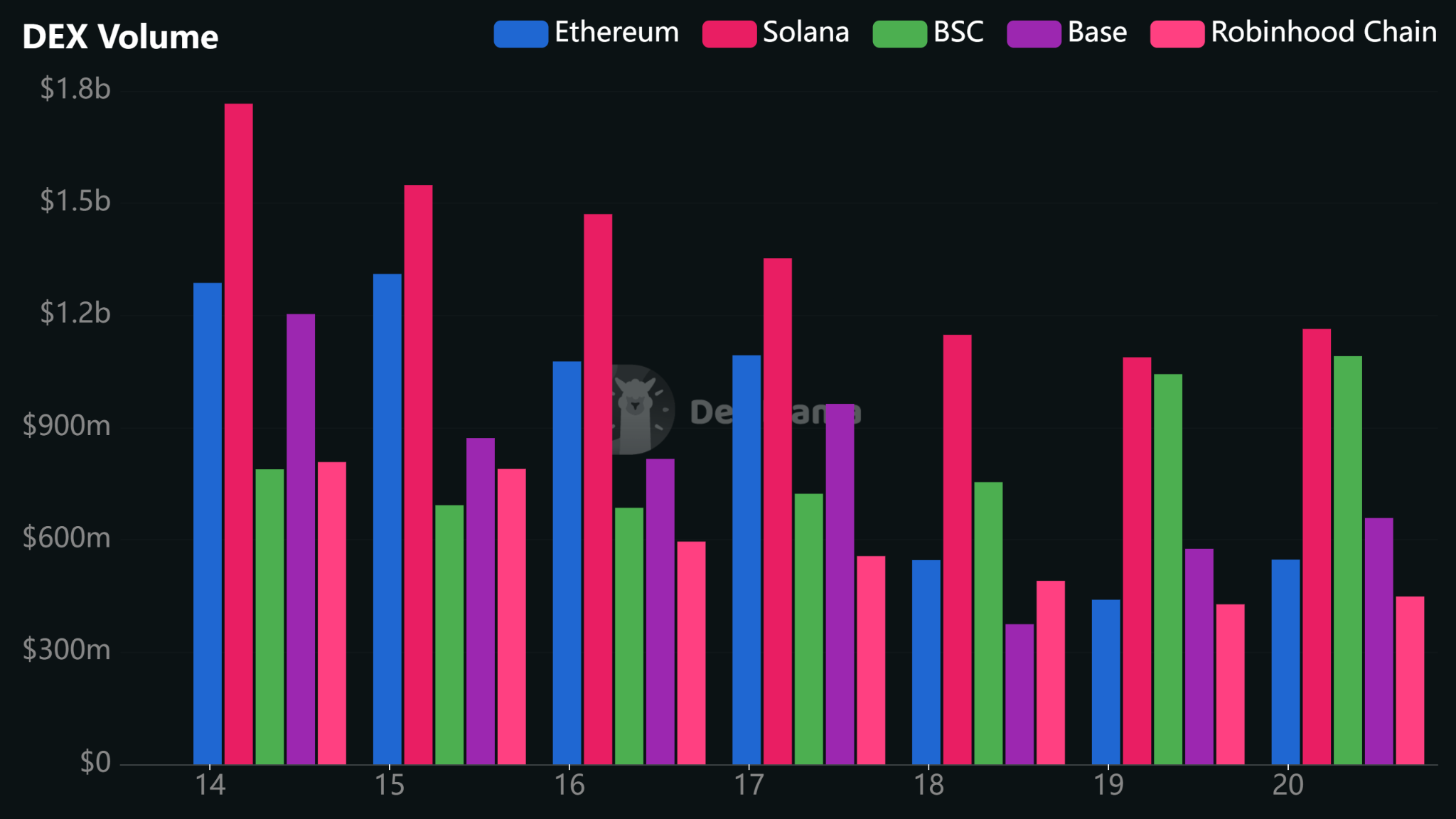
Robinhood Chain’s dominance is manufactured, but not empty.
A 90-day zero-gas subsidy (through September 29) combined with a memecoin launchpad cycle produced roughly $5.25B in 7-day DEX volume, briefly landing the chain in the top five by that metric. But the chain earns only ~$4,000/day in actual protocol fees against 7.6M daily transactions — a 16–33x gap between chain-level and app-level fees that shows almost all economic value is being captured by trading apps, not the chain itself.
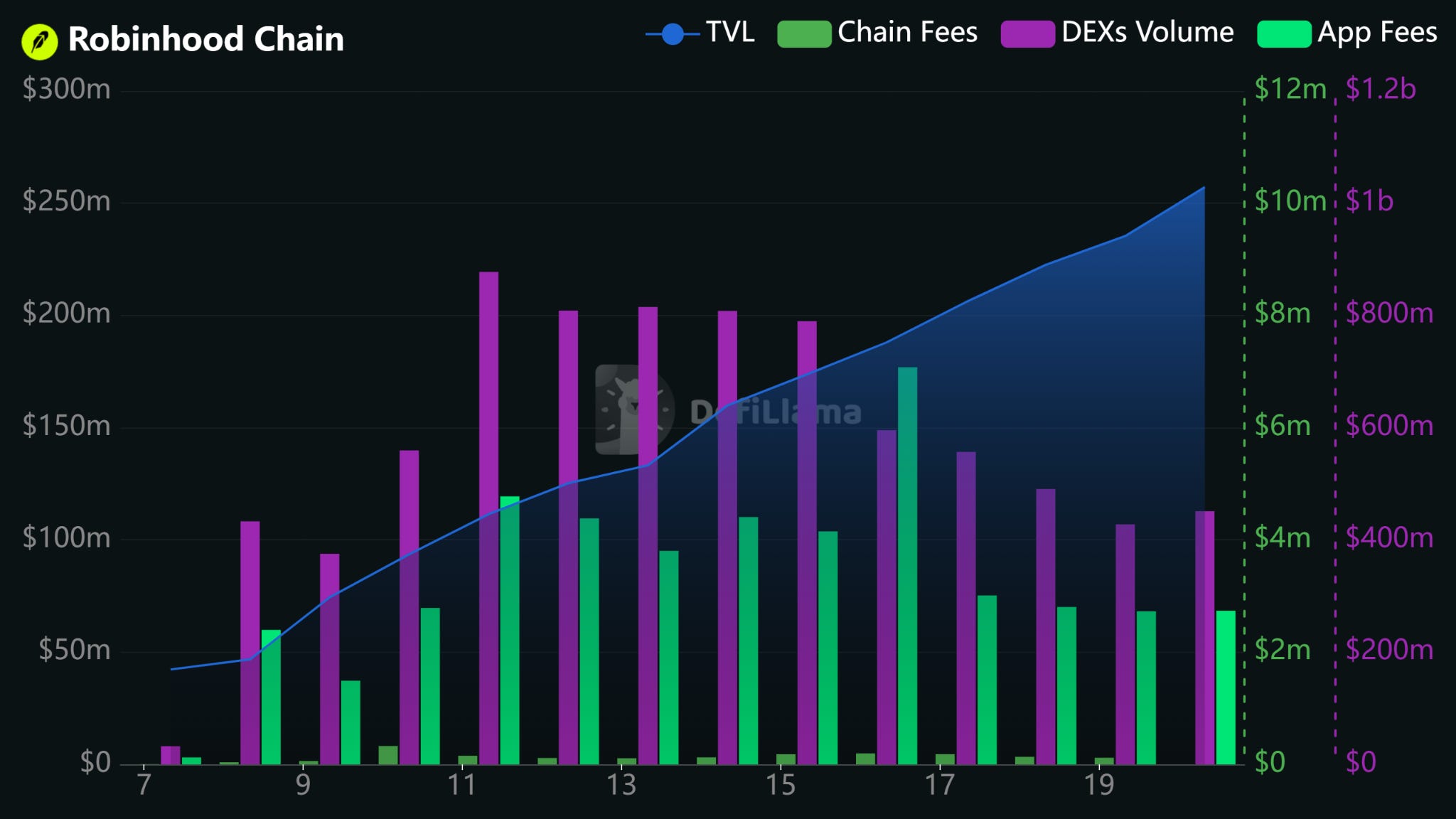
The memecoin engine was CASHCAT, launched July 7–8, which peaked near a $226M market cap before falling ~70%; on its peak day it alone generated ~$98M in volume, about 17% of the entire chain’s total.
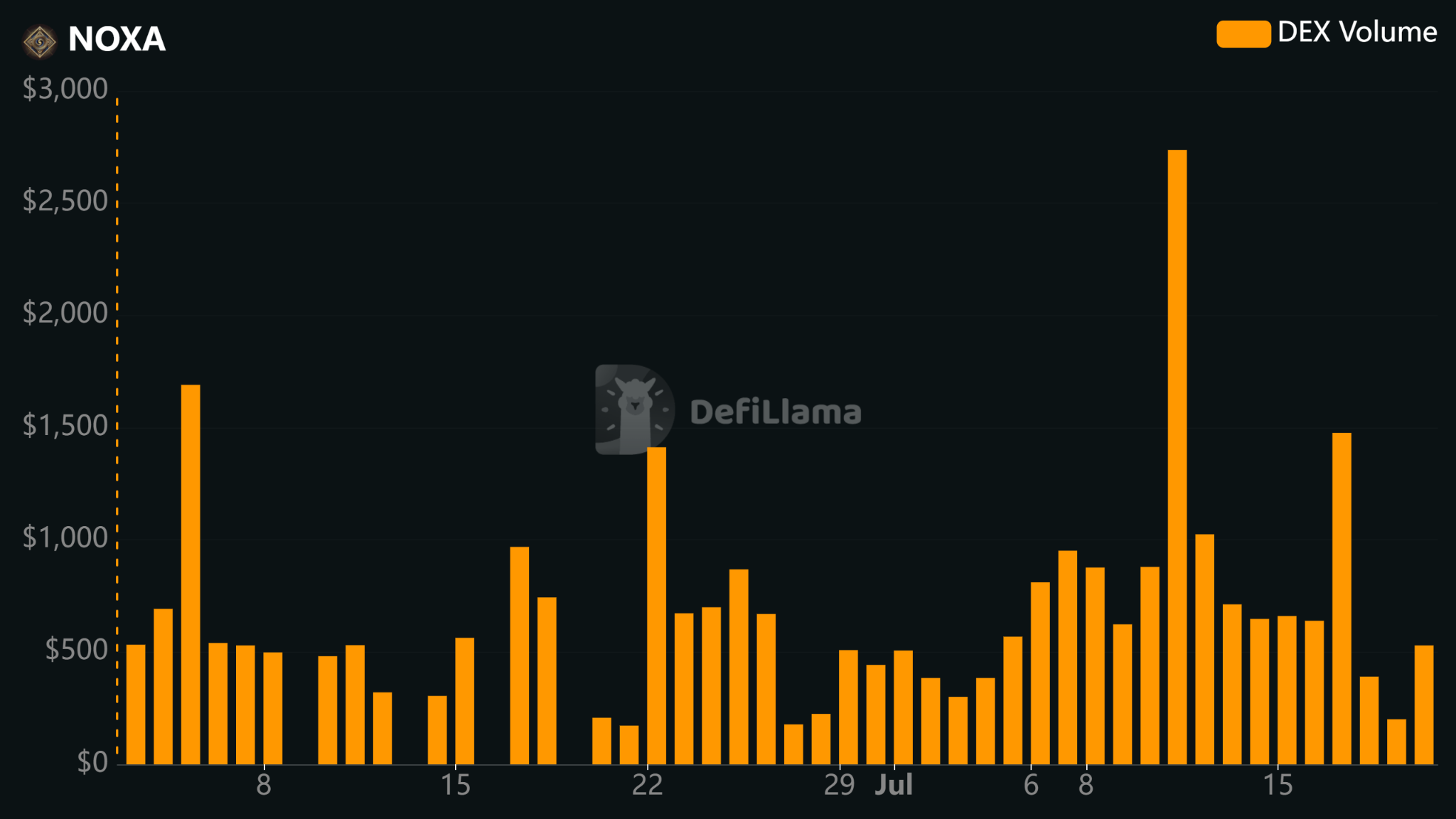
Its launchpad, NOXA, deployed the majority of all tokens on the chain, out-earned Pump.fun in fees for five straight days, then halted launches citing bot spam — and its successors haven’t replicated the traction.
Robinhood Chain: Anatomy of Manufactured Dominance
Launched July 1, 2026 as an Arbitrum Orbit L2 (ETH gas token, with 10% of net protocol fees routed back to the Arbitrum ecosystem), Robinhood Chain compressed a full launch-chain cycle into three weeks: vertical volume ramp, memecoin mania, launchpad collapse, and decay — all running on subsidized rails.
The subsidy distortion
Robinhood is covering gas for all Robinhood Wallet swaps above $5 through September 29, 2026. The result is a chain that processed 7.6M transactions in a single day while generating roughly $4,000 in daily protocol fees (July 10–11). The persistent gap between chain-level fees and app-level fees — roughly 16–33x depending on the window — confirms that nearly all economic value is captured by the trading applications, not the chain’s own infrastructure. Every volume and activity figure in the table above is running on subsidized rails.
Beneath the noise, locked capital tells a different story than volume does. Morpho Blue lending holds ~$150M — roughly 65% of chain TVL — well ahead of Uniswap (~$61M), Arcus (~$17M), and NOXA (~$6M).
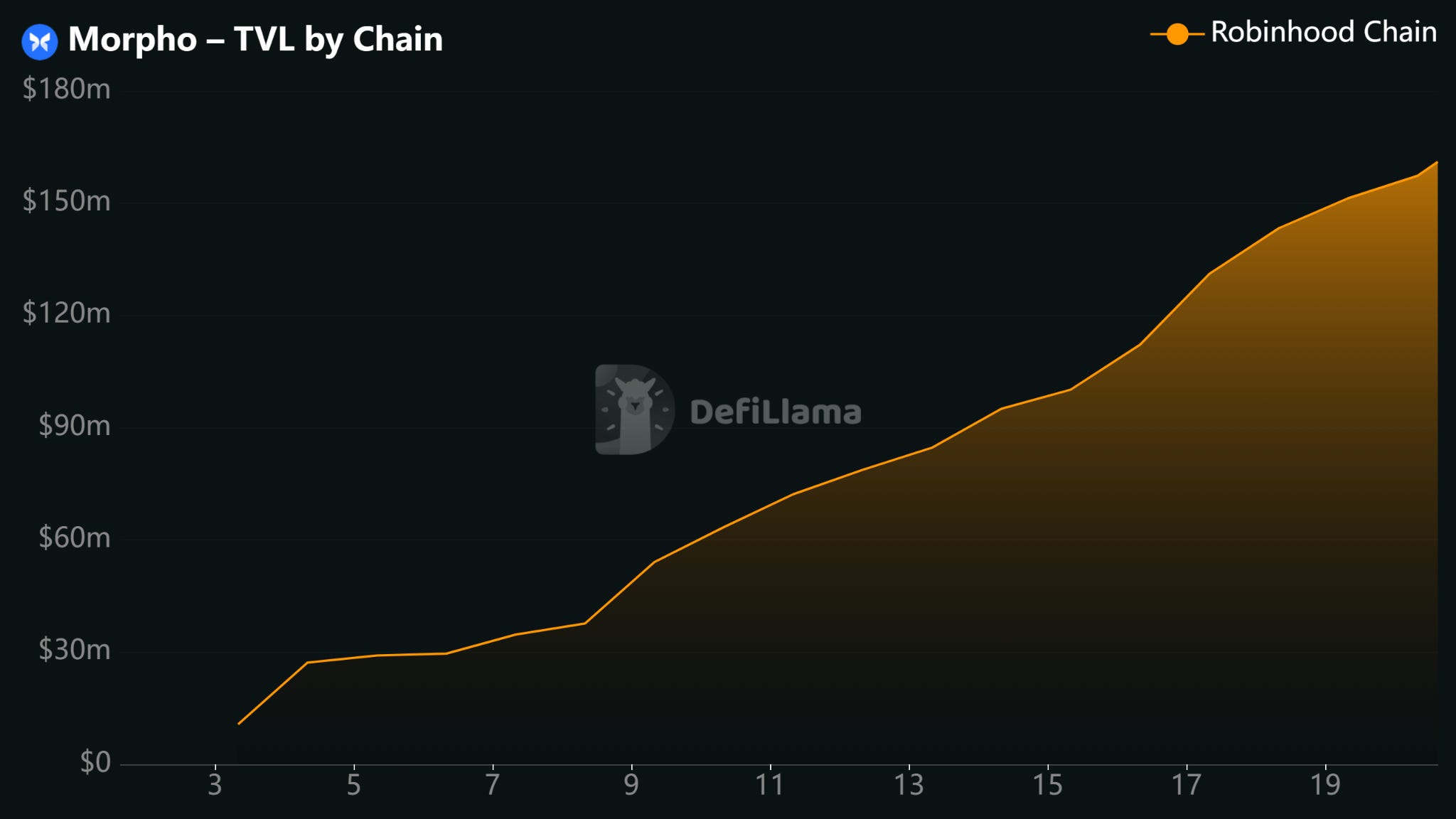
Robinhood Earn routes up to 7% APY on USDG through Morpho, and Ethena reportedly seeded ~$50M into a Steakhouse-curated USDG vault. Lending capital seeking structured yield is the most durable conviction signal on the chain today.
02 · The RWA Reality Check
Robinhood Chain was built, per its own leadership, to prove the tokenized real-world-asset thesis. Three weeks in, the evidence points the other way on every axis.
Scale: the flagship is a rounding error
Arcus — the zero-fee tokenized-stock DEX built by dYdX Labs with Robinhood Crypto, offering ~95 tokenized stocks spot and 35 RWA perps (still waitlisted) — accounts for well under 1% of chain DEX volume.
Total tokenized-stock holdings on the chain sit near $12.8M: roughly $10.7M in stocks, the remainder in commodities and ETFs, and about $410K in Treasuries. At CASHCAT’s peak, a single cat memecoin was worth more than every tokenized RWA on the chain combined, by an order of magnitude. In the meanwhile, the perps volume is much smaller.
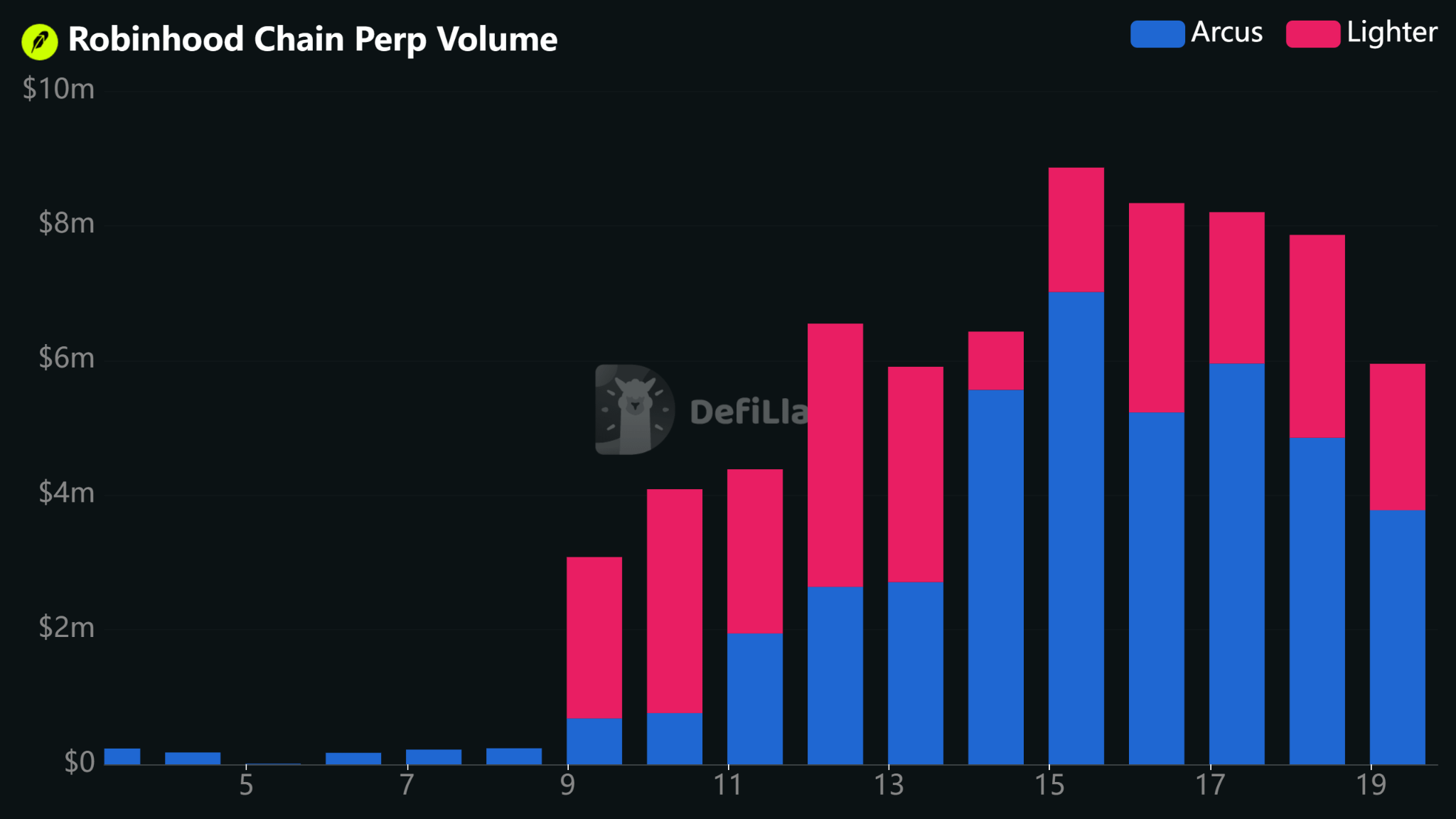
Uniswap is the largest DEX on Robinhood at the moment, and most of the trading volume is from memecoin, instead of tokenized stocks.
Structure: these are not equities
Robinhood’s Stock Tokens are debt instruments issued by Robinhood Assets Jersey Ltd. Holders receive price exposure but no shareholder or voting rights. The product is unavailable in the US, Canada, and the UK, and is live in 120+ other countries. The Bank of Lithuania — Robinhood’s lead EU regulator — is investigating the EU Stock Token structure, with particular attention to the OpenAI and SpaceX tokens (OpenAI publicly disavowed the product) and to consumer communications; the SEC flagged the structure for scrutiny in January 2026.
Competition: the category already has a leader
Solana handled approximately 96% of all on-chain tokenized-equity spot volume in June 2026 — ~$3.47B in a single month, with cumulative tokenized-stock volume of ~$51.7B out of ~$53.5B across all chains — and surpassed 300,000 RWA holders in early July. The tokenized-equity trade the Robinhood narrative describes is already happening at scale, on a different chain.
03 · Cross-Market Conviction Map
Ranking this week’s competing narratives on hard metrics — fees, sticky TVL, open interest, bot-adjusted users — against social reach, and explicitly separating farmed attention from organic positioning:
Hyperliquid — structural conviction
Record open interest (~$11.07B), RWA perps at an all-time high ~$3.6B (a third of OI), over $1.15B in cumulative revenue with ~99% of fees funding HYPE buybacks, and ~$170M in ETF inflows. Real fees, no subsidy.
Zcash / privacy — rotational conviction
The week's strongest social numbers and sector rotation, backed by Multicoin accumulation and privacy-regulation catalysts — but analysts read it as narrative repricing, not usage growth. ZEC is up ~2x over 30 days.
Robinhood Chain — farmed attention
The #1 social narrative of the week, but volume is subsidy- and launchpad-driven, the RWA flagship is barely active, and the launchpad that drove it has already failed once. Morpho lending is the only sticky part. Highest DEX-volume-to-TVL ratio of any major chain — a red flag, not a badge.
Solana — quiet category ownership
Owns ~96% of actual tokenized-equity volume with zero headline attention this week — proof that mindshare and real positioning aren't the same thing.
The Equity Tie-In: HOOD Into July 29
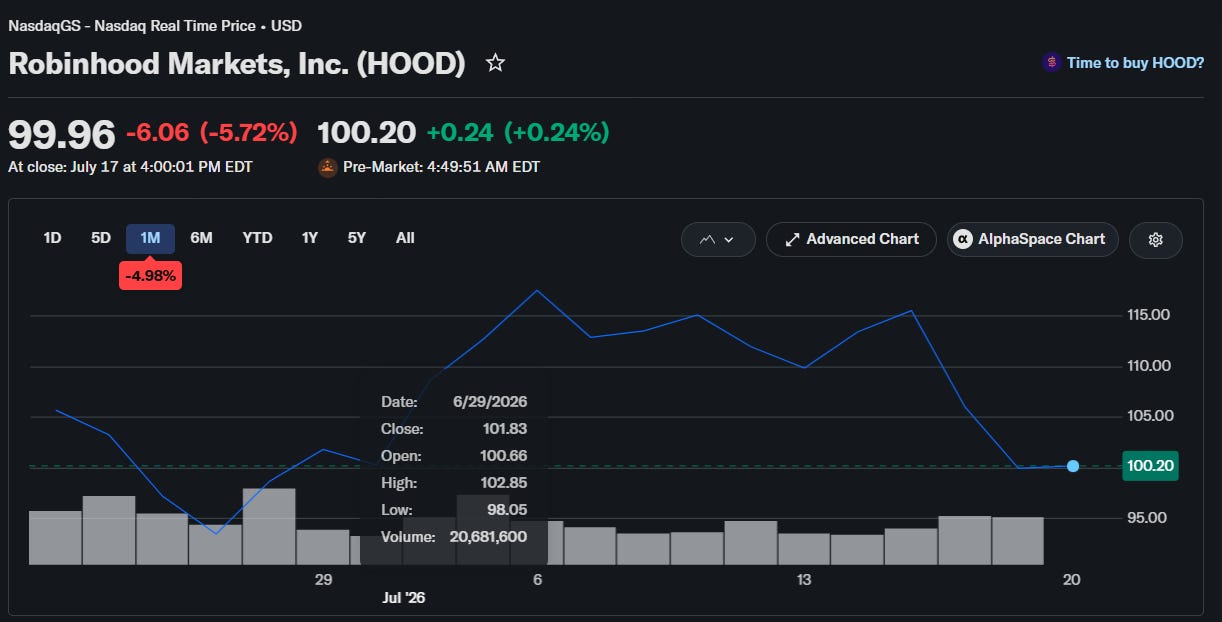
The stock is down ~11% over two weeks after rallying into the chain launch — its rally predated the chain, then reversed as on-chain activity peaked, so the “chain hype → stock rally” story doesn’t hold up cleanly. Q2 earnings (July 29) are the first report with live chain data; as of now, chain fees are immaterial to revenue — this is optionality, not an earnings driver.
What would change the call:
The September 29 subsidy expiry (does volume/TVL hold once gas isn’t free), the July 29 earnings print, RWA holdings breaking above ~$50M, and whether any post-NOXA launchpad sustains deployments. Until then, every Robinhood Chain metric is provisional.
Section 4 — Project & Protocol Discovery
4A. Token Price Movers - Observations, not trade ideas
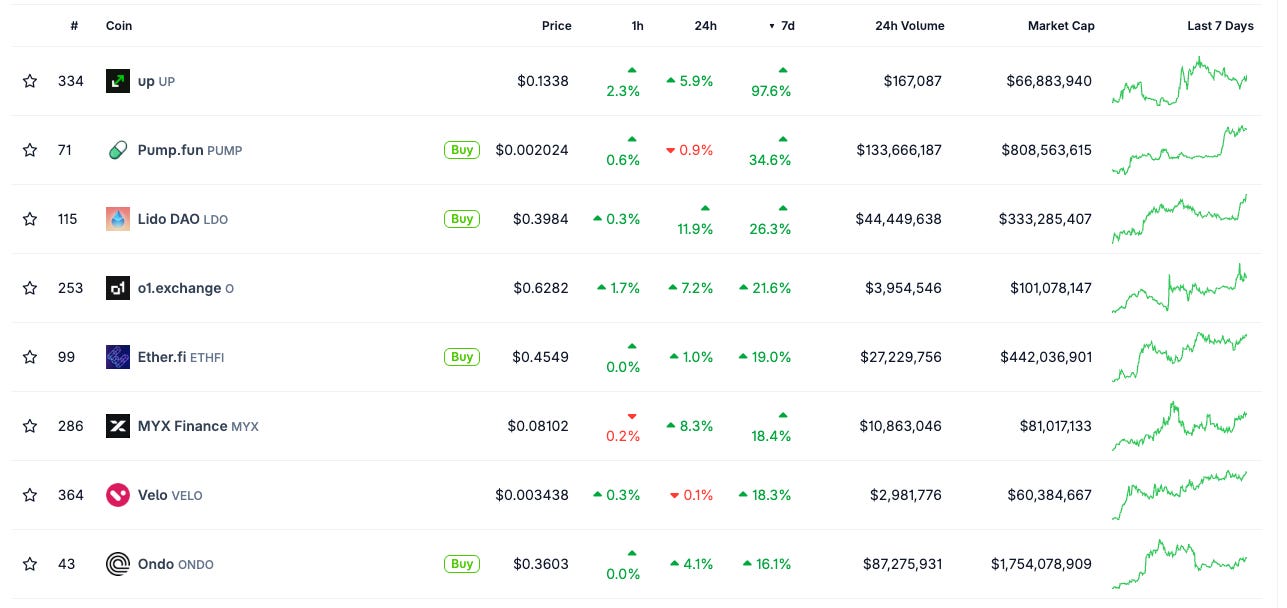
Ondo — ONDO.
The clearest fundamental week in the set. Ondo launched the first tokenized stocks built on DTC tokenized entitlements via the DTCC Tokenization Service — joining DTCC’s largest tokenization initiative — and announced a partnership with SBI Group to bring Japanese assets onchain, settled in the JPYSC stablecoin.
It also featured in Ripple’s institutional push alongside Mastercard, JPMorgan, and OKX. All landing in a week the broader tokenization narrative accelerated (UK’s 54-firm taskforce, the GENIUS Act’s one-year rulemaking deadline, RWAs nearing $34.8B). Ondo is positioned at the center of the institutional-RWA story. post
Lido — LDO.
ETH staking went live on Nansen, built on Lido’s V3 stVaults with Nansen’s validator infrastructure (non-custodial, base yield + MEV). Another distribution win for the stVaults primitive, extending the same institutional-staking expansion that put wstETH on Robinhood Chain a week earlier. post
Pump.fun — PUMP.
Ran on a widely-viewed thesis from trader Ansem, who disclosed a $100K position arguing PUMP is undervalued on ~$440M annualized revenue and that an unfulfilled airdrop is capping the token.
NOTE FOR PUMP: This is sentiment/KOL-driven — one prominent commenter publicly called it a possible undisclosed paid promotion.
No identified catalyst: Velo, Bitway, THORChain, Injective — moved without news in the material you sent; listed for completeness.
4B. TVL Gainers ($50M+ filter) — Ranked by absolute $ inflow.
Nest Credit

$117.4M TVL · +17.65% (7d) / +87.83% (30d) / +132.51% (90d)
Nest Credit’s growth is supported by two developments: continued expansion of institutional distribution across exchange-wallet surfaces, and the introduction of native leverage mechanics on its vault assets.
Distribution has broadened across major centralized-exchange wallets in sequence, with each integration opening an additional deposit channel. Plume’s Nest vaults launched an exclusive RWA vault with EtherFi on June 4, carrying a $100M institutional RWA-yield commitment.