

Subscribe for daily free DeFi news covering launches, tradable catalysts, and actionable farming opportunities.
Today’s News Headlines 🗞️
- Securitize goes public on NYSE as SECZ
- dYdX rebrands as Arcus on new Robinhood Chain
- Arcus launches perps beta with waitlist access
- Arbitrum proposes Fast Feed service
- Aave V3 launches on Monad
- Robinhood Earn goes live with 7% APR
- World launches new prediction markets on Solana

Find and execute 15%+ stablecoin yields in minutes
Save time without checking every protocol manually. DeFi Saver’s Discover page surfaces rates across Aave, Morpho, Spark, and more, lets you simulate leverage before committing, and handles the full loop in one click. Stop leaving yield on the table.
<Discover Yields on DeFi Saver> | Today in DeFi is Supported by DeFi Saver
Hyperliquid set the template, and Lighter proved it could be repeated: build a genuinely good perp exchange, run a points program, reward early users at the token generation event (TGE). Both have now launched their tokens, and the question for anyone still farming is simple — who’s next?
This is a look at five established contenders that stand out right now, plus one brand-new entry worth getting in early on. The filter is the two things that actually matter: perp volume (and whether it’s trending up) and total value locked (TVL).
TradeXYZ - The Leading Contender
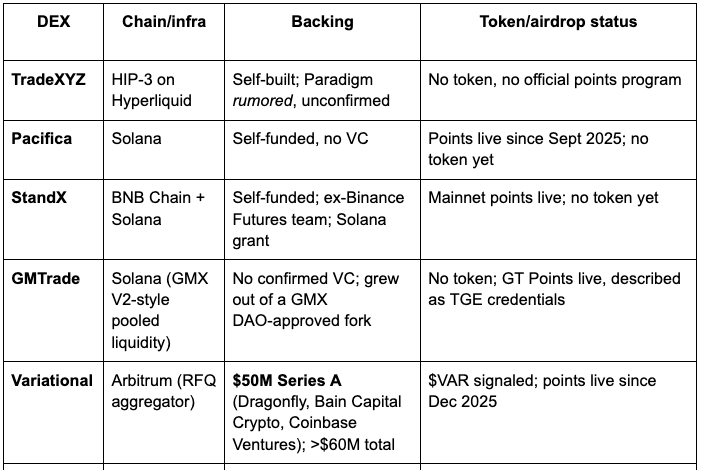
TradeXYZ was the first team to deploy under Hyperliquid’s HIP-3 framework, which lets independent builders run their own perp markets on top of Hyperliquid’s infrastructure. Its niche is traditional assets: 24/7 perpetuals on US equities (Tesla, Apple, Nvidia, Amazon), a synthetic Nasdaq-style index, commodities, and FX.

In March 2026 it secured an official S&P 500 license, enabling a round-the-clock perp on the benchmark index. It accounts for the large majority of HIP-3 open interest and has posted roughly $53 billion in 30-day perp volume.
Strength: real product-market fit in equity perps, a category most crypto-native DEXs don’t touch.
Weakness: there is no official points program and no confirmed token. Rumors of a Paradigm raise have circulated but remain unconfirmed.
How to earn points:
Because there’s no formal program, this is a “be early before a possible retroactive snapshot” play. You trade equity, commodity, and FX perps through Hyperliquid perps interface and search for the XYZ ticker in front, e.g: TradeXYZ app or integrated frontends (MetaMask Perps, Phantom), funding with USDC on isolated margin.

Volume here may also count toward Hyperliquid’s own points — a potential double-dip. The lack of an official program is the appeal, where competition is far lower than on platforms openly advertising rewards.
Pacifica — the previous Solana standout, but the window is narrowing

Pacifica went from zero to the top perp DEX on Solana by daily volume within months of its 2025 launch, overtaking Jupiter while still in closed beta. It runs sub-20ms off-chain matching with on-chain settlement, integrates AI risk tools, and has crossed $100 billion in cumulative volume.
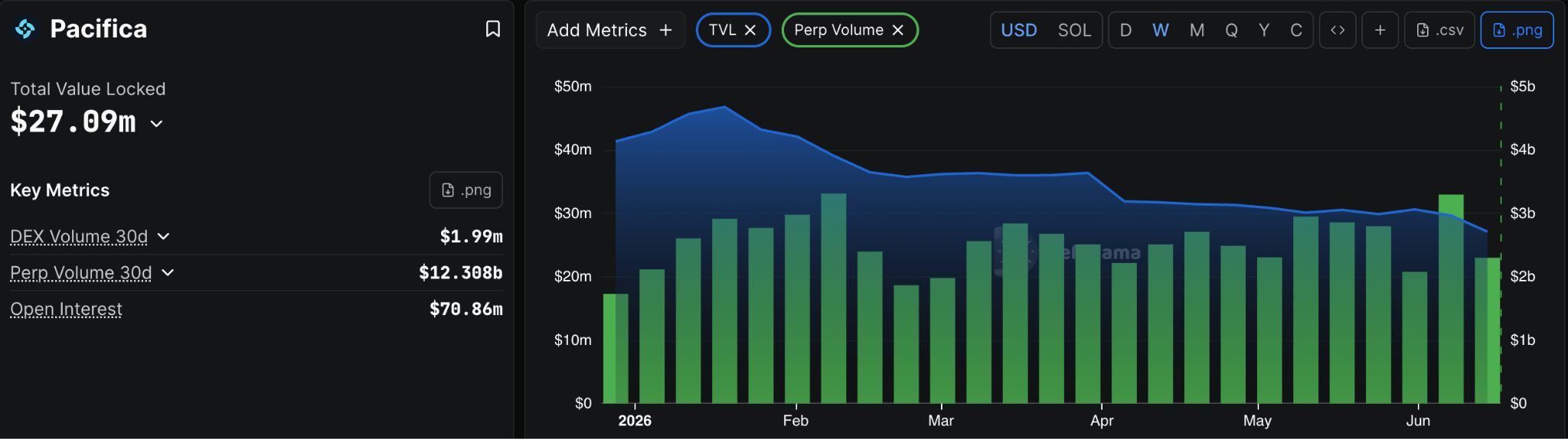
Strength: it’s self-funded with no VC backers — the same structure as Hyperliquid pre-token, meaning no investor allocations to dilute the eventual community share. Weakness: it’s been farmed heavily and is widely known, so you’re no longer “first.” There’s still no token confirmed. Backing: none — self-funded. Founded by ex-FTX COO Constance Wang with a team drawn from Binance, Coinbase, Jane Street and OpenAI.
How to farm it: connect a Solana wallet (Phantom or Solflare), deposit, and trade. A 10-million point pool is distributed weekly, with snapshots every Thursday at 00:00 UTC.
Pacifica’s points formula is deliberately opaque and updated weekly, and it is explicitly designed so that running multiple accounts gives no advantage — “having 100 accounts provides no advantage over one.” Self-trading and sybil activity earn nothing.
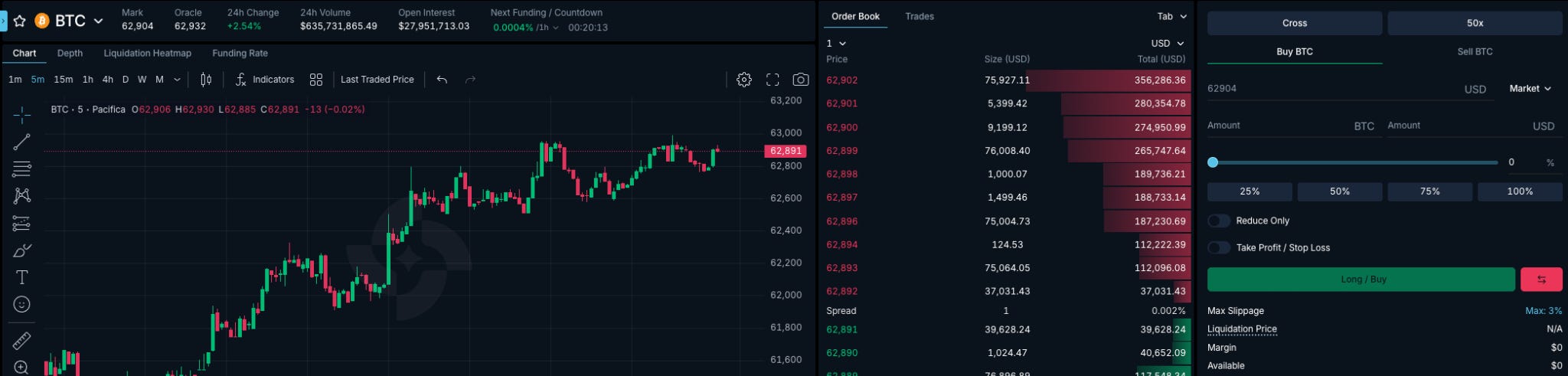
Points are earned through organic trading (via GUI or API), and the team says feedback and word-of-mouth also count. In short, this is a farm that rewards real, sustained usage rather than mechanical volume-spamming.
GMTrade — the pooled-liquidity RWA play that just took Solana’s volume crown
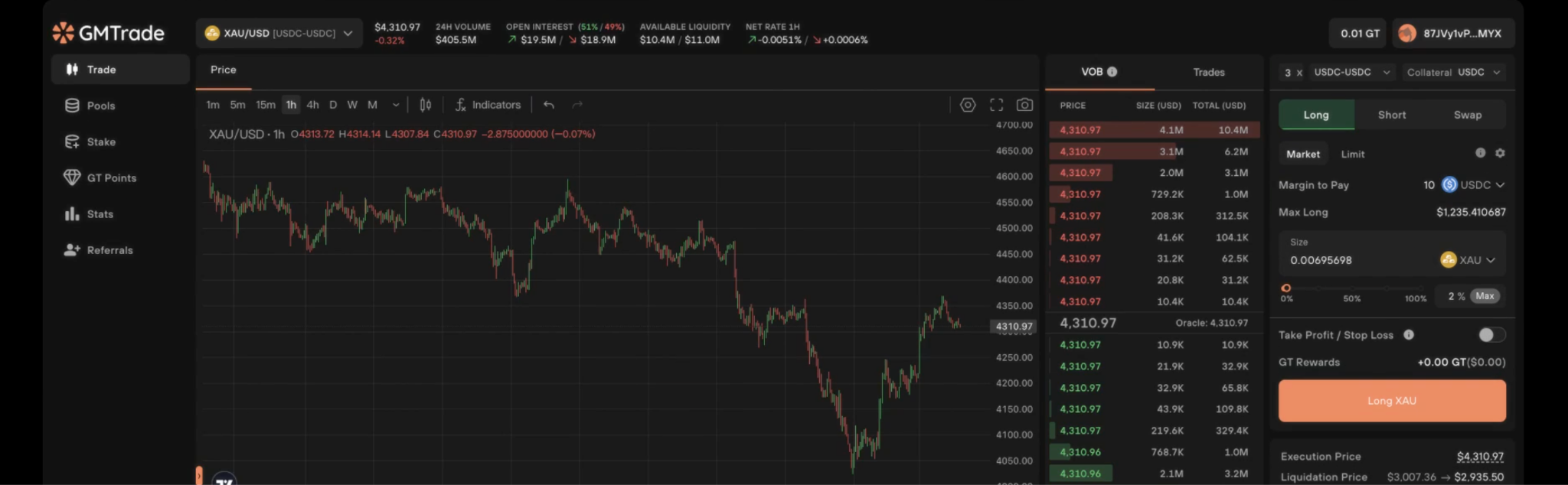
GMTrade is the newest on this list, and it’s earned its spot: by 30-day volume it’s now the single largest perp DEX on Solana, ahead of even Pacifica.

Structurally, it’s a different model from the order-book DEXs elsewhere on this list. GMTrade launched on Solana mainnet in March 2025 as GMXSOL, a GMX DAO-approved fork bringing GMX V2’s pooled-liquidity model (traders take the other side of a liquidity pool, not an order book) to Solana. It rebranded to GMTrade in November 2025 as the team moved toward full independence from the GMX label.
Its differentiator is breadth: alongside crypto, it lists close to 90 markets spanning forex, commodities (gold, silver, WTI crude, palladium), indices, and equities, priced via Chainlink Data Streams.
Strength: Broad market coverage for a pooled-liquidity model, and low fees (the team quotes ~0.5 bps trading fees, well under most Solana order-book competitors). The multi-pool (”GM Pool”) architecture also isolates LP risk per market rather than pooling it all together.
Weakness: no confirmed token, no announced TGE date, and — unlike Pacifica — no clearly disclosed VC backing or funding round to point to, which makes the eventual token structure harder to predict. As a pooled-liquidity model, LPs (not just traders) are taking on real counterparty risk against trader PnL, which is a different risk profile than an order-book venue.
Backing: not clearly disclosed. It originated as a community/DAO-approved GMX deployment on Solana rather than a VC-funded startup, and continues to be built by an independent team; no funding round has been publicly announced.
How to earn points:
points here are called GT Points, explicitly described by the team as “credentials for participation in the Token Generation Event (TGE)” — though no TGE date has been announced. The mechanic is a Bitcoin-inspired scarcity model:
Minting: GT starts at $0.01 to mint, meaning $1 in trading fees (after any discounts) generates roughly 100 GT.
Exponential cost curve: every 210,000 GT minted raises the mint cost by 2.1%, so early participation is worth meaningfully more GT per dollar spent than farming later — the crypto-equivalent of Bitcoin’s halving, but smoother and more frequent.
Sources: GT accrues from trading fees, providing liquidity, and referrals. VIP tiers and referral bonuses (reportedly a five-level referral structure with a 10% cut of direct referrals’ points) boost the rate further.
Because the mint cost keeps climbing and there’s no confirmed token yet, this is very much an “accumulate now while it’s cheap” play rather than a low-effort holding farm — you need to actually generate trading fee volume (or LP) to mint GT.
StandX — quietly strong volume, and a genuinely different points model

StandX is an order-book perp DEX on BNB Chain and Solana, with mainnet live since November 2025 and daily volume above $100 million. Its defining feature is DUSD, a yield-bearing stablecoin that auto-earns with no staking required and serves as the platform’s unit of account — the “house” runs delta-neutral.

Strength: you can effectively farm by holding, not just trading, which suits lower-activity users. Its points model is also the most distinctive on this list.
Weakness: the program is heavily skewed toward DUSD rather than trading, the platform is unaudited, and the market selection is still limited. Note too that point emissions were halved on May 24, 2026 — so the rates below are the current, reduced ones.
Backing: self-funded, built by former Binance Futures and Goldman Sachs team members, with a Solana ecosystem grant.
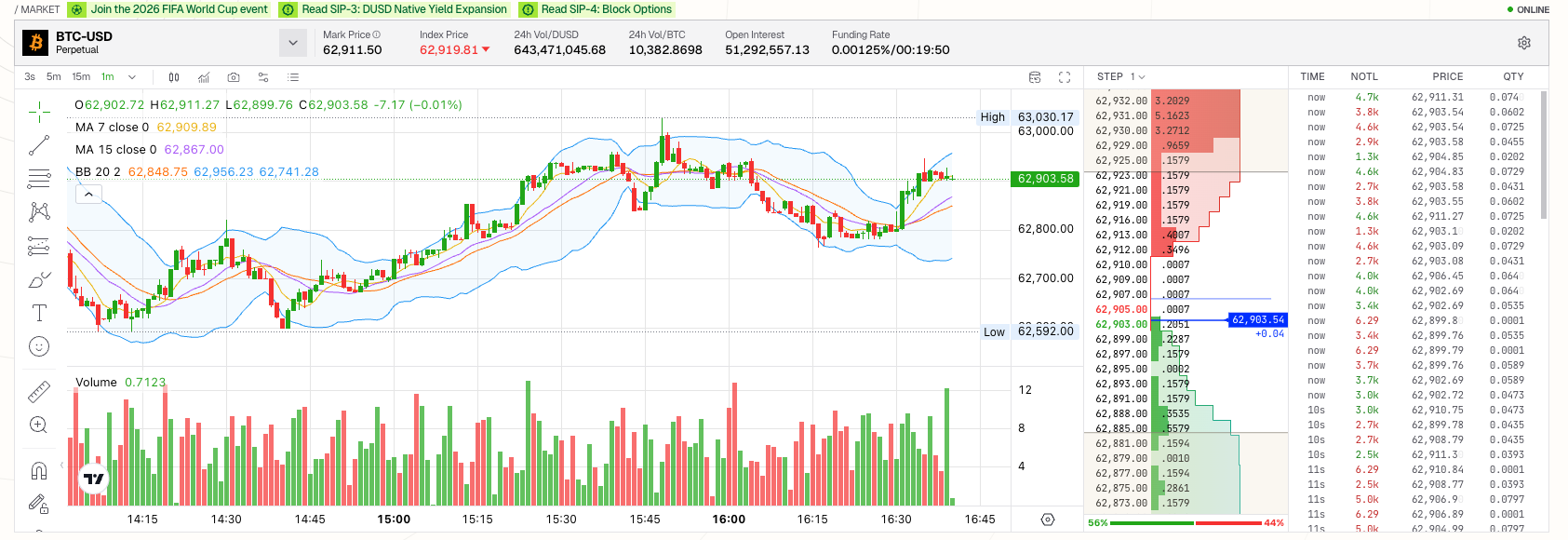
How to earn points:
Points split into three buckets — Trader, Maker, and Holder.
Holder: simply holding DUSD earns roughly 0.5–0.6 points per DUSD per day (a Vault deposit gets the top 0.625x multiplier), and the DUSD figure includes your unrealized PnL. Providing liquidity earns 0.5x on DUSD / 0.6x on other tokens, and swapping DUSD on select DEX pools (Raydium on Solana) earns 2.5% of volume.
Maker: you earn on resting limit orders even if they never fill — orders live 3+ seconds accrue points, and the closer to mark price the better (top rate within 10 bps). Keeping orders live 30+ minutes per hour within 10 bps unlocks a separate 5M-token maker pool. This is close to zero-execution-risk farming.
Trader: standard volume points, plus the unusual “Loser Points” — you earn points from your realized losses. Referrals add a 5% bonus on both sides.
The holding-plus-maker combination is what makes StandX worth a look despite the limited markets.
⚠️ Risk Warning: DUSD is a yield-bearing stablecoin that uses delta-neutral futures hedging to maintain its peg, but it is not without risk. Market volatility, funding rate fluctuations, smart contract vulnerabilities, and oracle failures could all impact the protocol’s stability and your returns. Rewards are not guaranteed and depend on staking and funding fee revenue, which can turn negative. Redemptions take 7 days to process, so funds are not instantly accessible. Only use funds you can afford to lock up, and always review the latest protocol metrics at StandX before participating.
Variational — the institutional-grade dark horse

Variational is less a single exchange than infrastructure powering multiple trading apps on Arbitrum. Omni is the retail-facing, zero-fee perp platform with 450+ markets; Pro targets the much larger institutional OTC derivatives market, bringing booking, clearing and settlement on-chain.
Rather than building an order book per market, Variational uses an RFQ model that aggregates liquidity from centralized exchanges, DEXs, and TradFi dealers, aiming for institutional-grade depth. In May 2026, it launched its first real-world-asset perps (gold, silver, copper, oil) and is betting that RWA perpetuals become the biggest contract class in DeFi.
Strength: a genuine dual flywheel (retail via Omni, institutions via Pro), zero fees, deep RWA ambitions, and arguably the strongest founder pedigree here — co-founders Lucas Schuermann and Edward Yu are both ex-Genesis Trading (engineering and quant trading, respectively).

Weakness: the token isn’t live yet (points only), the RFQ/whitelisted-market-maker model is less “decentralized” than an open order book, and RWA perps sit in a regulatory gray area with no CFTC approval. The rewards system is also explicitly a work in progress.
Backing: a $50M Series A led by Dragonfly (May 2026) with Bain Capital Crypto and Coinbase Ventures, on top of a 10.3M seed — total funding above $60M. This is top-tier capital, which materially raises the odds they ship and eventually do a token ( VAR is already referenced in their docs).
How to farm it: trade perps on Omni to build a Reward Tier based on your last 30 days of activity, where Total Volume = personal volume + (0.2 × referred volume). Tiers run Iron → Infinity (from $0 up to $2.5B in 30-day volume), each unlocking a larger points boost (+0% up to +5%) and eventually a volume multiplier (up to 1.3x at Infinity), so climbing early compounds everything you do afterward.
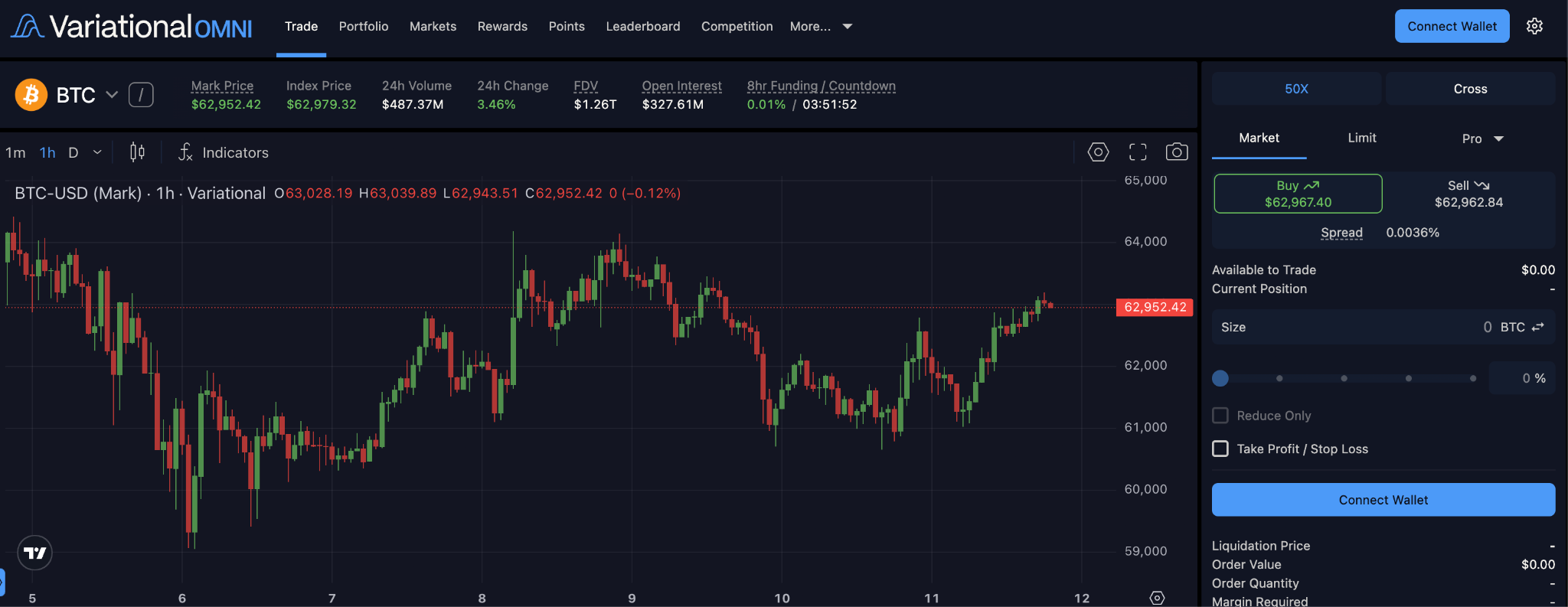
Points are distributed weekly, every Friday at 00:00 UTC, and the program runs no later than the end of Q3 2026.
Two quirks worth knowing: referrals earn you 1 point for every 10 your referrals earn, and every losing trade you close has up to a 5% chance of being fully refunded — a rebate-like edge that softens the cost of consistent farming.