

Subscribe for daily free DeFi news covering launches, tradable catalysts, and actionable farming opportunities.
Today’s News Headlines:
Balancer proposes wind-down, Snapshot vote Sept 25-29
An Analyst finds ~80% of Uniswap v4 hooks malicious
Kraken launches xStocks Vaults on Solana via Kamino
DeFi Saver launches Morpho Midnight on Ethereum
Derive proposes V3, zkVM exchange on Ethereum
Saturn backs USDat ecosystem with PYUSDx
LayerZero reportedly lost key managing Wyoming’s FRNT
Robinhood clarifies Stock Tokens fully backed 1:1
Key Takeaways:
The Fed is now far more likely to hike than hold.
Oil topped $100, a hot PPI, then a hotter core CPI stacked in one week — even an expanded Treasury buyback couldn’t hold yields down. Hike odds for Wednesday sit at 88.5%.
BTC is showing distribution; ETH is accumulated
Bitcoin’s exchange reserves rose, and its ETFs bled −$462.7M. Meanwhile, ETH reserves fell and its ETFs pulled in +$196.9M. Two weeks ago, BTC led both stories — this week, ETH does.
One AI token is becoming structurally scarcer every month; another has only a small float.
VVV and DGAI have both performed strongly recently, with different tokenomic structures behind them. Venice has burned 41.84% of VVV’s supply using platform revenue, while only 15% of DGAI’s 1B-token supply currently circulates.

Find and execute the 15%+ stablecoin yields in minutes
Save time without checking every protocol manually. DeFi Saver’s Discover page surfaces rates across Aave, Morpho, Spark, and more, lets you simulate leverage before committing, and handles the full loop in one click. Stop leaving yield on the table.
<Discover Yields on DeFi Saver> | Today in DeFi is supported by DeFi Saver
Macro in 3 Lines:
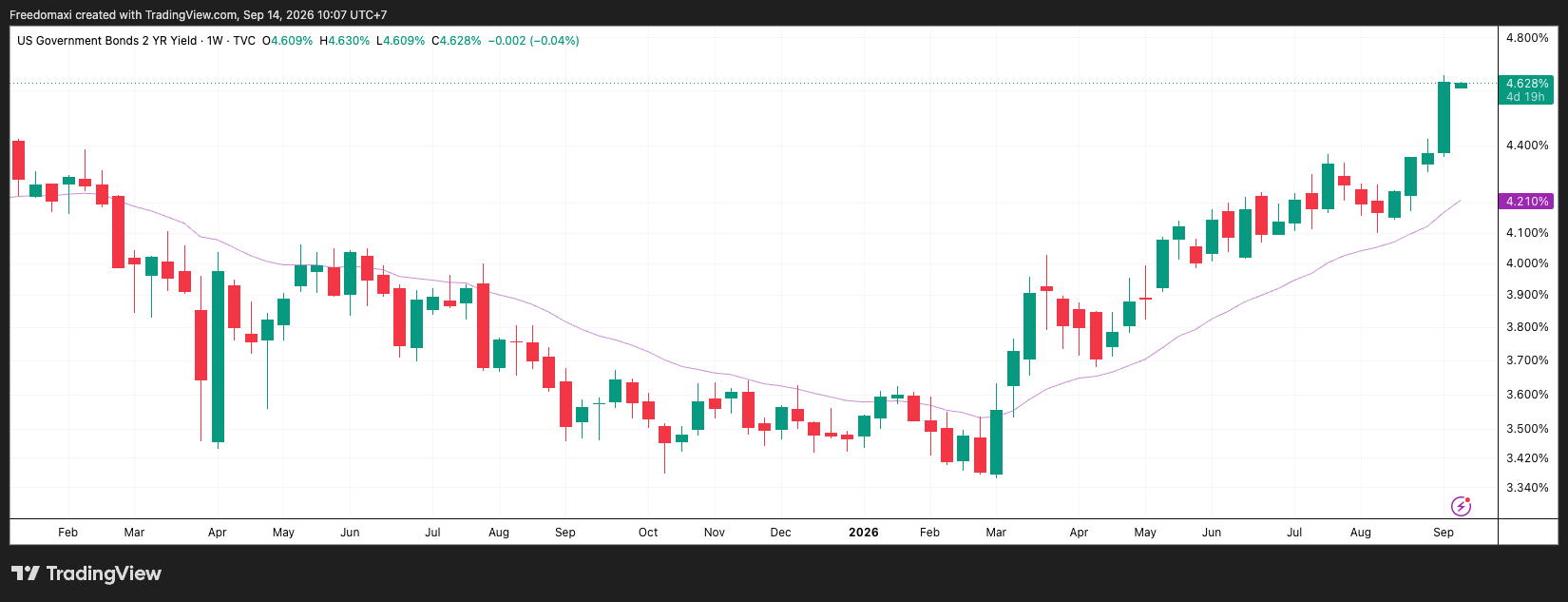
Rates: US 2Y closed near 4.63%, one of its sharpest weekly moves on record. Oil topped $100/barrel for the first time since May, feeding a hot August PPI (+0.4%), then Friday’s core CPI came in hotter than consensus (0.3% vs 0.2%) — hike odds for Wednesday’s FOMC sit at 86.5%.
The buyback that didn’t work: Treasury ran an expanded operation specifically to ease yields — $5.2B repurchased against a $6B cap — and yields kept climbing anyway.
Watch this week: CLARITY Act cloture (Tue), Retail Sales and the FOMC dot-plot decision (Wed) — three catalysts in 48 hours.
Crypto Capital On-Ramp
Total stablecoin supply: −$224.09M, the first outflow in three weeks.

Modest and broadly in line with the week’s price action — not a signal of a real reversal in the on-ramp, more a reflection of the risk-off tone from the rate spike in the macro section above.
Exchange Flows: BTC and ETH pointed in opposite directions
Bitcoin reserves rose toward 2.709M as price fell to a low near $76.5K before a late recovery — coins moving onto exchanges into weakness, a reversal from recent weeks' accumulation.
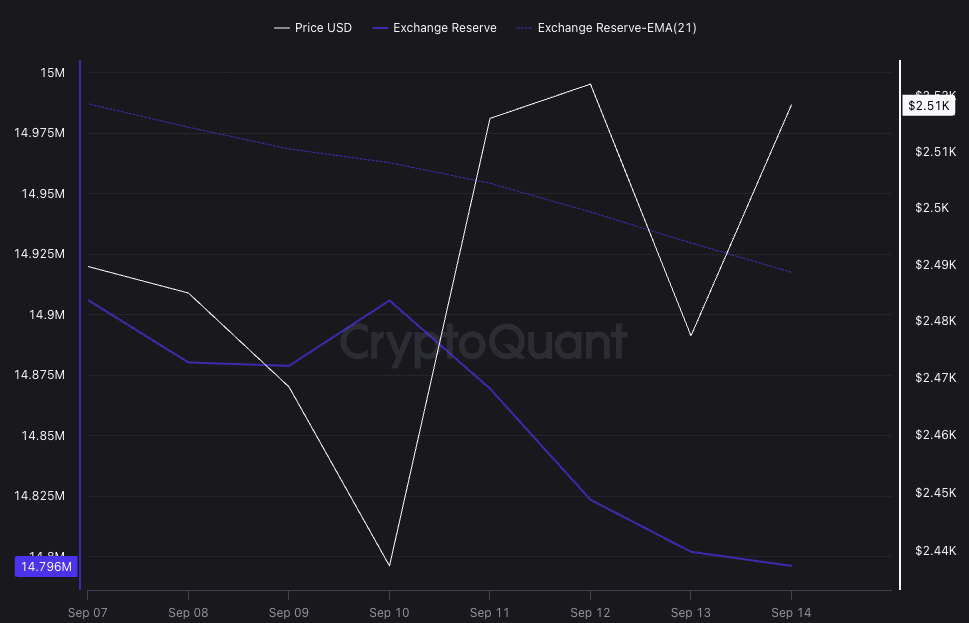
Ethereum reserves fell from ~14.98M to ~14.80M even as ETH dipped before recovering to ~$2.51K — holders keeping coins through the dip.
ETF flows: Inversion from last week
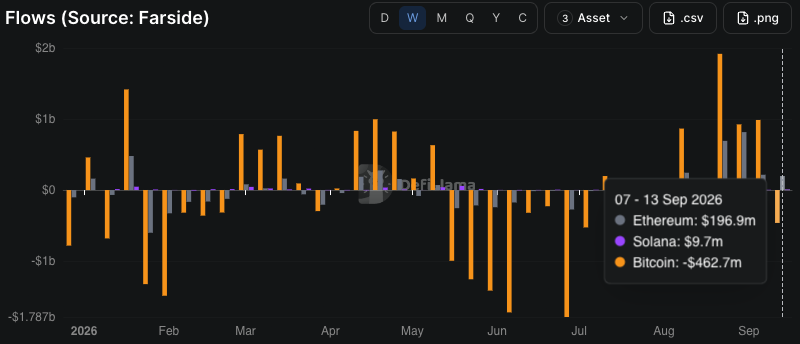
Spot Bitcoin ETFs posted a −$462.7M outflow, breaking the streak that made BTC’s demand the strongest of 2026 across the prior two weeks. Ethereum ETFs took in +$196.9M the same week. Two weeks ago, BTC led both the on-chain and ETF story; this week, ETH does.
Verdict: ETH kept leaving exchanges and pulled in fresh ETF money — signs holders are keeping it, not preparing to sell. BTC saw the opposite on both counts, plus −$462.7M in ETF outflows. A real reversal from recent weeks.
1C. Week-Ahead Catalysts
Tue, Sept 15, 2:15 pm ET — CLARITY Act cloture vote. The Senate’s first procedural test for crypto market-structure legislation, needing 60 votes. Odds have deteriorated sharply — Galaxy Research now puts the odds of passage in 2026 at around 10%, down from ~20% a month ago. A failed cloture effectively kills the bill for 2026.
Wed, Sept 16, 2:00 pm ET — FOMC decision. A dot-plot meeting, so even a hold carries updated forward guidance. Hike odds sit near 88.5%; press conference follows at 2:30 pm ET.
Rates & Risk
Individual Stablecoin Flows: yield led hard, even into a hawkish week
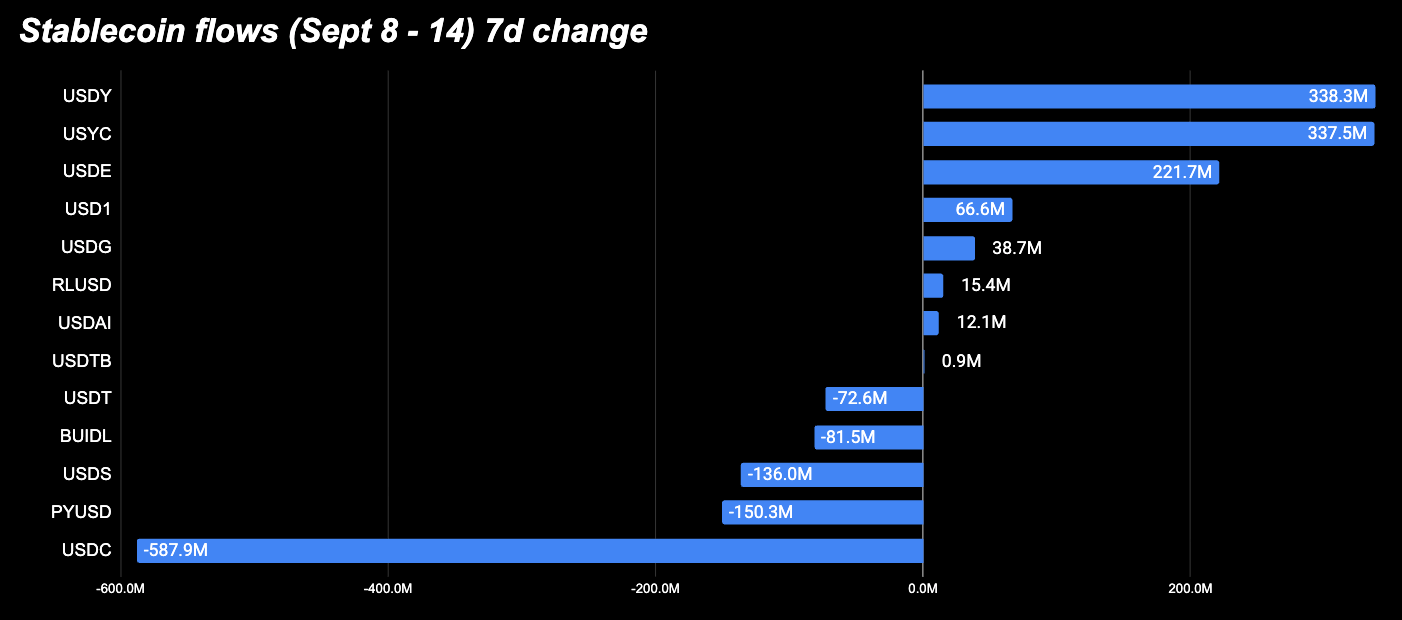
USDY (+15.36%) and USYC (+12.87%) posted their strongest weeks in a while, with USDe, USDAI and USD1 growing alongside — the rotation into yield-bearing dollars didn't slow as rates spiked. The real outflow: USDC shed −$587.9M, the board's largest single move, with PYUSD (−5.16%) and BUIDL (−2.89%) also bleeding.
Aave / Sphere Rates: funding ticked up slightly, cooling trend intact
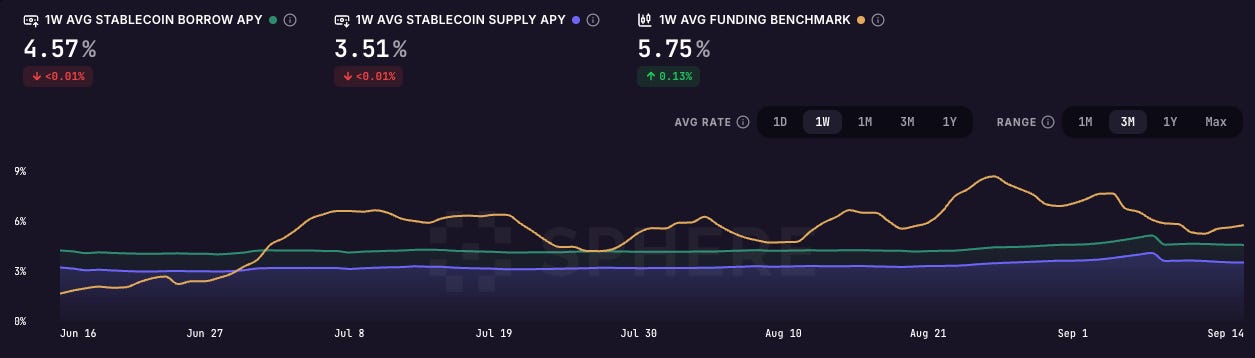
Sphere's borrow (4.57%) and supply (3.51%) held flat. Funding rose 0.13pp to 5.75% — within a multi-week decline from the 7.84% high, not a reversal.

The Cheapest Way to Long ETH Right Now
Liquity V2 lets you set your own fixed borrow rate. Up to 11x leverage on ETH exposure, and rates on wstETH/rETH average 2-3%. Through Sept 16, DeFi Saver is also rewarding users with 8,000 BOLD for opening or migrating a leveraged position on their platform — get paid to borrow when going long on ETH!
<Leverage on DeFi Saver> | Today in DeFi is supported by Liquity
Chain Flows and Comparison
3A. Stablecoin flows by chain
Base and Solana — organic, tokenized-stock driven.
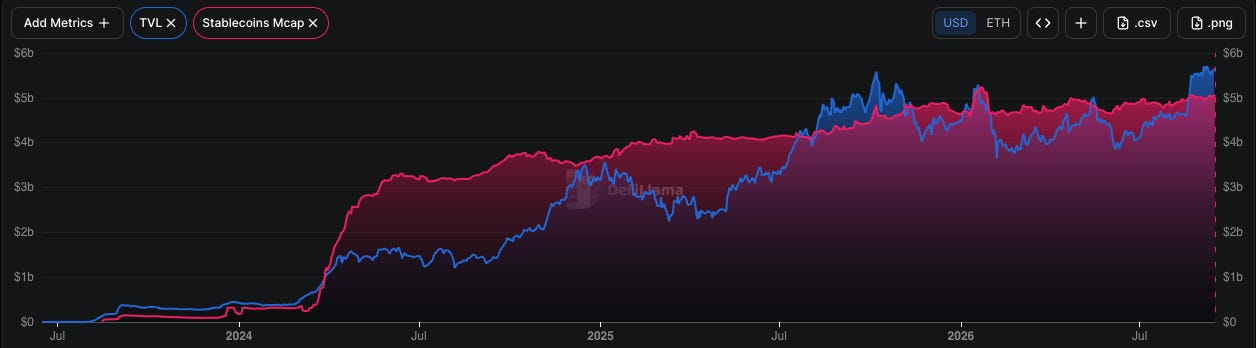
On Aerodrome ($3.01B 7d volume, +2.6%), Coinbase-wrapped stock tokens broke into the top-10 pools — GOOGLc/USDC alone turns over ~$9.8M/day at real fee tiers.
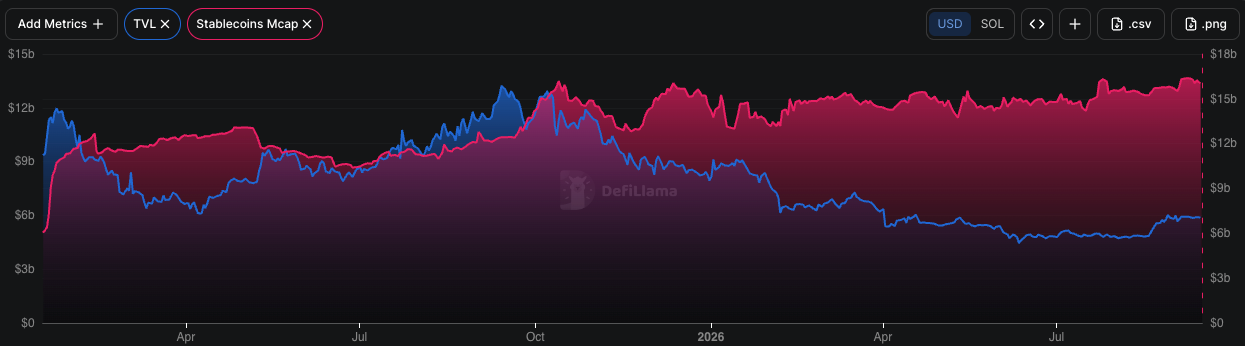
Solana adds a twist: alongside genuine xStocks pairs on Raydium (+115% volume), unbacked “pre-stock” memecoins now dominate PumpSwap’s leaderboard — three separate Anthropic-themed pools alone clear $55–89M/day trading the narrative, not the equity.
BSC — volume without fees. BNB Chain’s growth is the most artificial: one PancakeSwap pool did $1.06B over 7 days — ~17% of Pancake’s entire BSC volume — on a 0.01% fee tier, users wash-cycling through Binance Alpha-listed tokens to farm points. Enormous volume, negligible fee yield, and it disappears the day Binance changes the rules.
Robinhood Chain decelerating, Plasma absorbing the carry trade. Robinhood’s growth slowed from double digits to +0.7% weekly volume as fees normalized off an elevated base. Meanwhile Plasma is the quiet gainer — as USDe borrow costs rise on Ethereum and Monad, loopers are migrating collateral to Plasma, where rates have held stable. Same carry trade, cheaper venue.
Two AI Tokens That Refuse to Bleed
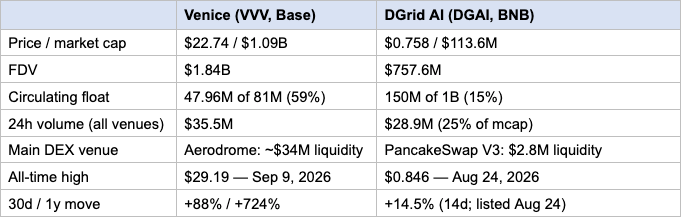
Most AI tokens trade like memecoins with a slide deck — a listing pop, a bleed, a chart that never recovers. Two of them currently don’t: Venice’s VVV printed an all-time high of $29.19 on September 9, up 88% in a month and 24x from its December low, at a $1.09B market cap twenty months after launch. DGrid’s DGAI has held within 10% of its listing-day high for three weeks while turning over a quarter of its market cap daily. The prices hold for almost opposite reasons
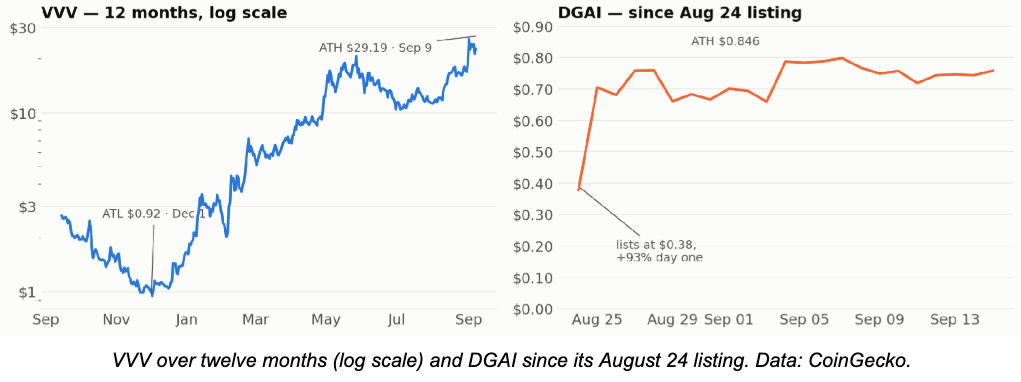
Venice’s support is earned.
VVV is the metering system for Venice’s private AI inference: staking 1% of all staked VVV grants a permanent 1% of the network’s daily compute, and staked VVV committed to mint DIEM locks up indefinitely — each DIEM buys $1 of API usage forever.
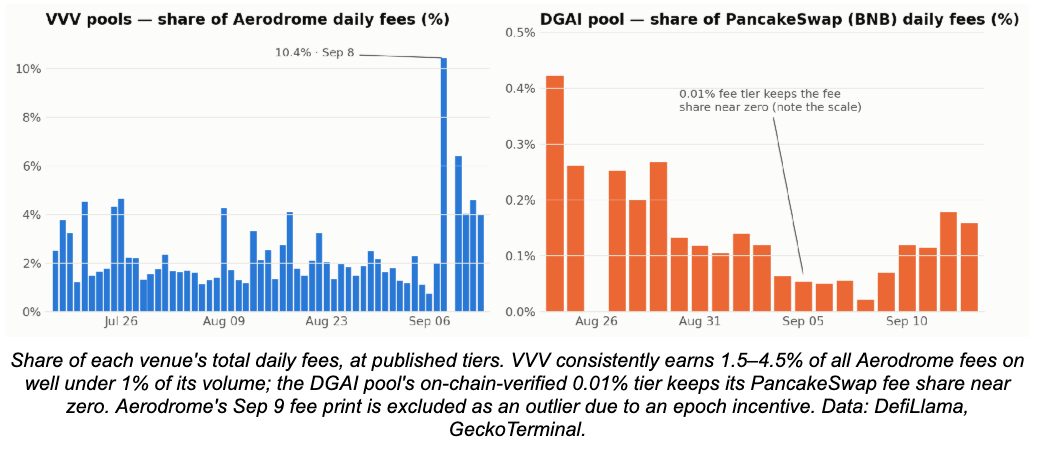
Product demand converts directly into locked float. On the supply side, Venice buys VVV with platform revenue and burns it: the September 8 discretionary burn was $391K, the largest yet, taking cumulative burns to 41.84% of supply, while annual emissions fall from 14M at launch toward 2M by October — a 1.4% inflation rate against a revenue-funded burn engine. Usage rises, revenue rises, burns rise, supply falls — precisely when demand grows.
DGrid’s support is engineered.
Only 15% of DGAI’s 1B supply circulates; 50% sits on a ten-year vesting schedule for node operators, with team and investor tranches on their own locks. The $113.6M market cap is defended by the absence of unlockable sellers, not by burns. The underlying business is real — $20–23M of H1 revenue on a $5M seed — but that revenue isn’t wired to the token the way Venice’s is. Nothing burns yet, and node rewards will eventually emit.
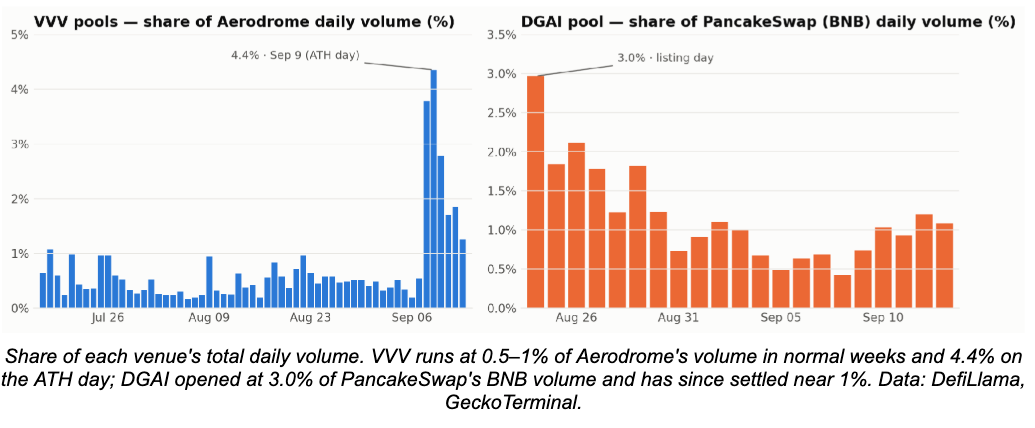
The risk map follows the mechanism.
VVV’s exposure is revenue dependence — burns are discretionary, so a slow month at Venice shows up in the burn line first, and its $1.84B FDV prices the flywheel continuing. DGAI’s exposure is the other 85% of supply: shareholder-friendly vesting holds beautifully until an unlock or emission event puts pressure on just $2.8M of on-chain liquidity sitting behind $29M in daily volume. Full mechanics, fee tables, and venue-by-venue liquidity breakdown in this week’s TIDR thread.
Section 4 — Project & Protocol Discovery
4A. Token Price Movers - Observations, not trade ideas.
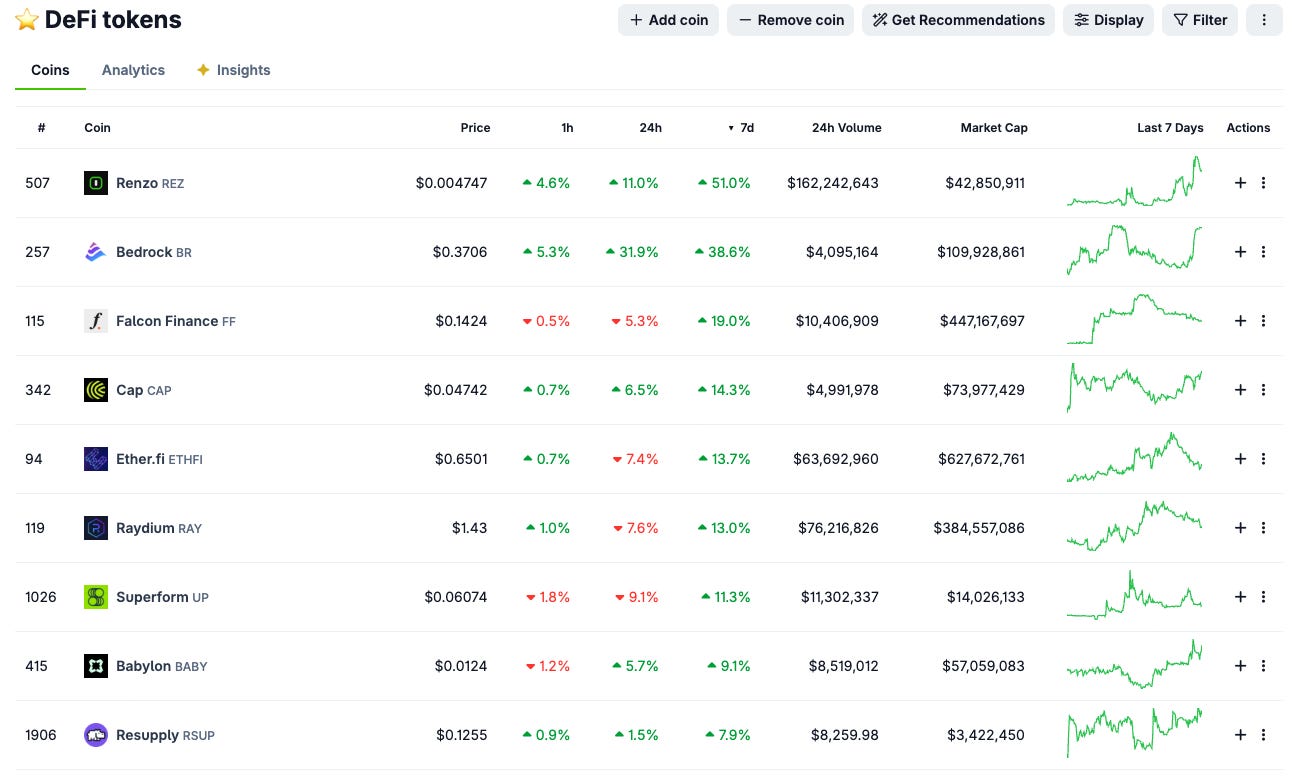
Renzo (REZ), +51%. Rebranded to Renzo Finance and shipped Renzo Basis, a self-custodial basis trade on Hyperliquid — long spot, short the perp, collect the funding rate. Live for BTC and HYPE. Not a new idea for the team (Renzo previously ran basis vaults with Superstate), but the first time it ships fully onchain — a real pivot, not just a rebrand.
Bedrock (BR), +38.6%. Optimism Splash Phase 2 (Sept 10–24): 25%+ streaming APR on uniBTC/WBTC LPs via Merkl, plus weekly raffles and an escalating VIP tier up to $50K. A well-designed but time-boxed incentive campaign.
Falcon Finance (FF), +19%. Falcon claims it’s approaching $40B in accepted collateral (treasuries, gold, tokenized stocks, credit) backing USDf, via an “El Salvador pipeline” for onboarding more. Self-reported — I couldn’t independently verify either figure.
Cap (CAP), +14.3%. Cap says ~85% of USDC deposits are lent to institutional borrowers, at a 30-day average 5.6% APR for depositors, each loan backed by a funded underwriter. Self-reported but specific.
Raydium (RAY), +13%. Riding Solana’s tokenized-equity wave, not one event: tokenized $GRND did $31M in volume in under 24 hours, ~2x its NYSE volume. Solana’s tokenized-equity supply crossed $684M this week, +47% in three weeks.4B. TVL Gainers ($50M+ filter) — Ranked by absolute $ inflow.
4B. TVL Gainers ($50M+ filter) — Ranked by absolute $ inflow.
With majors rangebound and the market cooling off a bit, this week’s growth is an RWA distribution story.