

TL;DR
Circle’s L1 went live on Sep 16, with BlackRock, Visa, Mastercard, and eight other institutions running validators. USDC is the gas token; native FX and institutional collateral (USYC, BUIDL, cirBTC) shipped at genesis.
The chain is rotating from casino to credit in real time. The memecoin frenzy that defined week one already collapsed — launches down 39%, transactions down 52% — while Morpho and Aave more than doubled over the same stretch.
Best opportunity: a handful of small, early-mover yield pockets plus one structural trade — borrowing USDC against bitcoin at a near-zero pinned rate.
Today’s News Headlines:
MetaMask staking incident, ~17K validators exiting
SEC proposes crypto self-custody rules for advisers
Kinetiq claim: 36.8M kPoints, fixed $0.26 per KNTQ
Sanctum launches App 2.0 for Solana staking
Revert added Launchpad pools on Robinhood Chain
What it is
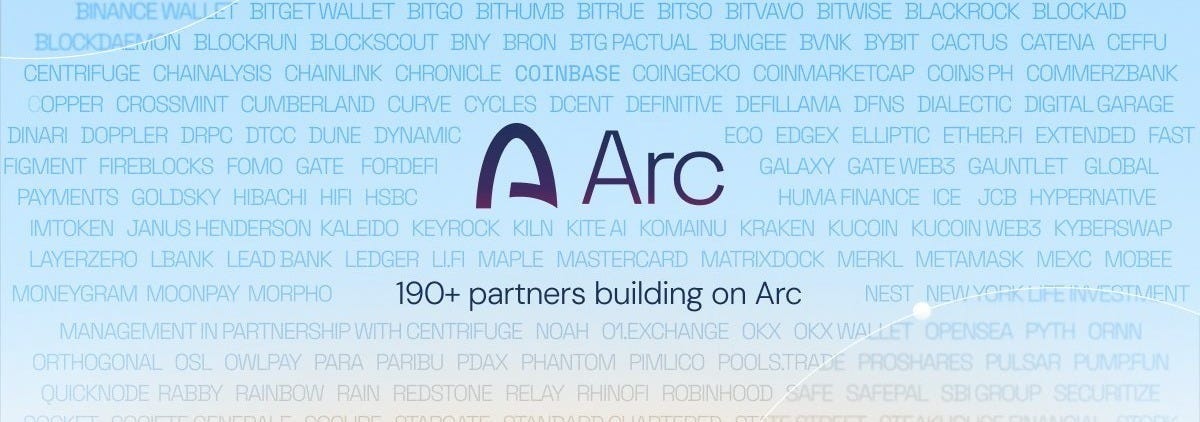
Circle switched on Arc’s mainnet September 16, with a founding validator list that reads like a Davos guest list: BlackRock, DTCC, Visa, Mastercard, ICE, Standard Chartered, Galaxy, MoneyGram, SBI, Sumitomo, Global Payments, and Circle itself. No L1 has ever launched with a more institutional cohort of block producers.
It’s EVM-compatible with sub-second finality, built around four choices that matter to DeFi users.
USDC is the gas token — no volatile native coin to buy; fees target ~$0.01/transaction straight out of your USDC balance.
The FX stack is native — EURC at genesis plus 17 local-currency stablecoins (JPYC, KRW1, AUDD, BRLA, MXNB, and more), an institutional RFQ settlement contract, and the Circle Payments Network underneath. Every other chain treats on-chain forex as an afterthought; Arc is built around it. I
Institutional collateral is native — USYC (Circle’s tokenized money-market fund), BlackRock’s BUIDL via Securitize, cirBTC (institutional wrapped bitcoin), and Maple’s syrupUSDC all launched with the chain.
The plumbing is Circle-grade — CCTP v2 and Gateway at genesis, Chainlink live day one, MetaMask as the default wallet.
Launch week brought the expected wave of memecoin energy — fifty-plus launchpads, 83,751 tokens on day one, and $LIFT hitting a $9.7M market cap in its first hour.
That’s settled down fast, the way it tends to on any new chain, with one standout surviving the shakeout: Argus, which built the only launchpad with an actual cash flow story — fixed buy/sell taxes paid in native USDC to creators, holders, and LPs, still generating ~$437K/day two weeks in, more fee revenue than the entire chain’s own base-fee burn by roughly 30x. Underneath that noise, the real story was already happening: Morpho and Aave’s credit markets more than doubled over the same stretch.
The ARC token exists but hasn’t launched. Circle minted the full 10-billion-token genesis supply at launch — the first publicly traded company to mint a network token for a new L1 — calling it “a technical milestone, not a commitment to launch publicly.” No announced airdrop, no disclosed community allocation, no timeline. What does exist: Arc House, a points-tracked community program, and a testnet history (700M+ transactions, 1,200+ projects) that would be trivially easy to snapshot.
Why use it?
Arc already has real institutional capital and real credit markets running on it, and retail yield hasn’t caught up yet—which is exactly the window worth being early to.
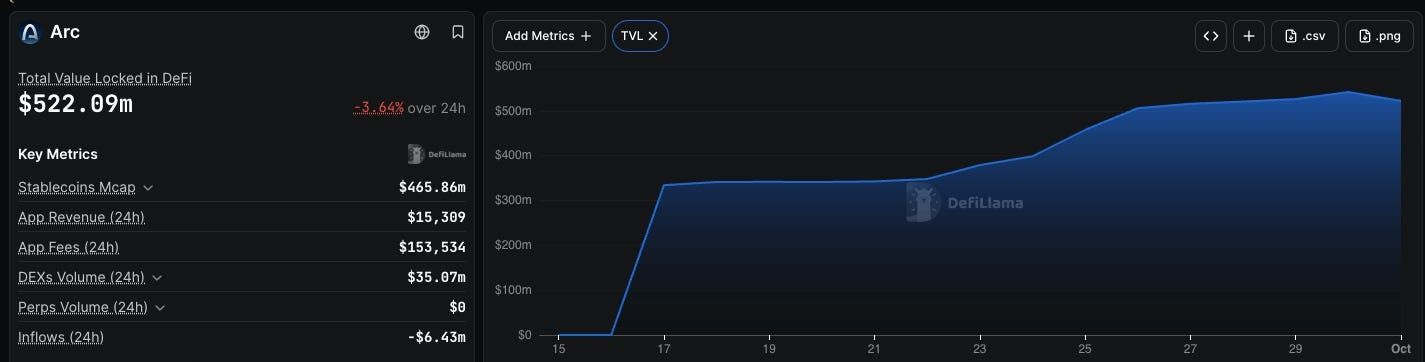
DefiLlama shows ~522MofTVLandstillclimbing(+19M net inflows on Sep 28 alone), split between Morpho (288M)andAavev4(185M).

Inside Morpho, the composition tells the real story: Galaxy and Keyrock’s whale vaults ($79.8M and $75.0M) pay just 0.35% because they park in a single market where someone is borrowing $175M of nearly-free dollars against bitcoin — that’s the actual product-market fit, and it’s also why headline vault rates look so unimpressive.
Besides Lending, LPing is also lucrative. A growing chain means LPs get disproportionate Fees.
Being early to a chain institutions are already building real credit infrastructure on is a good place to be.
Worth watching the field too — Stripe’s Tempo and the Plasma/Stable chains are running similar stablecoin-chain playbooks — but Arc’s $523M and its validator list give it a head start.
How to get in
MetaMask is Arc’s default wallet. Add the network using Circle’s own docs and nowhere else — RPC rpc.mainnet.arc.io, chain ID 5042, explorer explorer.arc.io. Your USDC balance doubles as gas; there’s nothing else to acquire anything else.
Bridging is where people get hurt.
The official bridge is portal.arc.io.— Circle’s own CCTP v2 bridge, native burn-and-mint, no wrapped assets, no third-party toll. USDC and cirBTC can be bridged 1:1 to and from Arc and Ethereum. Binance, Coinbase, Kraken, OKX, and Bybit are wiring direct on-ramps; SwissBorg and Robinhood also support Arc USDC deposits, so getting funds onto the chain is getting easier by the week.
What to do:
1. Cheap dollars against bitcoin.
$174.5M is already borrowed against cirBTC on Morpho at a rate pinned near zero (~97% utilization), and Aave’s Main spoke prices the same trade off a 4.1% curve. This is Arc’s single biggest, realest trade. You can buy cirBTC on Arc, but liquidity is better on Ethereum - bridging is 1:1 via Arc’s portal.arc.io bridge.
2. LP Majors and Forex
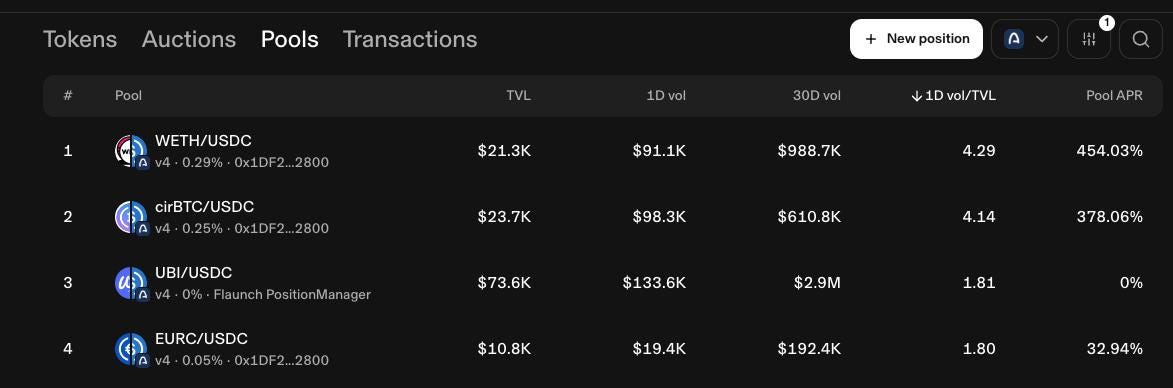
Aero Lite is offering solid double-digit yields on volatile pairs. Uniswap Pools for WETH/USDC and cirBTC/USDC are also offering 2- to 3-digit yields. New Chains reward liquidity providers, and these APRs help offset IL. 3. The first loops.
sUSDai/USDC and PST/USDC on Morpho, 86% LLTV, ~7x max — borrow at ~5.7% and ~5.2% respectively against collateral that’s yielding more than that.
Risk: the carry only works while the collateral’s native yield clears the borrow rate (check it before sizing), both markets are sub-$100K, and with no local sUSDai DEX depth on Arc yet, building leverage means bridging collateral 1:1 rather than swapping.
4. FX leverage via Aave’s Forex spoke.
EURC and USDC each count as 90% LTV collateral against the other, with a 2% liquidation bonus, up to ~10x effective leverage — arguably the most transparent on-chain EUR/USD positioning venue built anywhere.
Risk: this isn’t a yield farm — EUR/USD moves dwarf the rate differential — and conservative caps (EURC 10M/9M, USDC 13M/11M) mean it’s a positioning tool right now, not a size play.
5. Real yield now — the Bitwise RWA vault.
Bitwise’s RWA vault APY fluctuates, but at equilibrium, it earns 6- 9% by lending USDC at 86% LLTV against two yield-bearing RWA collaterals — sUSDai (USD.ai’s staked dollar, backed by GPU/hardware-financing loans) and PST (Huma’s PayFi receivables token) — both running 84-91% utilization, real borrow demand, not emissions.
This vault is small, so rates move fast, but SUSDai and PST’s relatively high supply APY means average APYs beat benchmark lending.
6. Points, as a bonus, not a thesis. Arc House is the only official points program (registration plus tracked tasks). At roughly a cent per transaction, the cost of being wrong is near zero — bridge properly, use the lending markets, swap the FX pairs, spread activity over weeks.
Risk: none mechanically — the real risk is treating speculative points as the reason to be here instead of a side effect of using the chain anyway.
Watch for:
A USDC/syrupUSDC market at 91.5% LLTV is already deployed on Morpho and sitting completely unfunded. The first vault to capitalize it creates an ~11x-max loop on Maple’s ~$1B loan book, on a fresh chain with launch caps — the single highest-value trigger on Arc right now, and it will move fast once it does.
Also worth an alert: USYC or BUIDL being wired in as collateral on Aave or Morpho, which would give Arc its first real on-chain yield curve.