

Subscribe for daily free DeFi news covering launches, tradable catalysts, and actionable farming opportunities.
Today’s News Headlines:
- xStocks launches tokenized equities on Hyperliquid
- Maple completes first SYRUP token buyback
- Strategy pushes STRC toward $100 par
- Jupiter launches Smart Vaults on Solana
- Solomon Labs launches yield-bearing USDv
- Solstice launches tranching for STRC yield
- Resupply launches syrupUSDC lending market
- FX100 launches liquidation-protected perps testnet
Key Takeaways:
Regime — Neutral, with a split underneath.
Equities hit records after a weak jobs report. Capital came into crypto too — stablecoin supply expanded for the first time in two months and ETF flows posted their best week since April. But it landed in wrappers and yield, not price: bitcoin closed flat and lost relative ground for the fourth straight week. The money is arriving; it isn’t buying risk.
Where capital’s flowing — Into yield, not risk.
The dollars entering crypto went almost entirely into instruments that pay: tokenized treasuries and yield-bearing stablecoins grew double digits while USDT shrank. On-chain, the growth chains are running subsidized carry loops — Robinhood Chain and Monad both saw fresh USDe arrive to feed cheap borrowing against it.
What to watch — Wednesday’s July CPI.
The first inflation print since the jobs miss flipped the rate debate from “will they hike” to “might they pause.” A soft read cements the pause; a hot one revives it.
Biggest risk — The growth is rented.
Robinhood Chain and Monad’s inflows are incentive-funded carry trades, durable only while the Merkl budgets and Ethena’s basis yield hold. When the subsidy clock runs down, the capital can leave as fast as it arrived.

Find and execute the 15%+ stablecoin yields in minutes
Save time without checking every protocol manually. DeFi Saver’s Discover page surfaces rates across Aave, Morpho, Spark, and more, lets you simulate leverage before committing, and handles the full loop in one click. Stop leaving yield on the table.
<Discover Yields on DeFi Saver> | Today in DeFi is Supported by DeFi Saver
1A. Traditional Macro
Crypto and equity comparison - BTC/NQ ratio
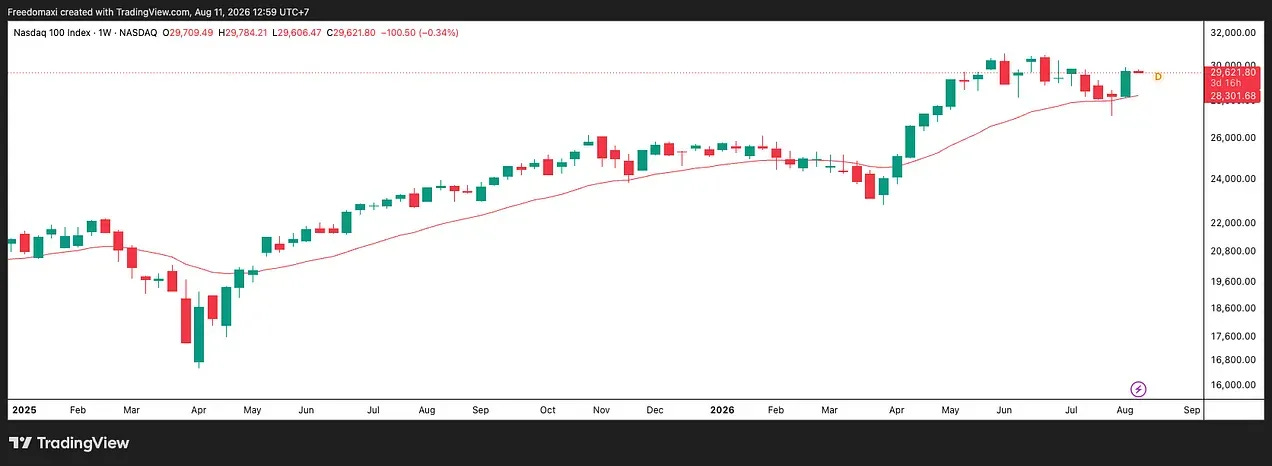
Bitcoin closed the week roughly flat while equities rallied hard, so the ratio fell again. This is the fourth straight week a risk-on catalyst has bypassed crypto: price didn’t drop; it simply held still through a move that lifted everything around it.
One number drove the week:
July payrolls fell 23,000 against a forecast of an 80,000 gain — the first monthly loss since February — with May and June revised down a combined 103,000, dropping the three-month average to about 20,000. The unemployment rate ticked to 4.1%, but because workers left the labor force.
Everything else followed from that print: net liquidity steadied at its 20-week average (+$14.53B), the 2-year yield slipped to 4.19% as September hike odds fell to ~42%, the dollar eased beneath its 20-week average, and equities read the weakness as good news — the S&P rose 3.6% to a record, the Nasdaq 5.2%. Bitcoin closed flat.
Verdict: A cracking labor market pulled yields and the dollar lower and sent equities to record highs on Fed-pause hopes — a clean risk-on week by every traditional measure. Bitcoin closed flat and lost ground on a relative basis.
1B. Crypto Capital On-Ramp
Total stablecoin supply + $879M(+0.29%)
The first weekly expansion after a two-month contraction that ran roughly $13.8B off the total. The outflows stopped the same week ETF flows turned and net liquidity steadied.
BTC and ETH Exchange Flows
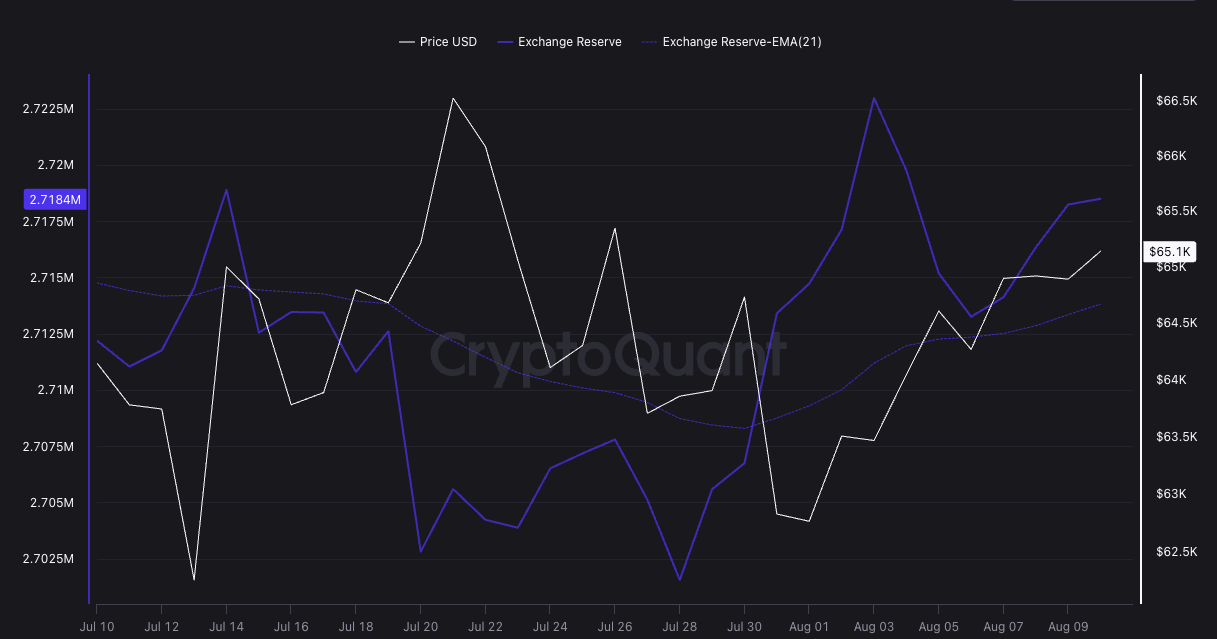
Exchange reserves: BTC up, ETH still leaving. Bitcoin reserves rose to 2.718M as price recovered from ~$62.5K to $65.1K — coins moving toward exchanges as bids returned, the less constructive read.
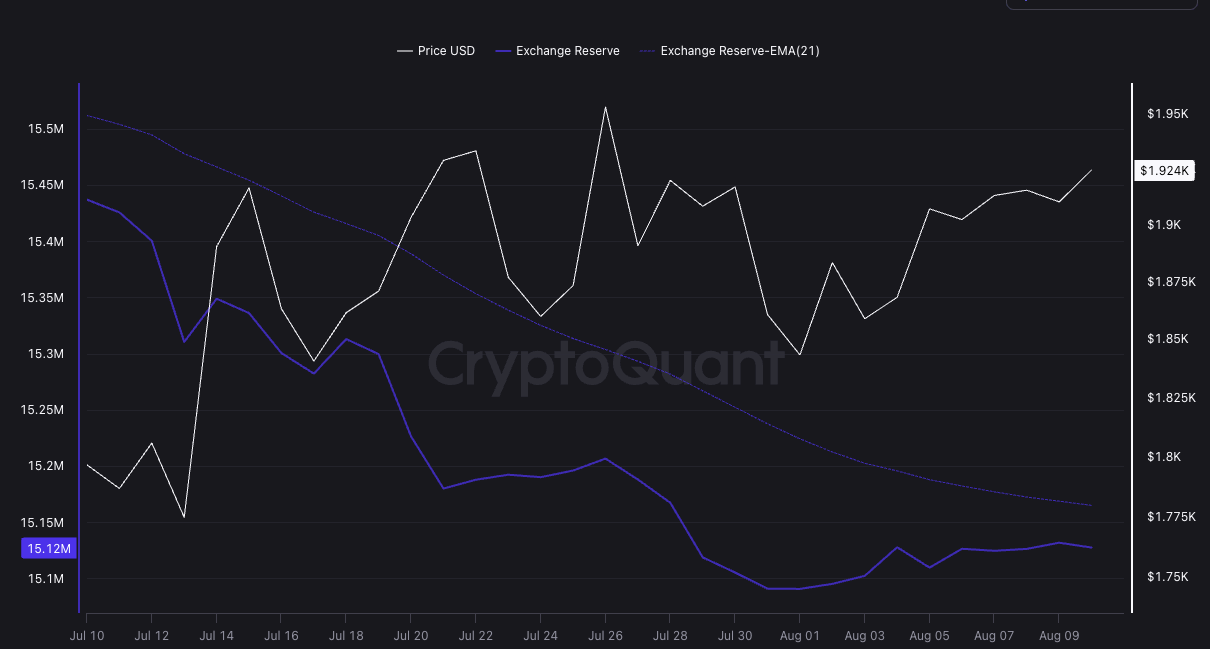
Ethereum reserves fell to 15.12M while price rose to ~$1,924, holding below the 21-day EMA all month. The divergence flagged last week widened: ETH left exchanges as it climbed, BTC arrived on them.
ETF flows
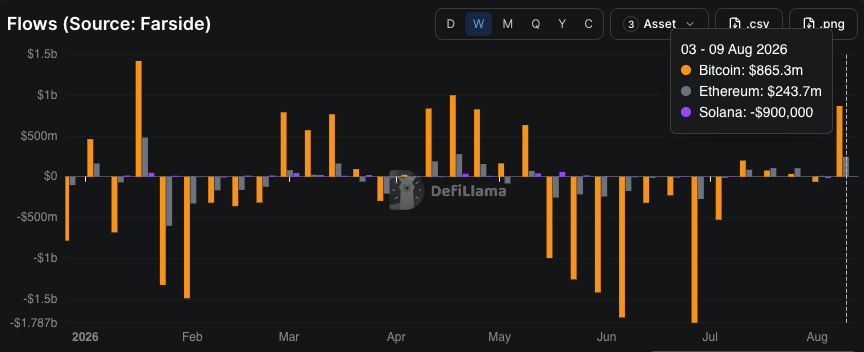
ETF flows: strongest week since April. Spot Bitcoin ETFs drew $853.5M with inflows every session — more than the previous four weeks combined and a ~$915M swing from the prior week’s outflow.
Ethereum ETFs added ~$244M, a fifth straight positive week that reversed last issue’s deceleration, back to nine figures from under $30M. BlackRock’s IBIT and ETHA supplied about $896M of the combined $1.1B.
1C. Week-Ahead Catalysts
Wed, Aug 12 — July CPI. The dominant release; the first inflation read since the jobs miss reset the rate debate. A soft print cements the pause that drove last week’s records, a hot one revives the hike case.
Section 2 — Onchain Risk Regime
Individual Stablecoins Flows: the rotation into yield is now a weekly event
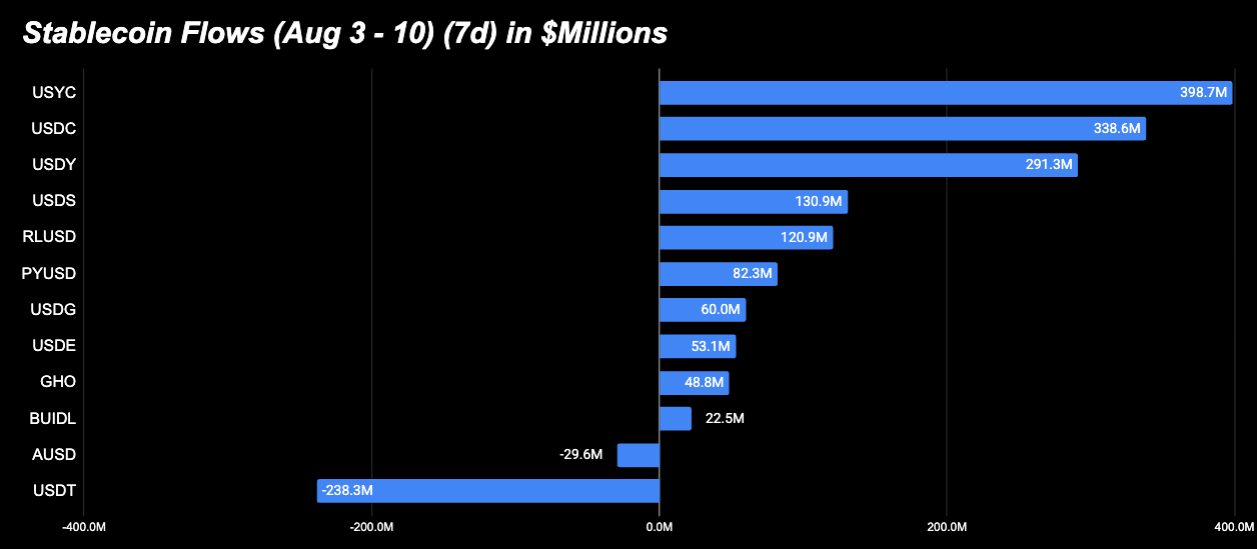
The two largest dollar gainers were both tokenized-treasury products — USYC (+$398.7M, +13.26%) and USDY (+$291.3M, +13.54%) — each growing double digits in a single week, joined by USDG (+17.85% over 30d) and GHO (+16.47% over 30d).
USDC grew $338.6M but only +0.47%, a function of size, not momentum. Against that, USDT — 60.88% of all supply — shrank $238.3M. Total supply expanded even as its largest component leaked: the entire net gain came from USDC and the yield-bearing names.
Aave / Sphere Rates : Funding Cooled, Credit Flat
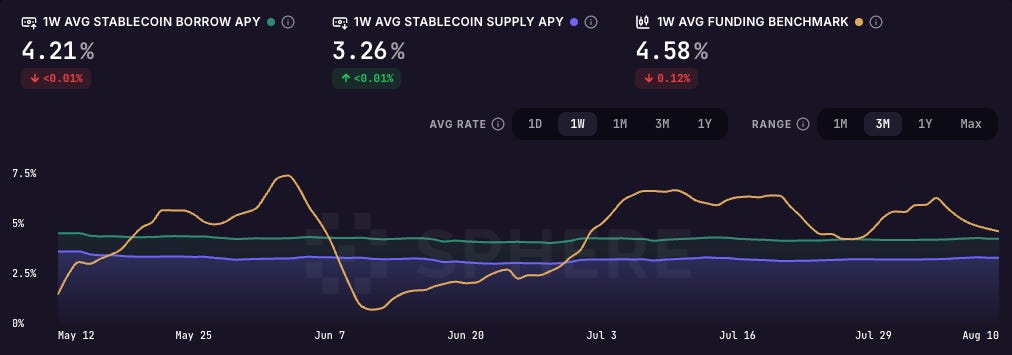
Sphere’s borrow (4.21%) and supply (3.26%) APYs held. The funding benchmark fell 0.12pp to 4.58%, compressing the spread over borrow to 0.37pp from 1.87pp last week — the crowded-long premium from last issue came off sharply.
ETH/BTC Comparison Chart
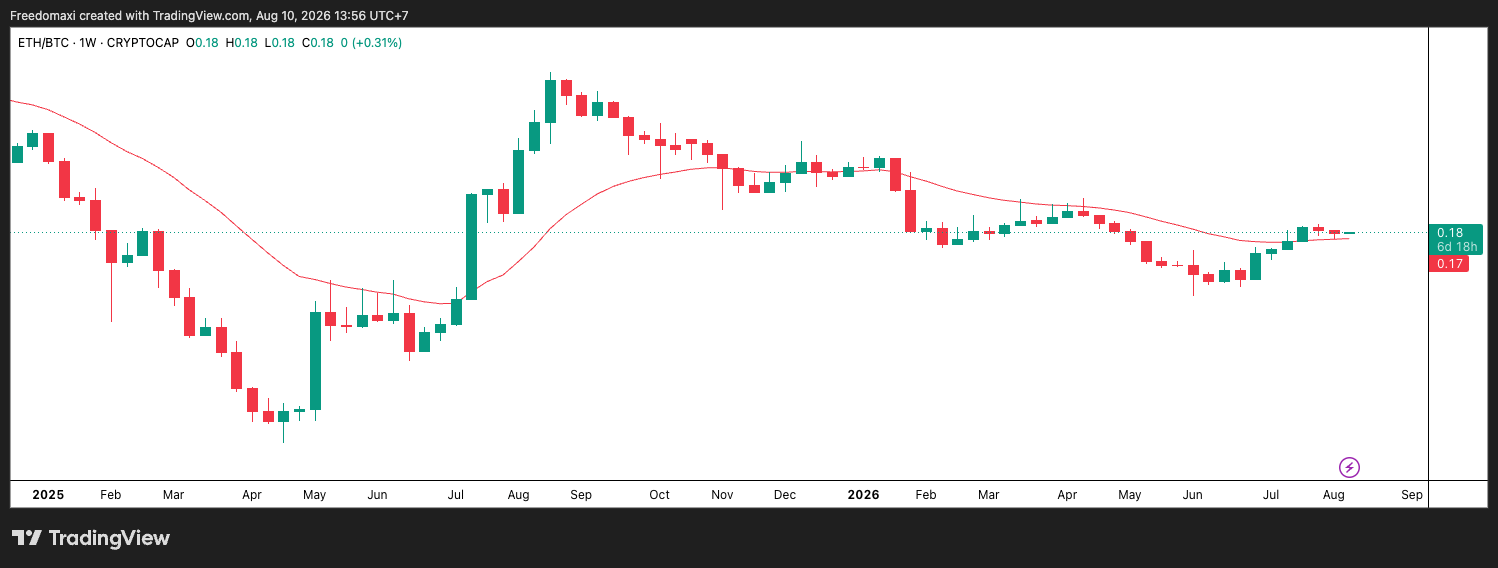
The ratio closed above its 20-week average, which is levelling off after declining since February — the July reclaim has now held over a month, matching the exchange-reserve divergence above.
Verdict: The dollars entering crypto went almost entirely into instruments that pay. Perp funding cooled and lending rates held flat. Ether kept its edge over bitcoin. Capital is present, and positioning is calmer — but it is parking in yield rather than deploying into risk.
Section 3 — Chain Comparison
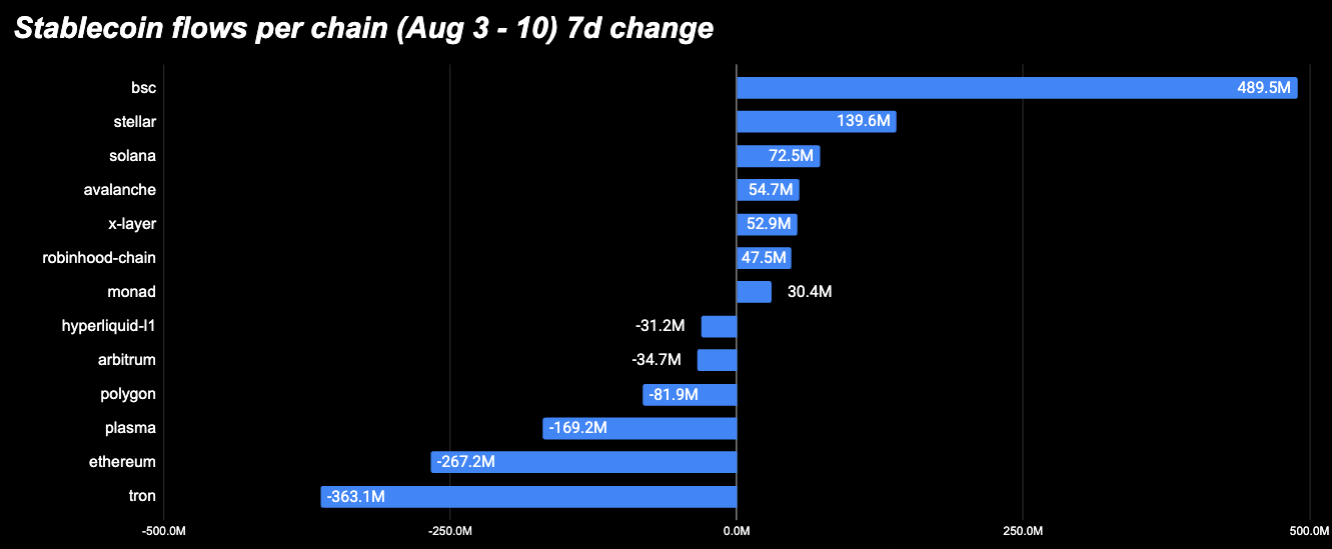
3A. Stablecoin flows by chain
Robinhood Chain — Retail USDG Deposits Are Funding a Cheap USDe Loop
Stablecoin market cap: $582.5M | +$47.7M (7d) | +$282.8M (30d)
Robinhood Chain’s stablecoin base has nearly doubled in a month, and this week’s growth is led by USDe (+$39.0M to $253.4M) ahead of USDG (+$8.6M to $329.0M). The engine is Robinhood Earn, which surpassed $250M in USDG vault deposits just over one month after launch (Robinhood, August 7). Those deposits flow into the Steakhouse USDG vault on Morpho, where a Merkl campaign pays approximately 7% APR — 3.09% protocol yield plus 3.91% rewards, with 325 days of budget remaining (Merkl).
Supply arriving this fast keeps USDG borrowing cheap — 3.58% against USDe, 4.06% against syrupUSDG, and 2.75% against spUSDG, at 91.50% LLTV (Morpho markets) — making loops on all three collaterals attractive. $225.9M of USDG is drawn against USDe alone. That loop demand is what pulls USDe onto the chain, while the Earn program keeps replenishing the USDG that funds it.
Monad — Ethena’s Liquid Leverage Boost Tops Up the Incentive Stack

Monad’s headline growth understates roughly $100M of gross inflows into GHO (+$52.7M), USDe (+$36.9M), and USDC (+$7.5M), offset by rotation out of USDT (−$30.0M) and AUSD (−$28.6M). The base driver is the ongoing Aave incentive program, paying roughly 5.4–6% supply rewards across the major stablecoins via Merkl (Merkl) and carrying Aave past $500M in deposits on the chain (Aave, August 4). On August 5, Ethena added a 1% boost over the 4% base promotional rate for USDe collateralized on Aave — 5% APY in total, capped at $250M of USDe, and the highest Liquid Leverage rate on any chain (Ethena, August 5).
The boost is pulling in fresh USDe: from near zero a month ago to $49.2M today, $36.9M of it this week. GHO, the week’s largest contributor, is the borrow leg of the same trade — its circulation scales with borrowing on Aave’s Monad deployment and carries its own 5.81% supply reward.
Morph — Up 50% Week-Over-Week on USDC Alone

Morph is the smallest base but the fastest in relative terms, up roughly 50% week-over-week — entirely in USDC (+$10.2M to $23.4M; USDT flat at $7.1M).
The incentive program is still attracting new deposits at pace, and the concentration in USDC points to the destination: Gauntlet’s curated vaults went live on Morph on July 31, led by Gauntlet USDC Prime on Morpho, distributed to more than 125 million users through Bitget and Bitget Wallet (Gauntlet, July 31). Growth here should track the incentive budget and the Bitget funnel until the deposit base diversifies.
3B. Structural Shifts- Onchain Activity
Base vs Robinhood Chain: Who Is Taking What From Whom
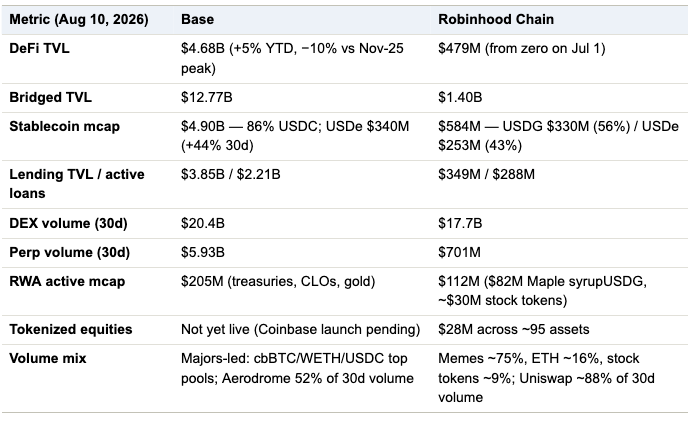
Robinhood Chain is competing with Base for users and trading flow — not for capital. Five weeks after its July 1 mainnet launch, it has flipped Base in daily active users and printed $17.7B in 30-day DEX volume — 87% of Base’s $20.4B, and ahead of Base on many individual days. On every capital metric, however, Base is roughly ten times larger and did not shrink during the ramp: Base TVL rose 14% between July 1 and August 10 to $4.68B, its stablecoins held at $4.9B, and Morpho on Base crossed $5B in deposits.
Base’s slowdown is real, but it predates Robinhood: users have faded since the mid-2025 content-coin collapse, and TVL peaked in November 2025. The chain that actually paid for Robinhood’s rise is Arbitrum (−58% TVL YTD), which hosted — then lost — the stock-token franchise. Coinbase is still acting like the threat is real: a 7.02% USDC vault launched days after Robinhood’s 7% Earn campaign, and tokenized equities are now “imminent” on Base.
Head-to-Head Snapshot
TVL: No Cannibalization — the Donor Is Arbitrum
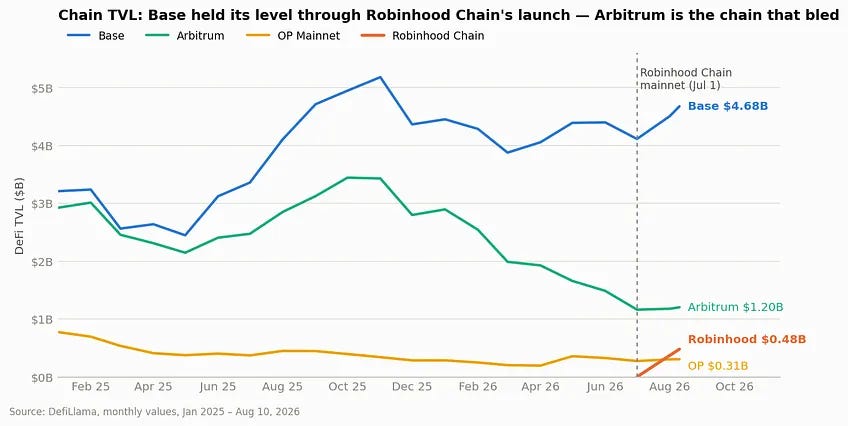
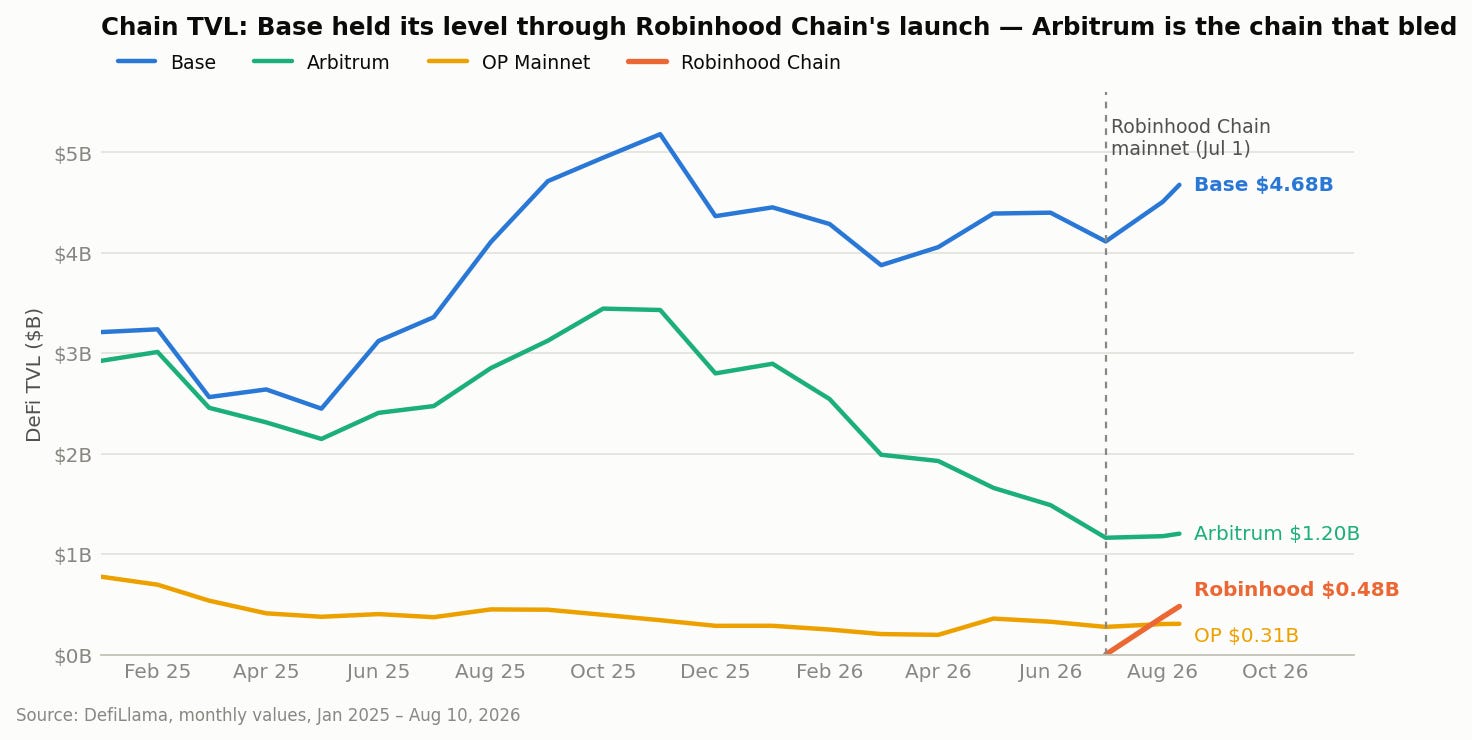
Base added roughly $560M of TVL during the exact five weeks Robinhood Chain built its first $479M — Robinhood’s capital came from Ethena bridge inflows and Paxos USDG minting, not Base outflows. Both chains run on the same credit engine: Morpho is 70% of Base’s TVL and, with Spark, 73% of Robinhood’s — expansion, not migration.
Robinhood’s version is a subsidized carry trade: Robinhood Earn pays ~7% on USDG via Steakhouse-curated Morpho vaults, borrowed at 86% utilization against USDe, syrupUSDG, and spUSDG collateral. Note DefiLlama excludes Robinhood’s tokenized stocks (~$30M) from chain TVL — the headline number is a stablecoin-lending number.
Stablecoins: A Two-Coin Carry Trade vs a $4.8B USDC Base
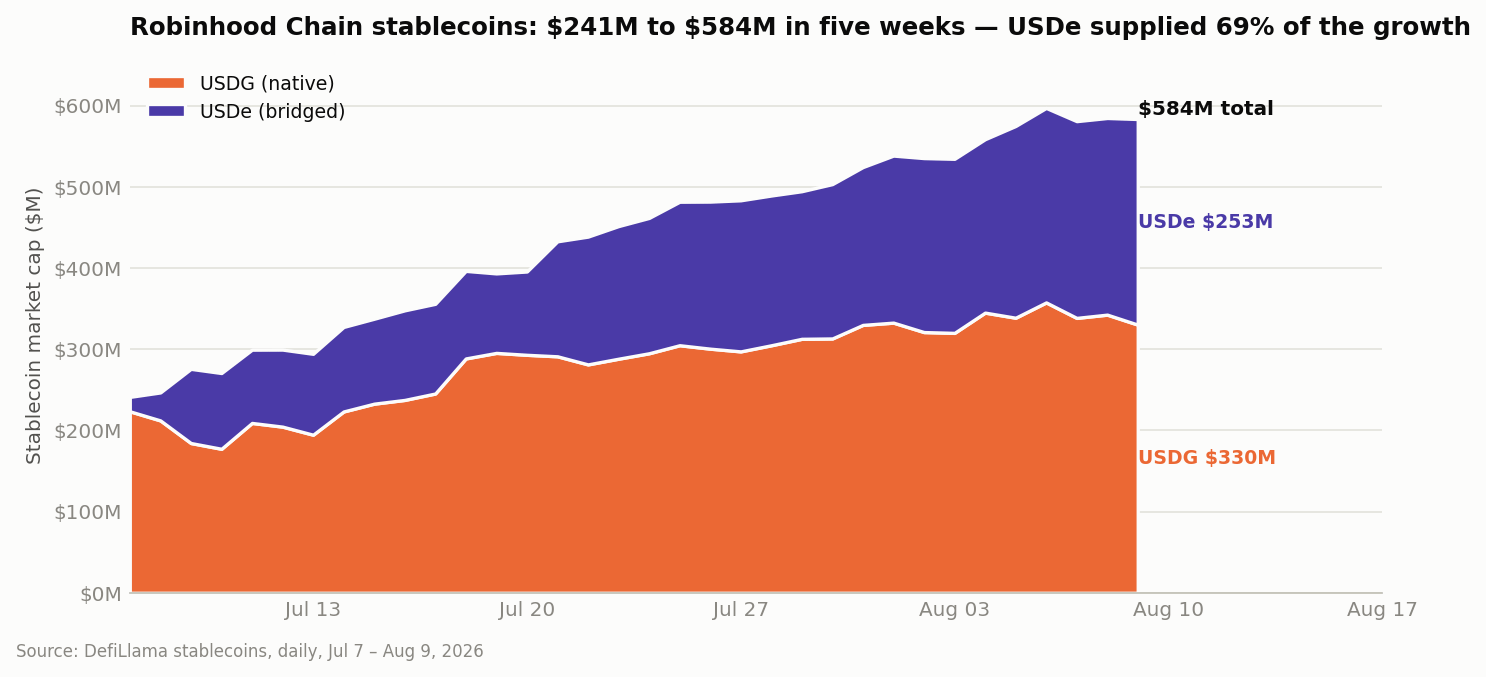
The stablecoin picture is the loop made visible: exactly two assets, with bridged Ethena USDe supplying 69% of the growth as the collateral leg to USDG’s borrowable leg — durable only as long as the subsidy and Ethena’s basis yield. Base’s $4.9B barely moved (+0.6% 30d), but its fastest-growing component is the same asset: USDe +44% in 30 days, pulled in by Coinbase’s rival vault. Ethena is supplying yield to both sides of this fight.
DEX and Perp Volume: The One Front Where Robinhood Actually Took Share
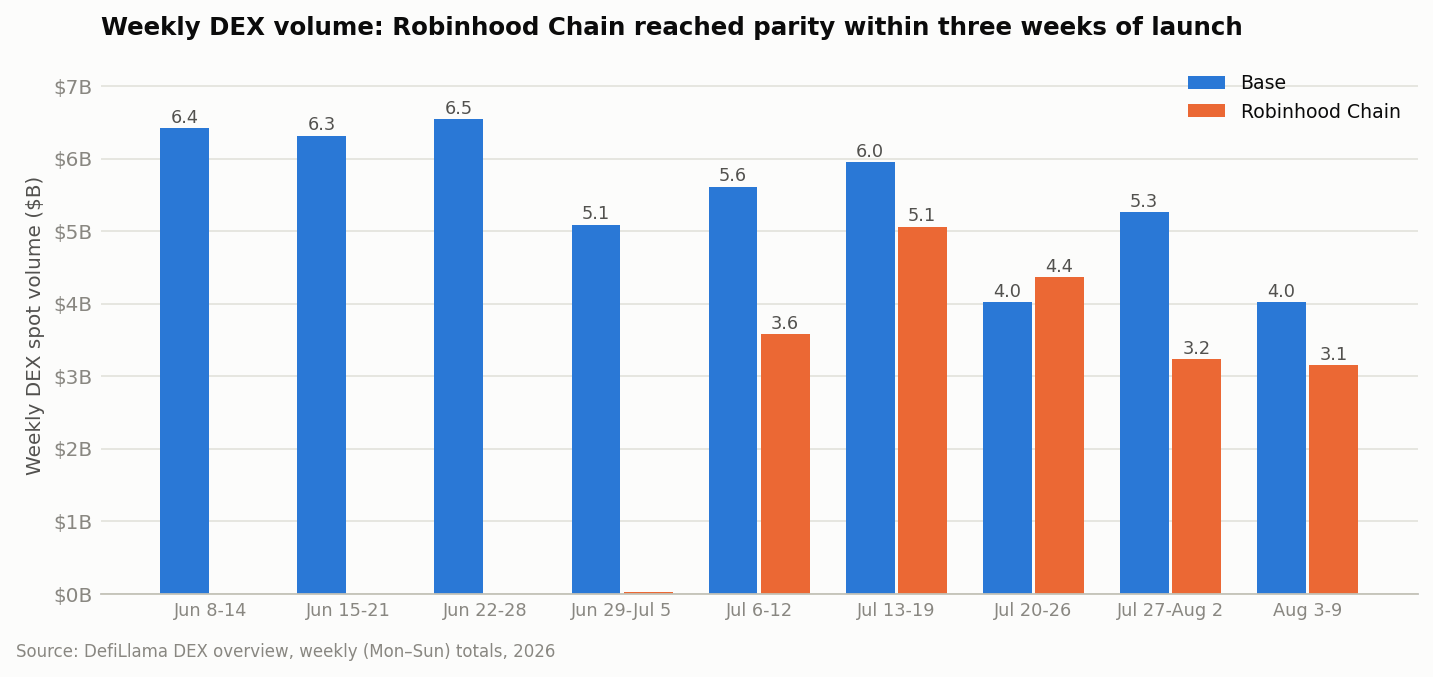
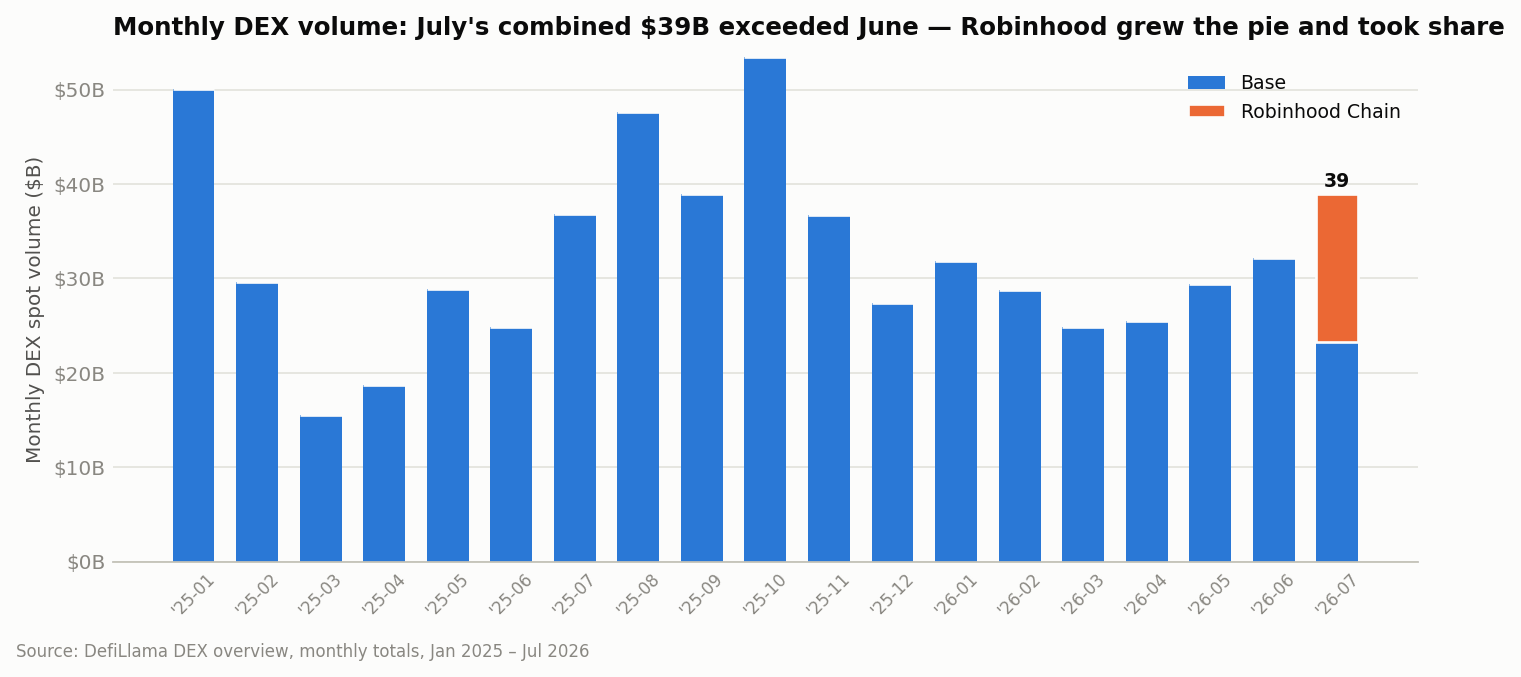
Volume is where competition has teeth: Robinhood reached parity in three weeks, passed Base in the week of July 20–26, and now regularly outranks it on 24-hour windows, while Base’s weekly volume fell 37% from its June average.
But July’s combined volume ($39B) exceeded June’s ($32B) — Robinhood grew the pie as much as it took share — and the flow it captured is ~75% memecoins (GMGN alone routed $1.45B in 30 days), the same low-loyalty churn Base already lost with its meme era. Base’s remaining flow is majors-led: cbBTC/WETH/USDC pools, Aerodrome at 52%. In perps, Base leads $5.93B to $701M over 30 days.
RWA and Tokenized Stocks: Big Narrative, Small Numbers — For Now
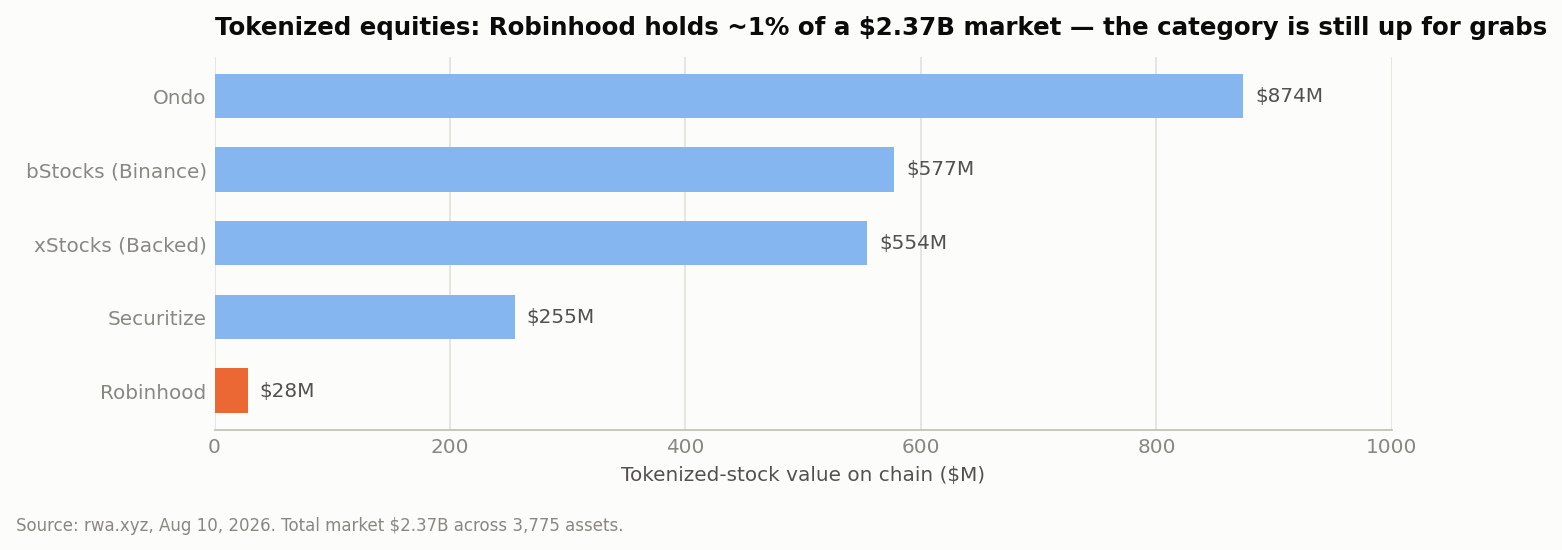
The category both companies are actually fighting over barely exists on either chain. Robinhood’s stock tokens sum to $28M — 1.2% of a $2.37B market led by Ondo, Binance’s bStocks, and Backed’s xStocks — and contribute ~9% of chain volume (~$30M/day); July’s “RWAs up 5x” headlines were mostly Maple syrupUSDG inflows. Base has none live, but Coinbase’s 1:1 share-backed product with dividend pass-through would out-spec Robinhood’s MiFID derivative wrappers the day it ships. The next two quarters decide whether Robinhood’s meme-and-subsidy traction converts into durable capital once the 7% program sunsets — and whether Base’s equity launch restarts its user growth. Today’s scoreboard: Base keeps the capital, Robinhood took the crowd, and tokenized equities are 99% up for grabs.
Section 4 — Project & Protocol Discovery
4A. Token Price Movers - Observations, not trade ideas.
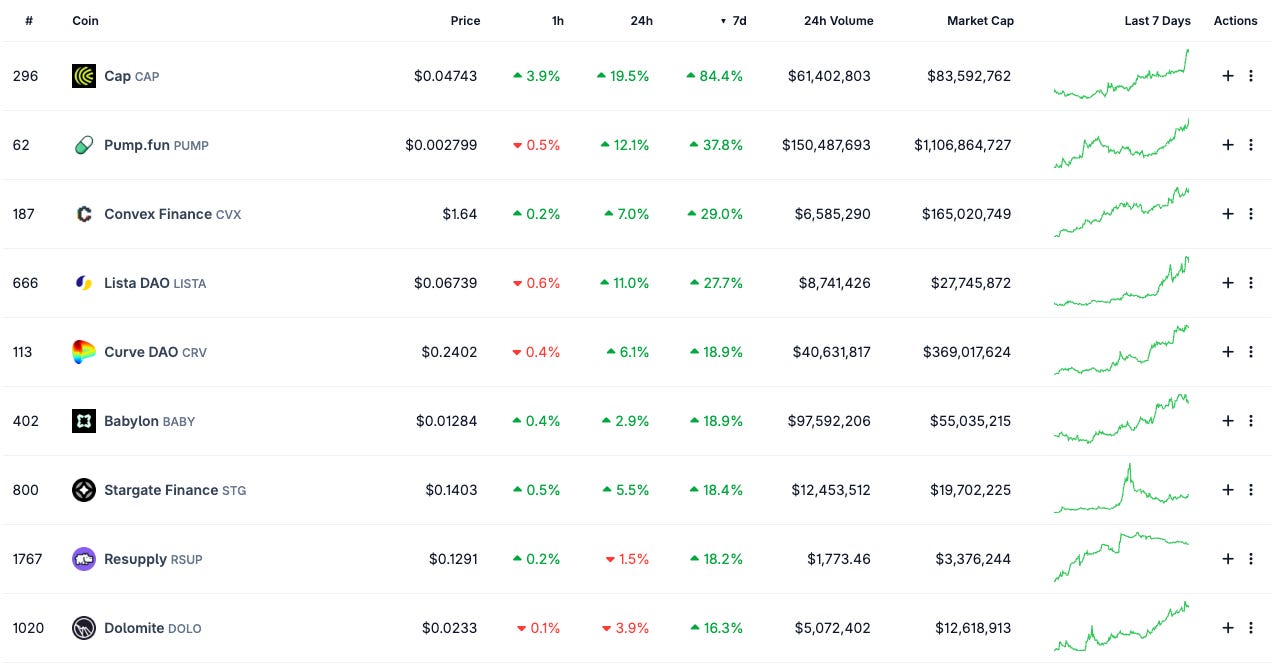
CAP (+80%): USD deposits rose 68.59% since July 14, which Cap credits to institutions and neobanks depositing for yield. Both sides of the credit engine expanded through July: Aave listed stcUSD on MegaETH’s v3, and Flow Traders opened a credit line — diversifying the borrower base.
CVX (+29%), CRV (+18.9%), and RSUP(+18%)
The Curve complex moved together on Resupply Summer, a cross-protocol incentive campaign launched August 3 routing months of rewards through Curve’s Llamalend V2 markets, with Convex, Frax and Inverse all participating. Proposal 33 on August 5 raised RSUP borrowing rewards 33%. CVX has no standalone yield mechanism — it tracks Curve’s fee and TVL activity — so it moved with the ecosystem rather than on its own news.
PUMP (+37.8%). No identified catalyst this week; the move reads as continuation of the undervalued-versus-fees re-rating.
LISTA (+27.7%). Recurring, not new — same tokenized-equity collateral expansion and weekly buybacks as last week. Momentum, not a fresh catalyst.
4B. TVL Gainers — Ranked by absolute $ inflow.
Cap — Institutional Deposits, Reinforced by a Senior-Tranche Borrowing Layer

Cap’s growth is being driven by institutional deposit demand. cUSD deposits have risen 68.59% since July 14, which Cap credits to institutions and neobanks depositing into the protocol to fulfill their yield requirements (Cap, August 7). Both sides of the credit engine expanded through July: Aave listed stcUSD on MegaETH’s v3 instance, and Flow Traders began accessing a credit line through Cap — a diversification of the borrower and underwriting base that gives institutional depositors more places for their capital to earn.
A second, reinforcing driver is the borrowing layer forming on top of Cap’s senior tranche. TermMax allows users to borrow up to 500,000 USDC against Royco’s stcUSD senior tranche at 3% APY (TermMax, August 6), and Royco highlights that borrowing against Cap’s and Maple’s senior tranches is now cheaper than ever, improving capital efficiency (Royco, August 7). Holders of stcUSD can now access cheap liquidity without exiting their position, which makes the deposit base stickier and supports continued inflows. Cap’s institutional trajectory has independent support: the protocol is backed by Franklin Templeton and Susquehanna, has raised more than $63M, and its approved reserve assets include WisdomTree’s WTGXX, BlackRock’s BUIDL, and Franklin Templeton’s BENJI.
Keep reading with a 7-day free trial
Subscribe to Today in DeFi to keep reading this post and get 7 days of free access to the full post archives.