

Subscribe for daily free DeFi news covering launches, tradable catalysts, and actionable farming opportunities.
This week in DeFi:
Circle's Arc mainnet launches September 16, with BlackRock, DTCC, Visa, and Mastercard among its 11 founding validators. Ether.fi also made a major move, splitting weETH into pure liquid staking and launching weETHs to carry restaking exposure separately. On the risk side, Coldcard hardware wallet hack losses now top $114M, and a live BTCPay Server zero-day is draining Lightning nodes.
DeFi📈

Circle is launching Arc mainnet September 16 with 11 founding validators including BlackRock, DTCC, Visa, and Mastercard.
The permissioned validator set enables institutional-grade stablecoin infrastructure across Ethereum, Binance, Near, and Noble.
Ether.fi separates weETH into pure liquid staking and launches weETHs as a dedicated liquid restaking token powered by Symbiotic.
This simplifies the product by removing restaking exposure from weETH entirely.
Term V2 launches on Ethereum, Plasma, Binance, Avalanche, Arbitrum, and Base with peer-to-peer fixed-rate market execution. Launch partners include Ether Fi, Falcon X, Pareto Credit, Pendle, and Tori Finance.
Kamino launches Institutional Yield on Solana, connecting onchain capital with institutional credit markets through purpose-built vault infrastructure.
Raydium launches Limit Orders on Solana, allowing trades to execute automatically when target prices are reached.
Morpho introduces Multi-market Offer, allowing capital to be allocated across multiple markets simultaneously until matched.

Find and execute the 15%+ stablecoin yields in minutes
Save time without checking every protocol manually. DeFi Saver’s Discover page surfaces rates across Aave, Morpho, Spark, and more, lets you simulate leverage before committing, and handles the full loop in one click. Stop leaving yield on the table.
<Discover Yields on DeFi Saver> | Today in DeFi is Supported by DeFi Saver
Issues⚠️
Bitcoin stolen from Coldcard hardware wallet hack now exceeds $114 million. The ongoing security breach highlights vulnerabilities in popular hardware wallet infrastructure.
Users are reporting stuck withdrawals since July 26 as BitMart winds down, with one user claiming $10.1M frozen and support staff going silent.
Founder Sheldon broke silence days later, denying misappropriation or fleeing, and says the team is conducting asset reviews and considering third-party audits — but has not given a timeline for resuming withdrawals.
BTCPay Server faces an actively exploited zero-day vulnerability draining Lightning node funds, with Foundation and Citadel21 already compromised despite ongoing patch efforts for version 2.4.2.
Seamless DAO completed remediation for the USDC vault on Morpho’s Base deployment, contributing 190,925 USDC under SIP-51. The incident response addresses the USR exploit with an additional 190,897 USDC in recovery funds.
A fake Wasabi Wallet drainer app appeared on the Apple App Store, with one victim already losing 6 BTC — the 27th wallet clone to reach the App Store this year. A fake Ledger app remains the worst offender at $9.3M stolen.
Always verify wallet apps through official links before downloading.
Stablecoins/RWA🪙

Bond SuperApp launches pre-deposit campaign on Ethereum, Avalanche, and Linea with up to $10M in incentives from 0G Labs.
Apyx launched on Solana, letting users stake apxUSD to mint apyUSD and earn real-time yield backed by Strategy’s STRC preferred equity — with points accruing toward the October 13 APYX TGE.
Backpack Securities launches real stocks onchain via Solana, tokenizing U.S. brokerage shares for seamless ecosystem movement.
News🗞️
Senate Leader Thune advanced the CLARITY Act toward a floor vote in September, marking a major legislative push for crypto market structure regulation.
EIP-8361 proposes a tapered burn on staking rewards that fully offsets issuance around 50% staked ETH, capping the incentive for stake growth beyond that point.
Critics including Aave’s Stani Kulechov warn it could slash yields and disrupt DeFi protocols reliant on staking returns.
Cloudflare launched Cloudflare Wallets, enabling stablecoin storage, service payments, and fund receipts natively across the web — bringing crypto payments infrastructure directly into internet plumbing.
ai16z founder Shaw declared the token dead and the foundation winding down, following a Burwick lawsuit settlement that drained the treasury.
He said he never sold his holdings and will keep building the Eliza AI framework independently, without a token, citing burnout and community hostility.
Mastercard is piloting its Crypto Credential compliance framework with Borderless.xyz to verify participants in cross-border stablecoin payments.
Multipli launched its MULT token community sale via SONAR, Coinbase Echo’s onchain sale platform, with a pre-open registration phase now live at claim.multipli.fi.
Never Get Liquidated in Your Sleep Again: How DeFi Saver Automation Protects Leveraged Positions
DeFi Saver’s Automation steps in before liquidation can — so a 3 am wick is its problem, not yours. It protected 365 positions at a 100% rate in the last crash. Here’s how it works, and how to put it in front of your own position before the next selloff.

<Set up Automation on DeFi Saver>
TL;DR
Cross your liquidation price on a lending protocol, and a third-party liquidator can force-close up to 50% of your debt and charge a ~5% penalty on the whole block — usually while price is at its worst.
DeFi Saver’s Automated Leverage Management watches the position for you and steps in before that point, using Auto-Repay to deleverage you back to a safe ratio.
It moves only the minimum needed to restore your target — a 0.3% fee on that slice, not a liquidation penalty on half your position.
During the Jan 25 – Feb 9 2026 selloff, DFS triggered 382 repays on Aave V3, 365 of them emergency saves, at a 100% success rate — protecting $446M+ in collateral and saving users an estimated $8.38M in penalties.
Every Leverage Trader’s Nightmare
If you’ve ever used leverage, you’ve probably seen this happen: the market suddenly wicks down on a low-liquidity weekend, your position gets liquidated while you’re asleep, and by the time you wake up, the price has already recovered—but your position hasn’t.
On Aave, liquidators can close up to 50% of your debt in a single liquidation and charge a penalty on the entire amount. Because liquidations usually happen at the worst point of a selloff, your collateral often gets sold near the bottom.
The issue isn’t just that the market moved - that’s natural. It’s that you weren’t there to react, and the only system acting in that moment was designed to protect the protocol—not your position.
There’s a setting that changes that. Here’s what happened the last time the market really cracked.
What DeFi Saver’s Automation does instead
DeFi Saver is a management layer that sits on top of protocols like Aave, Morpho, Spark, and Compound — not a lender or an exchange itself. Its liquidation-protection tooling has been live since 2019, through dozens of market volatilities, refined over years, and today it runs quietly enough that most users treat it as if it were part of Aave itself.
The mechanism is Auto-Repay.
Set a target once — for example:
“ If my Safety Ratio falls below 130%, Repay back to 145%.”
And from then on, the system watches the position for you. As your ratio drops toward the danger zone, Auto-Repay uses a precise slice of your collateral to pay down debt and pull you back to target, before a liquidator can act.
The difference from a liquidation is that the liquidator seizes up to 50% of your debt and penalizes the whole block. Auto-Repay calculates the minimum swap needed to restore your ratio and touches only that — with the 0.3% automation fee applied to just that slice.
No 5% penalty.
No forced fire-sale of your whole position.
Triggered by the same falling ratio, but opposite intents. The liquidator takes as much as the rules allow. Auto-Repay takes as little as it can.
Setting it up takes about a minute.
From your positions page or, say you’re farming on Aave from the DeFi Saver dashboard, open the Automate tab, switch on Automated Leverage Management
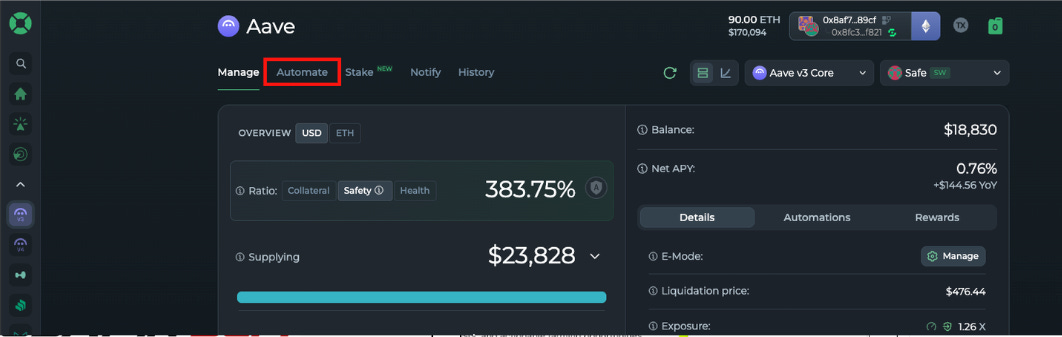
Set your target ratio and the floor that triggers Auto-Repay when prices go down, and also boost your trade by maintaining a constant health ratio if it goes the right direction.
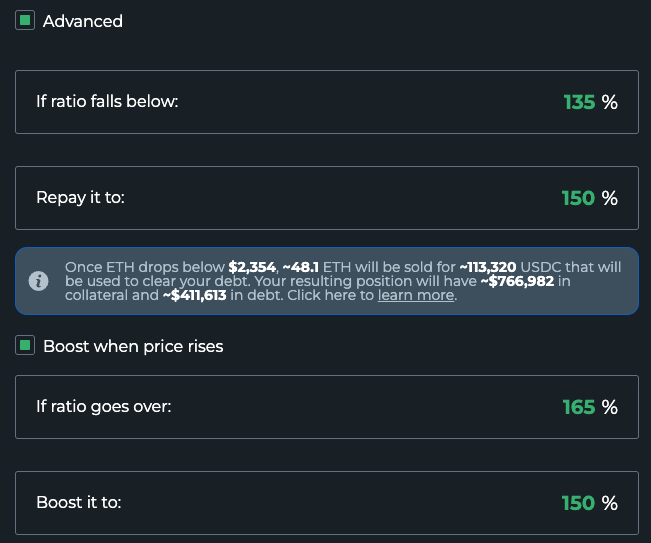
Save, confirm the transaction, and the position manages itself against that boundary until you change it — whether you’re at your desk, traveling, or asleep.
Proof: the last time the market cracked
Between January 25 and February 9, 2026, during the hard market sell-off, this feature proved resilient.
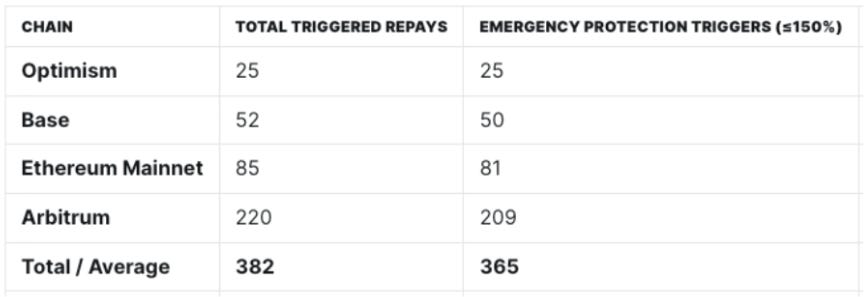
On Aave V3 alone, DFS Automation executed 382 automated repays across Ethereum, Arbitrum, Base, and Optimism. Over 365 of them (95%) were emergency interventions on positions that had dropped below a 150% Safety Ratio.
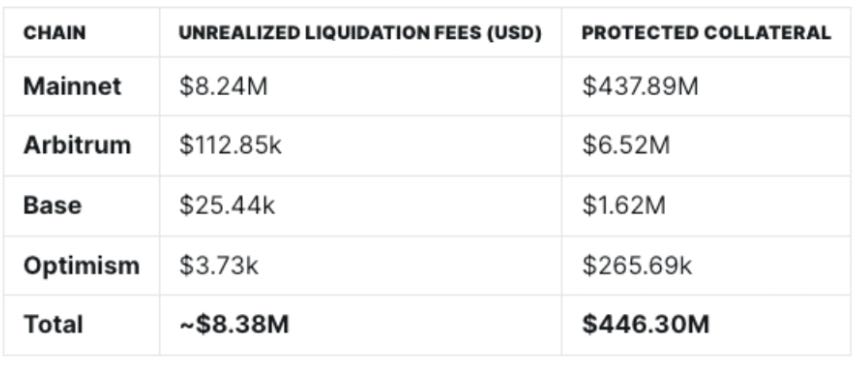
As a result, not one protected position was liquidated. In total, automation shielded users from an estimated $8.38M in third-party penalties and defended $446M+ in collateral backing $335M in debt.
Put a single real position under the microscope — an on-chain, verifiable one caught in the ETH drop on January 29, carrying about $7.16M in debt:
Using a standard liquidation: a liquidator closes 50% of the debt (~$3.58M) and takes a 5% penalty on that whole block — roughly $178,990 in seized collateral, before counting the loss from that collateral being dumped at a distressed price.
DFS Automation: it swapped just ~27.5% of the debt’s worth of collateral — the minimum to restore health — and repaid the loan back to a safe ratio. The 0.3% fee hit only that slice. Total cost: about $5,896.
Same crash, same position, same trigger point. A 97% smaller cost — and the only variable was whether automation was switched on.
The risks — worth being clear-eyed about
Automation is a powerful backstop, not a magic shield. A few honest caveats:
It’s not a guarantee against every loss. A gap or a single violent wick that blows through your target faster than a transaction can land can still result in a liquidation. Automation dramatically reduces the odds; it doesn’t repeal them. Keep your target ratio with real breathing room, not right at the edge.
It acts on the triggers you set. Set your Repay threshold too low, and you leave the system no room to act before the liquidation price. The 365 saved positions worked because their ranges left margin.
Fees and slippage are real. The 0.3% fee is small next to a 5% penalty, but each Repay also incurs swap slippage. Frequent triggering in a choppy market has a cost — one reason a sensibly wide target beats a hair-trigger one.
You still inherit the underlying protocol’s risk. Automation manages your position; it can’t protect you from a protocol exploit, an oracle failure, or a market freeze. That risk is Aave’s or Morpho’s, and it’s yours to weigh.
Turn it on before you need it. The single most common mistake is enabling protection after the first liquidation instead of before it. It can only defend a position it’s already watching.
Set it up before the next one
The 365 traders who came through the January crash untouched had exactly one thing in common: they’d set up protection before the drop, not after.
Never used DeFi Saver? Simulation Mode lets you watch automation behave with fake funds and no wallet — a safe way to see a Repay trigger fire before you rely on one. When you’re ready to go live, open a position from the Quick Start page or the Aave dashboard, then go straight to the Automate tab and set your range.
The market will crack again. The only question is whether something’s watching your position when it does.
<Set up Automation on DeFi Saver>
Today in DeFi is proudly sponsored by DeFi Saver.
Follow @todayindefi to keep up with the latest DeFi news on Twitter.
Disclaimer: Projects or tokens mentioned in this newsletter are often experimental or unaudited. Do your own diligence before using or buying anything mentioned.