Subscribe for daily free DeFi news covering launches, tradable catalysts, and actionable farming opportunities.
Today’s News Headlines:
- Apyx schedules APYX TGE for October
- Saturn adds early unstake penalty fee
- Maple launches institutional Borrower Hub dashboard
- YO Protocol launches yoSOL reward emissions
- Yield Basis opens v3 governance voting
- Berachain upgrading their POL mechanism
- Verus exploiter returns 75% stolen ETH
- Strata offers 20% APY on USDe
- Nado launches public Season 2 trading
- Frax launches frxUSD incentives on Aave
- Upshift launches Solana vault with Jito
- Grove launches daily points rewards program
- Uniswap expands to Solana via Wormhole
- Pump.fun launches USDC liquidity pools

Find and execute the 15%+ stablecoin yields in minutes
Save time without checking every protocol manually. DeFi Saver’s Discover page surfaces rates across Aave, Morpho, Spark, and more, lets you simulate leverage before committing, and handles the full loop in one click. Stop leaving yield on the table.
<Discover Yields on DeFi Saver> | Today in DeFi is Supported by DeFi Saver
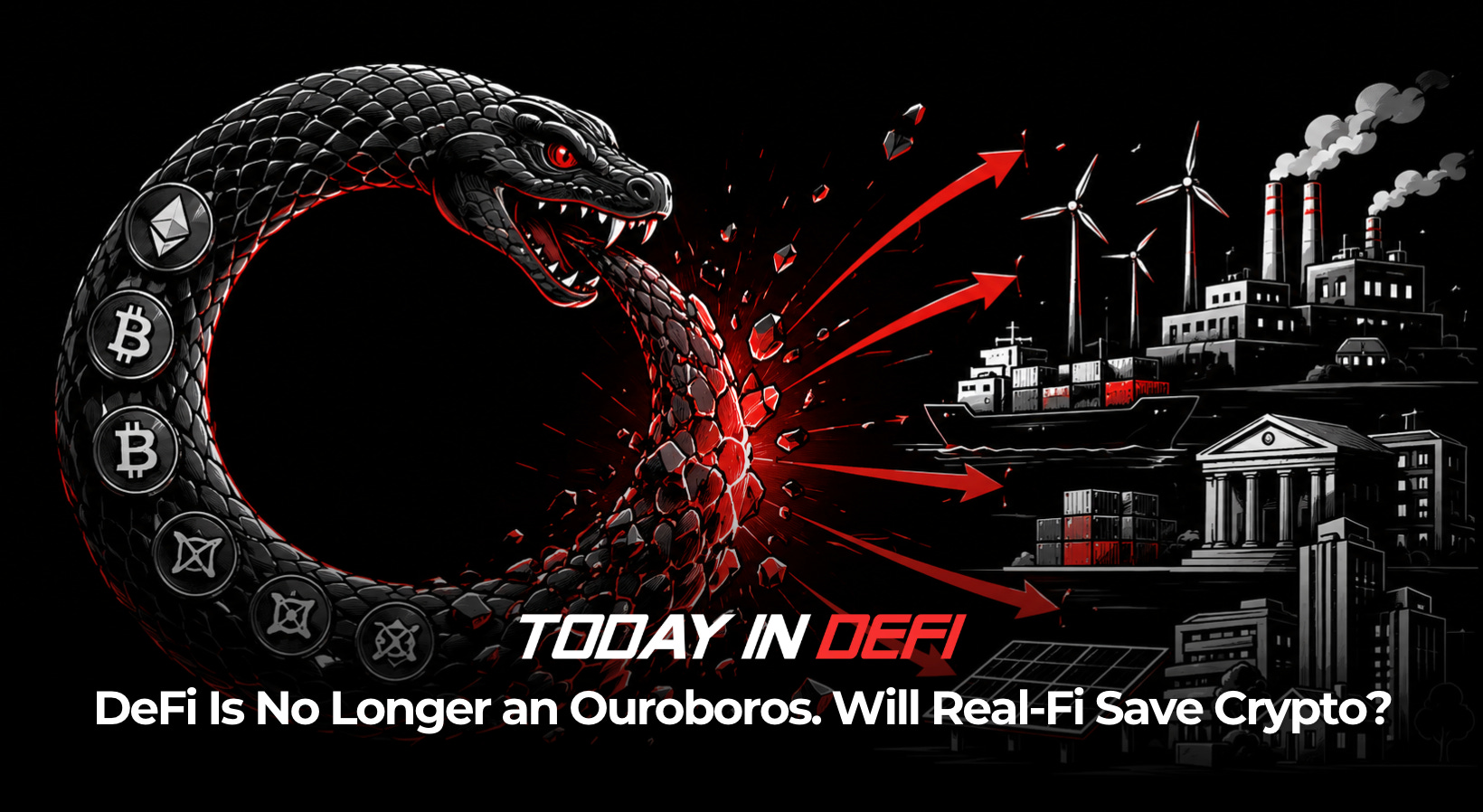
Two years ago Vitalik called DeFi a snake eating its own tail — yield paid for by people trading crypto, nothing external. The external story finally arrived. Sentiment is at multi-year lows anyway. That gap is the opportunity.
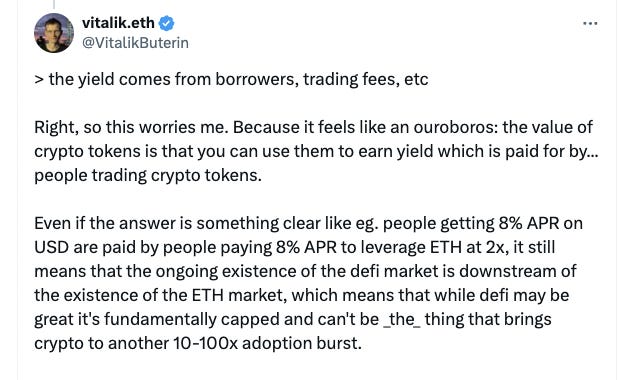
In August 2024, Vitalik Buterin described DeFi as an ouroboros — a snake eating its own tail. “The value of crypto tokens is that you can use them to earn yield which is paid for by... people trading crypto tokens,” he wrote.
His point was not that DeFi was useless but that it was capped: a market living downstream of crypto’s own trading activity could be great and still never become the thing that drives the next 10–100x of adoption. What he wanted to see was “a story for where the yield is coming from that’s rooted in something external.”
For most of the last cycle, that asterisk hung over everything. The technology was elegant, settlement was instant and global — but the honest answer to “what is it actually used for?” was uncomfortable: leverage on tokens that existed mostly to provide leverage. The real-world assets were perpetually six months away. The institutions were “exploring.” We were building rails for trains that hadn’t been built yet.

Two years on, the external story has arrived — call it Real-Fi, the part of on-chain finance whose activity is rooted outside crypto’s own trading loop. And the strange thing — the thing worth writing about — is that the mood in the space has rarely been worse.
The crypto Fear & Greed Index sits in the “fear” zone at 28. The Altcoin Season Index has spent months pinned in the 30s and 40s, nowhere near the 75 that would signal a broad rally. By one measure, cumulative net selling pressure on altcoins outside BTC and ETH reached roughly -$209 billion over thirteen months — the most extreme reading in five years. If you only read price charts and group chats, you would conclude the industry is in decline.
It isn’t. It’s the opposite. We are living through the most substantive twelve months DeFi has ever had, and the sentiment data and the fundamentals data have simply come unglued from each other. Understanding why is the difference between seeing a bear market and seeing a setup.
The fundamentals are not subtle
Start with the numbers that don’t care about vibes. Each of the following is, in its own way, the external story Vitalik asked for — yield and activity sourced from outside the crypto trading loop.
Real-world assets went from a slide-deck category to a real one. Tokenized RWAs grew from under $5 billion in early 2024 to roughly $34 billion by May 2026, more than doubling year-on-year. BlackRock’s BUIDL fund alone crossed $2.5 billion. This is not crypto-native money chasing yield in a circle — it is tokenized Treasuries, private credit, and commodities, much of it from institutions that spent the previous eighteen months quietly building the custody and compliance plumbing to hold it. The RWA sector grew while most other crypto verticals contracted. That divergence is the whole story in miniature.
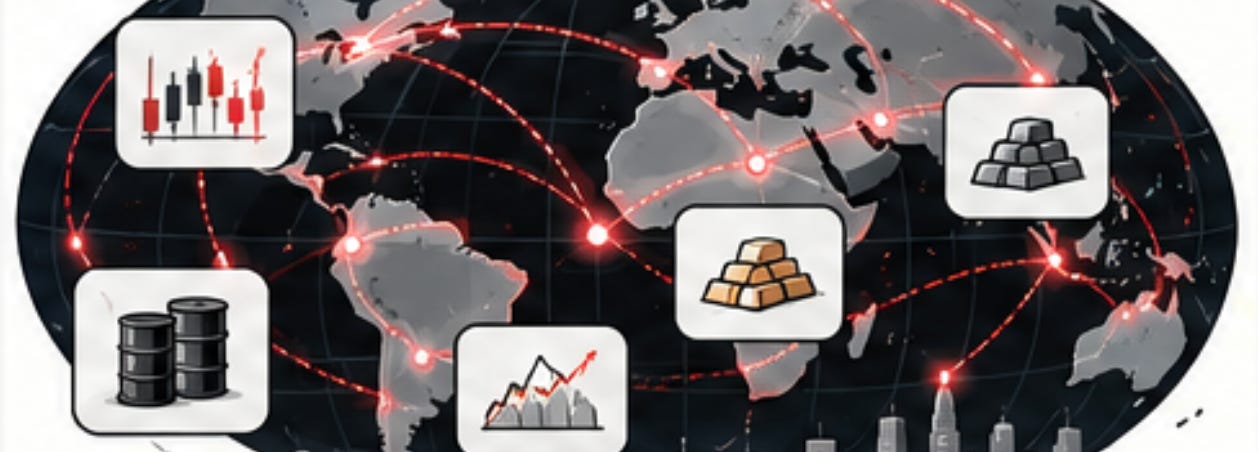
Traditional markets are now traded on-chain in real size. This is the one that should reframe how you think about the space. On Hyperliquid — the dominant on-chain derivatives venue, clearing around $190 billion in monthly volume — only 7 of the top 30 markets are crypto pairs. The rest are equities and commodities, deployed by builders like Trade.xyz on Hyperliquid’s permissionless HIP-3 framework. WTI crude perpetuals did $1.27 billion in a single day in March; Brent and silver each cleared a billion.
The “why” is more interesting than the “how much.” These markets never close — which matters when the events that move oil and gold (airstrikes, tariff shocks, weekend escalations) keep breaking precisely when traditional venues are dark. For the first time, a trader in any timezone can hedge an equity book on a Saturday, take a position on a pre-IPO name that retail was structurally locked out of, or trade a properly licensed S&P 500 perpetual. The thing the industry promised — open, global, always-on access to real markets — is not a roadmap item anymore. It is live, and it has volume.
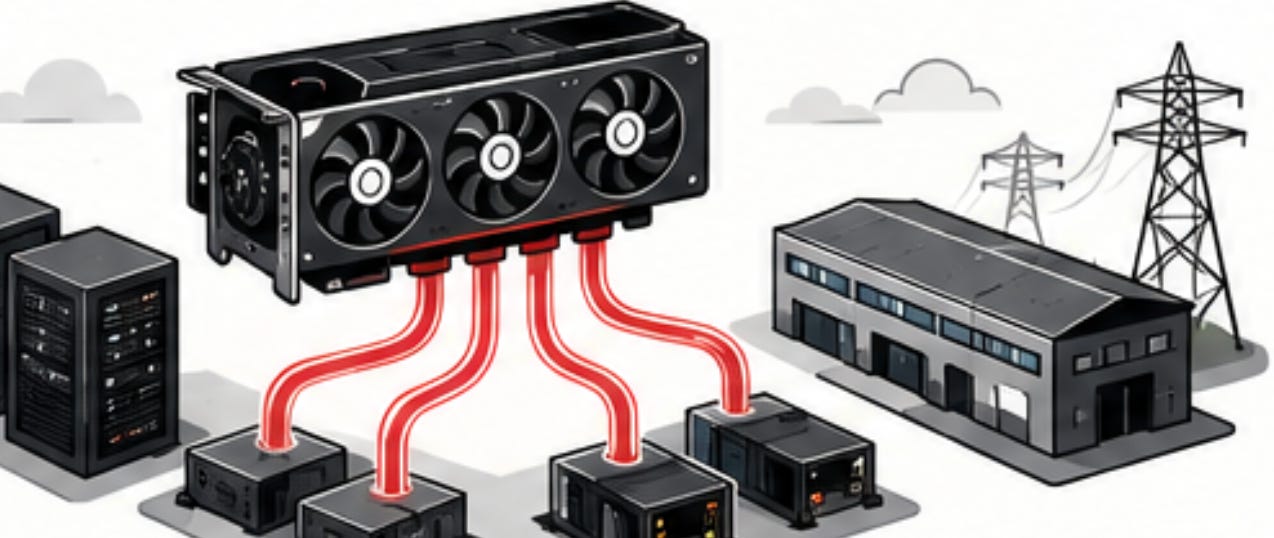
Capital is funding real-world infrastructure. USD.AI, a stablecoin protocol that lends against GPUs and data-center hardware, has drawn roughly $685 million in deposits to finance the physical backbone of the AI build-out. It’s early and unproven through a full credit cycle — worth saying plainly — but the shape of it is new: on-chain dollars financing tangible productive assets, not just recycling into more on-chain dollars.
So: institutions are here. Real assets are here. Real usage is here. Every box the 2021 pitch deck promised has been ticked. Why does it feel like a funeral?
Why the mood and the data diverged
Two forces, and they fit together.
The first is structural, and the data states it bluntly: the universe of tokens exploded, and the median holder got diluted into the ground. The number of tracked tokens went from roughly 5.8 million to 29.2 million in a single year. Capital that once concentrated into a few hundred alts now has tens of millions of destinations.
There is no plausible amount of inflow that makes “altcoin season” — a broad, rising-tide rally — mechanically possible again. The float is too big. Worse, most of these tokens launched with low circulating supply and high fully-diluted valuations, so the dominant force on the chart is a steady drip of insider unlocks selling into whatever demand exists. And much of this universe was never built to reward the people buying it: the prior two cycles rewarded the token whose only real product was the promise of its own price — vaporware with a roadmap, then memecoins without even the roadmap.

Retail has now, correctly and at scale, figured this out. By one count, 53% of all listed cryptocurrencies had effectively failed by the end of 2025. That is not a market in distress. That is a market doing garbage collection.
The second force is external. Crypto’s historical role was the premier venue for high-volatility speculation — the place you went to find a multibagger. It no longer has that role to itself.
AI is the dominant speculative narrative of the era, available in a regulated wrapper: not just the AI majors but the picks-and-shovels bottleneck names — power, cooling, memory, the whole datacenter supply chain. A memory supplier like SK Hynix has gone close to vertical, roughly ten-folding in two years: a crypto-shaped return, in a brokerage account, with no seed phrase and no rug risk.
The point is narrow but important — crypto no longer has a monopoly on the multibagger.

What’s left for it to win on is something harder and better: real growth, real usage. And the two forces fold together. Onchain venues are clawing some of that speculative flow back — but when a trader takes an NVDA perp or a pre-IPO position on Hyperliquid, that appetite is routed through crypto infrastructure. It validates the rails — volume, fees, the venue — without putting a dollar of bid under the long tail. The capital comes back to the plumbing, not the casino.
That is what the headline sentiment numbers miss. Fear & Greed and Altcoin Season are averages, dragged down by the corpse of the long tail. They measure the dilution and the speculative outflow — not the construction.
The aggregate looks like a bear market because the median asset genuinely is in one. But it has stopped telling you anything useful about the assets that matter, because the market has bifurcated.
This is the real state of things in 2026: not a bear market, a sorting. The bid has moved — it used to chase promises; now it requires proof of use. A quality tier with real users is pulling away while a vast tail of promise-only tokens is repriced toward zero. The pain in the index is the sound of that sorting. It only looks like decline if you insist on reading the average.
What’s getting bid — and the question underneath it
If the market now bids proof of usage, be precise — because “real usage” and “real value to the people who hold the token” have turned out to be two very different things. The gap between them is the most important, and least appreciated, feature of this market.
Hyperliquid is the most complete case: real users generate real fees, and the overwhelming majority are routed into buying back HYPE — an estimated $600M-plus a year toward holders, making it one of the highest-earning protocols in crypto outside the stablecoin issuers. It also quietly settles the oldest debate in the space.

The “fat protocol” thesis held that value accrues to base layers, not apps; Hyperliquid didn’t pick a side — it collapsed the distinction by being an application that became its own chain. But it is not cheap: on a fully-diluted basis the valuation is demanding, only a minority of supply circulates, and fee growth has recently turned negative. It is the best business in the set, not a bargain — and anyone citing only the circulating-market-cap multiple is ignoring three-quarters of the eventual supply.

Ondo is real institutional adoption meeting real dilution — genuine partnerships, a large tokenized-asset footprint, and a governance token walked downhill all year by unlock overhang. Morpho is the purest version of the question: adoption second only to Aave, powering billions in Coinbase loan originations, integrated by serious custodians — and returning, by deliberate governance choice, essentially nothing to token holders. Its fee switch has never been flipped.

Morpho is not alone. Once you look at fees actually captured by token holders rather than fees generated, how often the number is near zero is striking. Lido — one of the largest fee generators in all of DeFi, well over half a billion dollars a year — passes effectively none of it to the LDO token; that revenue goes to stakers and node operators, as designed, leaving the token a pure governance claim. These are not bad protocols. They are excellent ones. The lesson is that “generates fees” and “is a claim on those fees” are separate facts, and the market is still learning to tell them apart.

The genuine good case exists too. Pendle, which has effectively built an on-chain bond market for tokenized yield, rebuilt its tokenomics in early 2026 expressly to fix this problem: its new sPENDLE model directs up to 80% of protocol revenue into buybacks distributed to stakers, replacing the old vote-locked design. It is not the largest fee generator on this list, and crypto-yield demand is cyclical — but it is one of the few names where the architecture is deliberately built so that protocol revenue reaches the token. Proof the good structure is achievable — not proof it is yet the norm.
You could read all of this as a warning, and the skeptic should: plenty of these valuations still rest on usage alone, with the cash-flow case unproven or switched off by choice. But step back, and the trend is unmistakably right. A market that bids enormous, real, sticky usage — even before that usage pays holders a cent — is vastly healthier than one that bid memecoins with no product and vaporware with no users. Usage-without-revenue-yet is a far better problem than promises-without-anything. The bar has risen. It just hasn’t risen all the way to “proven cash flow” — and pretending otherwise would be its own kind of vaporware.
And the base layers?
If apps can now accrue real value, can the chains they run on? The “fat protocol” assumption — that the base layer automatically captures the upside of everything built on top — has looked shaky for years. But the answer isn’t simply “no.” It’s “yes, if the chain does real, fee-generating work rather than relying on the assumption.”
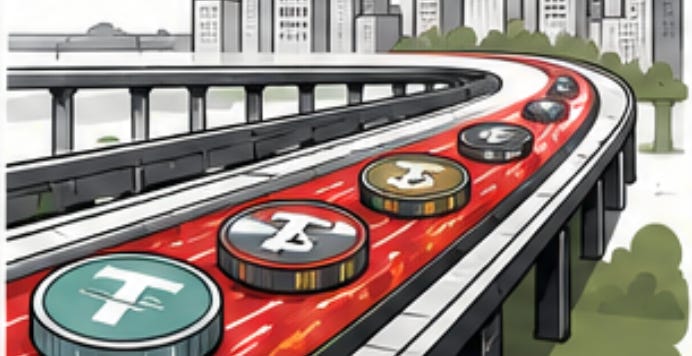
The clearest proof point is an unglamorous one. Tron generates roughly $31 million in fees a month, growing steadily, off about $90 billion in stablecoin balances — almost entirely from USDT settlement. It is not exciting; it hosts little of the speculative activity that defines crypto’s mood. But it does a real job — moving dollars — at scale, and its token has a genuine link to that activity.
Ethereum, by contrast, still anchors by far the largest stablecoin base, but its fee revenue is far more volatile, swinging with congestion and speculative cycles. The point is not which chain wins. It is that a settlement layer accruing value is not theoretical — it just has to be earned through use, the same as everything else. The free pass is gone. The opportunity is not.
The opportunity nobody is pricing

Put the halves together. Fundamentals — real adoption, real assets, real usage — are at all-time highs. Sentiment is near multi-year lows. Those two facts are not usually allowed in the same room.
The bridge between them is the bifurcation. The market is averaging a tier that is genuinely building with a tail that is genuinely dying, and reporting the blend as a single depressed mood. For anyone willing to stop reading the average and start reading the constituents — and then to read past usage into who actually captures the value that usage creates — that is not a warning sign. It is a window. The kind that only stays open while consensus is looking at the wrong number.
None of this forecasts that prices go up next quarter. Dilution is a real headwind, unlocks are real selling pressure, AI will keep competing for the speculative dollar, and a skeptical market can stay skeptical for a long time. But the durable pattern of this industry is that periods when fundamentals and sentiment diverge this far are not where stories end. They are where the next one quietly begins — usually while everyone is still looking at the chart and concluding nothing is happening.
Something is happening. It arrived without a rally to announce it. The ouroboros has loosened its grip on its own tail — the yield, the volume, the growth are increasingly rooted in something external, exactly as Vitalik asked. Real-Fi is no longer a thing crypto is waiting for; it is a thing crypto is doing. Whether it saves crypto depends on the harder question the market has only just started asking: whether all this real usage becomes value the holder can actually claim. That the question is live at all is the best news the industry has had in years. The fact that it doesn’t feel that way yet is precisely the point.
Data points are drawn from public sources current to May 2026 — RWA.xyz, DefiLlama, CoinGecko, and protocol reporting. Fee, revenue, and holder-revenue figures should be read with the usual skepticism toward consensus bullishness, and protocol value-capture mechanics can change with governance votes.
For sponsorships, questions, or news tips, reach us at: support@todayindefi.com