

Subscribe for free daily news headlines, weekly news recap, on-chain trading outlook, airdrops, and actionable farming opportunities.
Today’s News Headlines:
- Maple Proposes Revenue-Based SYRUP Buybacks
- World Migrates to Robinhood Chain
- Jito Confirms Solana-Only Trading Venue
- PancakeSwap Launches on Robinhood Chain
- Rysk V12 Goes Live on Ethereum
- N1 Acquires 01Exchange
- Arbitrum Earns Fees From Robinhood Chain
Find and execute the 15%+ stablecoin yields in minutes
Save time without checking every protocol manually. DeFi Saver’s Discover page surfaces rates across Aave, Morpho, Spark, and more, lets you simulate leverage before committing, and handles the full loop in one click. Stop leaving yield on the table.
<Discover Yields on DeFi Saver> | Today in DeFi is Supported by DeFi Saverr
This Week’s Farming News:
StableEarn launches on StableHub, enabling USDT holders to earn on-chain yield directly through the platform.
Exponent launches srONyc on Solana, offering protected exposure to ONyc with 8.36% APY and 45.32% principal protection.
Apyx launches new Morpho markets for PT-apxUSD and PT-apyUSD with 86% LLTV, curated by Hyperithm. Suppliers earn 40x points multiplier toward the October 13 airdrop.
Goblin Finance launches Goblin Private Credit I, its first RWA vault on Aptos via Pharos Network with a $20M limit. The permissioned private credit vault settles fully on-chain through Ember Protocol.
Jito launches JTX waitlist with access opening next week, confirming it will build exclusively on Solana rather than the Robinhood chain.
SkyMoney offers fixed yield on sUSDS at 4.97% APY through November 26, 2026, built with Pendle Finance.
Yieldbasis reopens capacity in main leveraged farming pools on Ethereum with limited availability.
Stacks launches stBTC liquid staked Bitcoin via Stacking DAO, enabling BTC holders to earn base yield while keeping capital active in lending and trading.
Neverland launches Merkl campaigns on Monad for AUSD and Pendle PT-AUSD supplies with nMON incentives.
Turtle launches Huma PST Vault on Ethereum targeting 10-15% APY by supplying USDC and looping 2.5-3x through Morpho.
Farming Benchmarks:
Average Lending APY on proven stablecoins: 3 - 5%
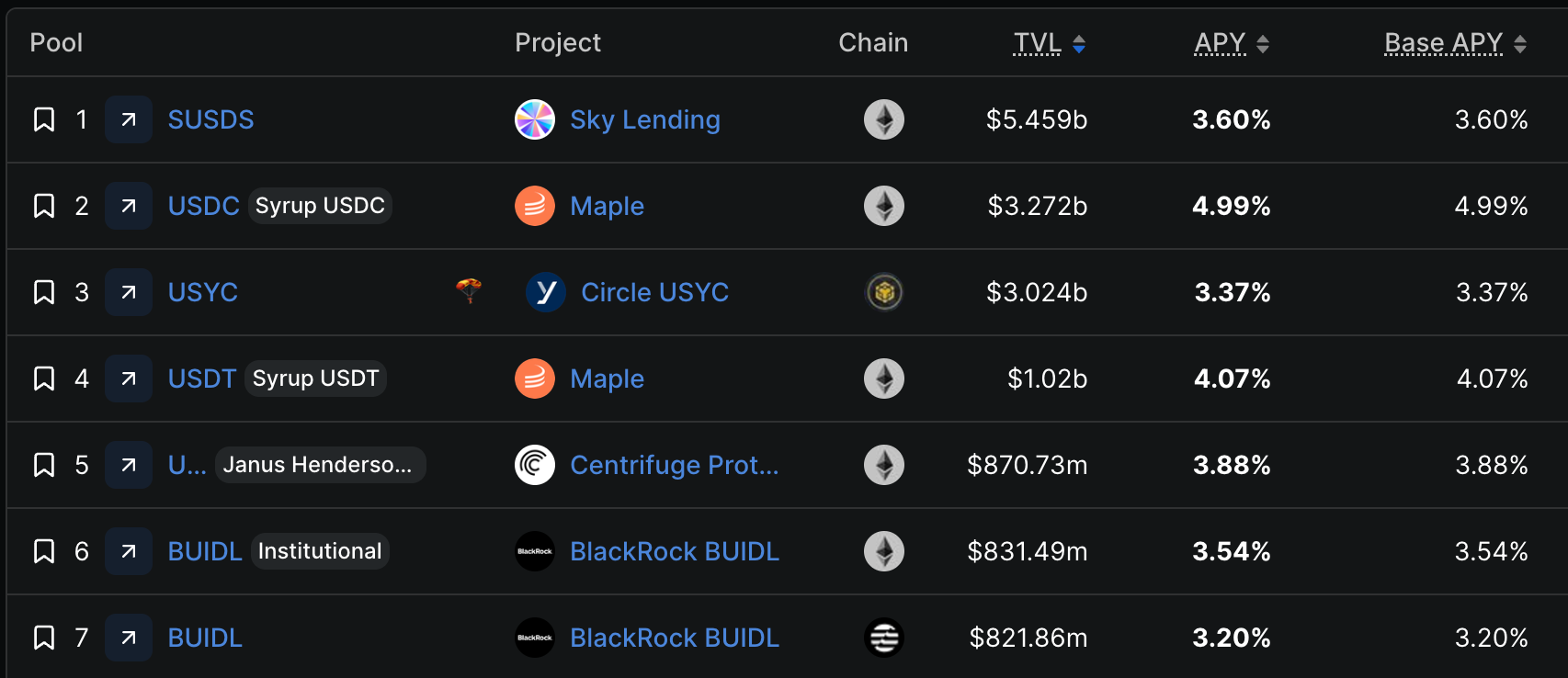
Lending yields on proven stablecoins are holding in the 3–5% APY range. Sky Lending’s sUSDS sits at the low end (3.60%), while Maple’s Syrup USDC leads at 4.99%. Institutional products — Circle’s USYC and BlackRock’s BUIDL — price between 3.2–3.4%.
Fixed Rate benchmark: 4-7%
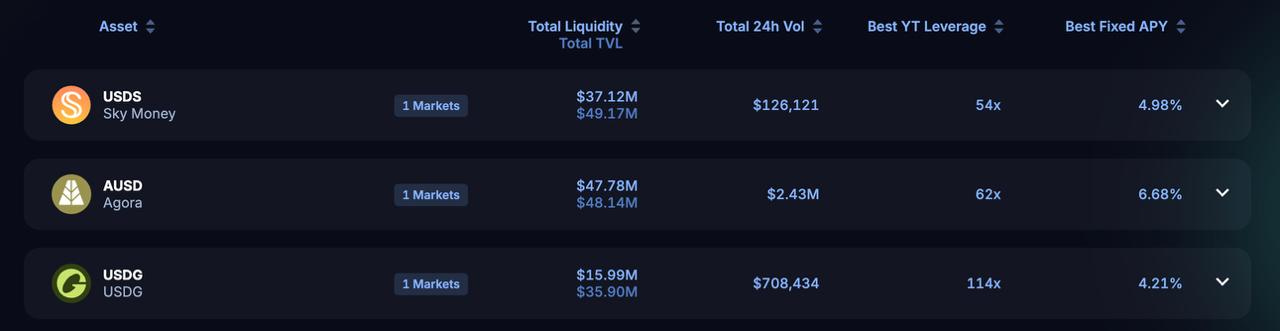
Fixed-rate (PT) benchmarks range 4–7%: USDG at 4.21%, USDS at 4.98%, and AUSD at 6.68%.
Earn Up to 10% on USD Stablecoin Farms:
Morpho – StableEarn Vault – USDC –9% APY(Ethereum – Lending vault)

Gauntlet-curated Morpho vault on Stable chain accepting USDT0 deposits. Net APY is 13.44%: 7.54% vault yield plus 5.89% in gtusdtb (Gauntlet’s USDtb token) rewards. 0% performance fee and 0% management fee.
The vault follows Gauntlet’s Balanced framework — optimizing for risk-adjusted yield across large and medium risk sources
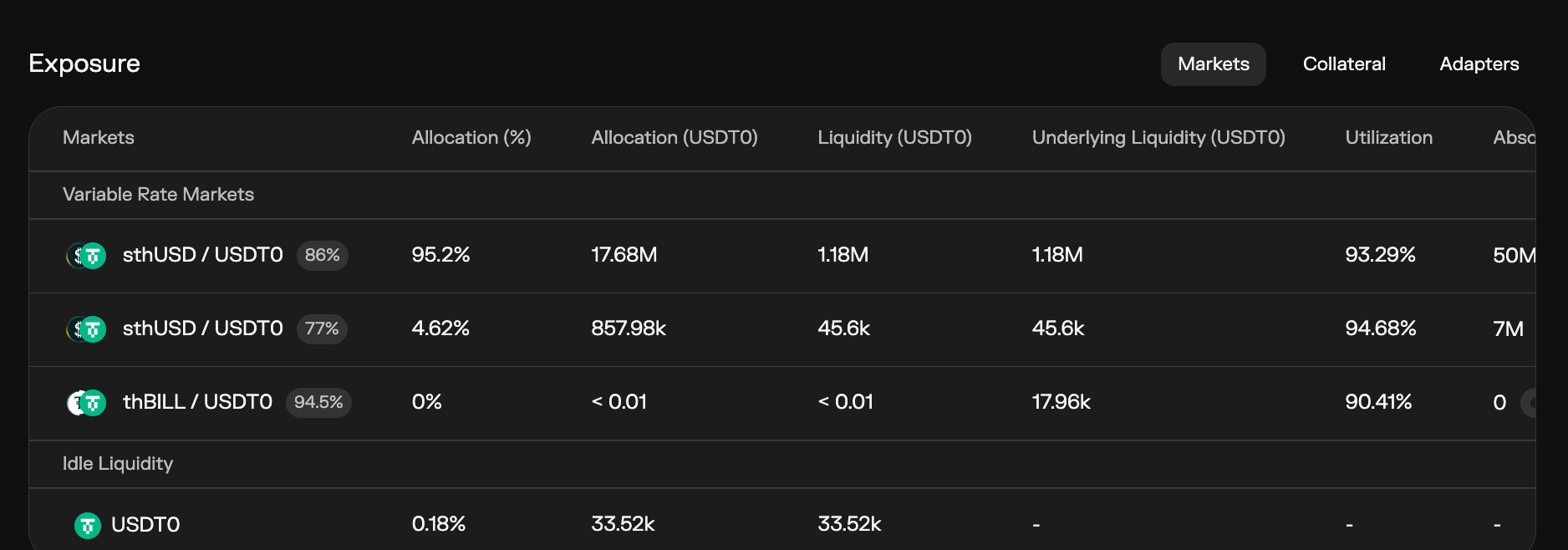
Exposure is to USDT0 and Theo’s institutional RWA products (thBILL, thGOLD, thUSD backed by Standard Chartered Libeara and Wellington Management). $1.26M available liquidity against $18.56M deposits.
Risk — Medium ⚠️13% on a USDC vault is above the typical range for conservative Morpho curators (4–8%), which means either incentives are driving the headline or the collateral set is more aggressive than standard. Check the curator identity and allocation breakdown on Morpho before sizing in. Standard Morpho smart contract risk applies.
Aave V3 – AUSD Lending –7% APY (Monad – Lending)

Lend AUSD into Aave’s Monad v3 market. Total APY is 6.70%: 2.00% base lending yield plus 4.70% WMON via a Merkl incentive program initiated by the Aave DAO.
Note that the WMON reward applies to your net lending position — AUSD supplied minus any AUSD, GHO, mUSD, USDC, USDT0, WETH, or USDe borrows you have open. Supply is 71.72% utilized ($14.34M of $20M cap) with $4.83M available liquidity.
Risk — Lower⚠️ AUSD is the main variable here — less established than USDC or USDT. Aave’s protocol risk is well-understood and battle-tested across multiple chains. Monad network risk applies. The 7% rate is variable and will fluctuate with borrowing demand — verify live before entering.
Amplify your Aerodrome LPs by leveraging your yield — now live on Revert Lend
What’s new: your Aerodrome LP is now collateral
Until now, an Aerodrome LP did exactly one thing. You provided concentrated liquidity, staked it in the pool’s gauge, and it earned. That was the whole lifecycle. If you wanted to do anything else with that capital — borrow against it, free up liquidity, increase your exposure — you had to unstake, which meant giving up the yield you opened the position for in the first place.
<Find the best LP yields on Revert Lend>
Revert Lend removes that tradeoff entirely.
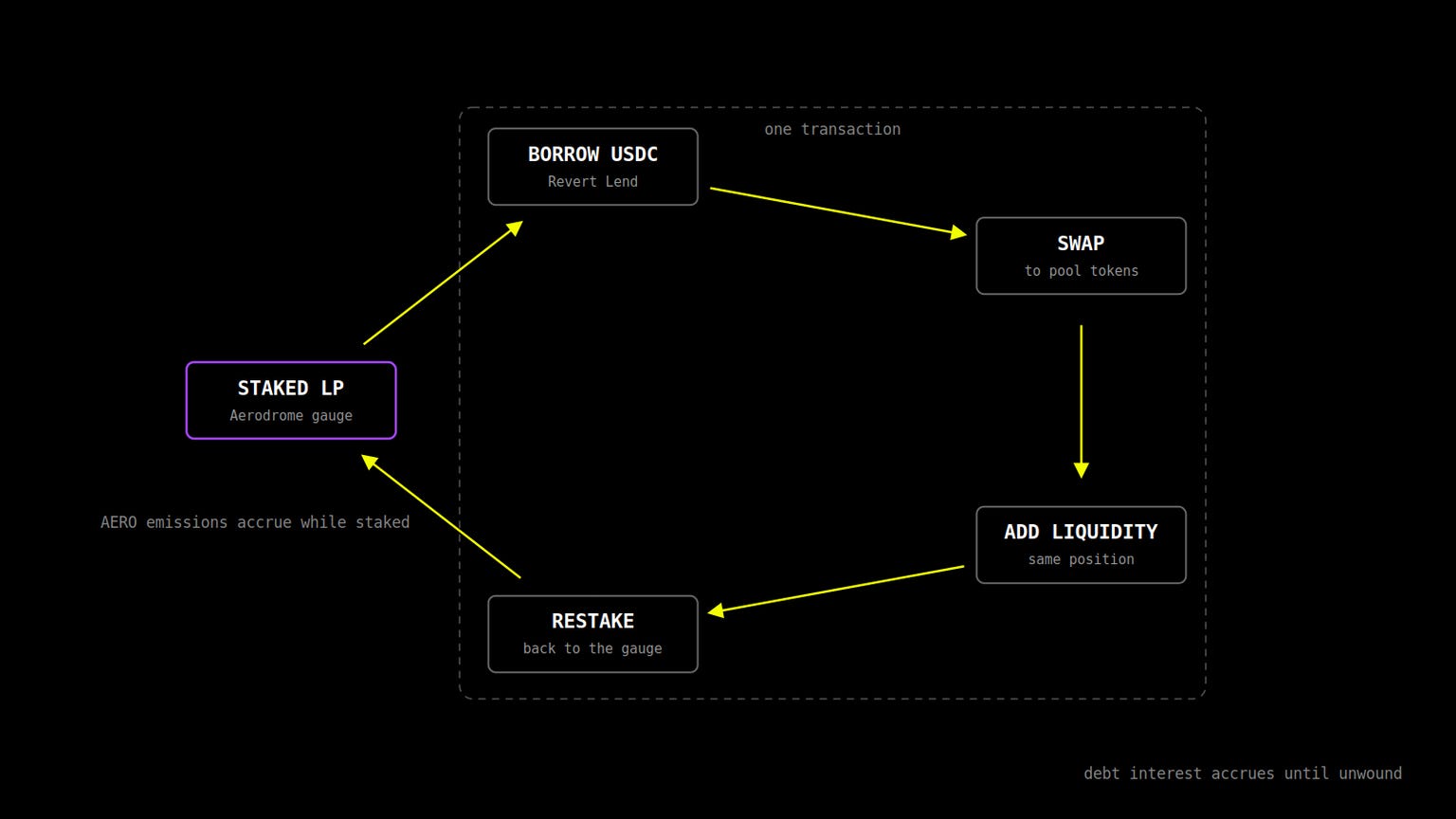
You deposit your staked Aerodrome position into the Revert Lend vault and borrow USDC against it. The position stays staked the whole time. It keeps earning. Nothing pauses. Then you take that borrowed USDC, swap it back into your LP’s token pair, add it to the same position, and restake the larger amount.
That’s leverage. You’ve taken a position earning a base yield and turned it into a larger position earning yield on borrowed capital. The same LP, working at a higher multiple.
This is the use case. People can technically borrow against an LP for all kinds of reasons, but the one that actually makes sense — the one this integration is built for — is leverage. Borrow, loop, amplify the yield.
The math: leveraged versus unleveraged
The key detail is that a staked Aerodrome LP position earns AERO emissions, not swap fees. The two are mutually exclusive: staked positions earn emissions while trading fees are directed to veAERO voters; unstaked positions earn fees but stop receiving emissions. Since Revert keeps collateral positions staked, the relevant yield is the rewards APR.
This creates a carry trade. Your LP collateral earns AERO emissions while your borrowed USDC accrues interest. As long as rewards APR exceeds the borrow rate, the position generates positive carry.
For example, a $10,000 staked LP earning 40% APR generates roughly $11/day in AERO rewards.
Borrowing $5,000 against it at a 15% borrow rate costs about $2/day in interest, leaving approximately $9/day in net carry before any leverage.
Revert allows users to loop this position by borrowing USDC, swapping into the LP assets, adding liquidity, and restaking the larger position in a single transaction. This effectively increases exposure to AERO emissions using borrowed capital.
The critical risk is that neither side of the carry is fixed. Rewards APR changes weekly based on gauge voting and fluctuates with AERO’s price, while borrow rates rise and fall with lending pool utilization. A position that is profitable today can turn negative if emissions decline, AERO falls, or borrowing costs increase. Leverage amplifies both the potential carry and the liquidation risk, making it essential to monitor both the reward and borrowing legs of the trade.
The pairs you can leverage
Revert Lend accepts deep-liquidity Aerodrome LPs as collateral:
WETH / USDC — 85% LTV on the USDC side
USDC / cbBTC — blue-chip BTC exposure
WETH / cbBTC — ETH and BTC
A note worth being honest about: these are volatile pairs. They carry impermanent loss and range risk, and that’s exactly why they generate the higher yields that make leveraging them worthwhile in the first place.
But that risk is manageable, and managing it is the whole reason the automation tools below exist. Leveraging a volatile LP with no protection running is how positions quietly bleed out. Leveraging the same position with Revert’s automations active is a managed, monitored strategy. The difference between those two outcomes is entirely about whether you’ve set up the safeguards — which takes about thirty seconds.
How to set it up
The flow is four steps, and Revert handles the complicated parts.
1. Open a position. Use Revert’s Position Builder to set your range on one of the blue-chip pairs. The volatility bands on the chart help you size the range — wider ranges are safer and stay in range longer, tighter ranges earn more fees but need more attention. Revert auto-stakes the position on Aerodrome the moment it’s created, so it starts earning immediately with no extra clicks.
2. Borrow against it. Go to the dashboard, deposit your staked position into Revert Lend, and borrow USDC. Your borrowing capacity is set by the position’s value and the collateral factor — 85% on USDC pairs, 77.5% on WETH or cbBTC pairs. The position never leaves the gauge. It keeps earning the entire time it’s backing your loan.
3. Loop it. Hit leverage. Revert’s LeverageTransformer contract swaps the borrowed USDC into your pair’s tokens, adds the liquidity to your existing position, and restakes it — all atomically, in a single transaction. No manual chaining, no external flash loan to manage yourself. Practical leverage runs up to about 4x through the UI, and up to ~6.7x at the full collateral factor.
4. Turn on the automations. Before you walk away from the position, enable Auto-Range and Auto-Compound. On a leveraged volatile position, these aren’t a nice-to-have — they’re the thing standing between a managed strategy and a slow loss. More on why in a moment.
Not into leverage? There’s a conservative path too

Leverage isn’t for everyone, and that’s fine. If you’d rather not run a leveraged volatile position — if you’re a more passive farmer who doesn’t want to monitor health factors or think about range drift — Revert also surfaces blue-chip stablecoin farms you can run completely unleveraged.
These are lower yield and far lower risk. Stablecoin pairs stay in range most of the time, carry minimal impermanent loss, and don’t require babysitting. Same platform, gentler strategy. You give up the amplified returns, but you also give up the homework.
For most people reading this, though, the reason to use Revert Lend’s new Aerodrome integration is leverage. That’s where the upside is.
The automations that make leverage safe
Leveraging a volatile LP has one specific failure mode, and it’s worth understanding clearly.
Concentrated liquidity positions only earn while the market price sits inside the range you set. The moment price drifts out of that range, your fee and reward accrual drops to zero. For an unleveraged position, that’s just opportunity cost — annoying, but harmless. For a leveraged position, it’s actively dangerous: your collateral has stopped earning, but the interest on your borrowed USDC keeps accruing every block. That’s how a leveraged position quietly turns negative without you noticing.
Revert ships three tools that handle this directly.
Auto-Range monitors your position against its boundaries and rebalances automatically when price drifts past a threshold you set. It withdraws the liquidity, recreates the position centered on the current price, and restakes it — so your position never sits idle and out of range. You set the threshold once and the protocol does the work.
Auto-Compound reinvests your earned rewards back into the LP automatically. This does two things at once for a leveraged position: it grows your collateral base, which improves your health factor and pushes you further from liquidation, and it counteracts the interest accruing on your debt by continuously building the asset side. For a leveraged position, this is active defense, not just convenience.
Auto-Exit is your stop-loss. If price crosses a threshold you define, the position is automatically withdrawn and optionally swapped into a single asset. It’s the safety net for the scenario where the other two aren’t enough — a sharp, sustained move against you. One thing to know: Auto-Exit unwinds the position but doesn’t repay your debt automatically, so a manual repay is still required after it fires.
None of this exists on Aerodrome’s native interface. You could replicate it with your own bots and monitoring scripts, but realistically, almost nobody does. Revert ships it as a built-in feature, wired directly into the leverage flow.
What to know before you leverage
Range risk is the dominant one. Out of range means zero yield while interest keeps accruing. Auto-Range and Auto-Compound exist for exactly this — running a leveraged position without them is the single most common way these strategies go wrong.
These are volatile pairs. WETH/USDC, USDC/cbBTC, and WETH/cbBTC all carry impermanent loss, and leverage amplifies outcomes in both directions. A move in your favor is magnified; so is a move against you. Size accordingly.
The borrow rate floats. It moves with the utilization of the lending pool. A position that’s positive carry today can flip negative if the pool gets heavily borrowed and rates climb — without any movement in your underlying pool at all. Watch both legs of the trade, not just the yield side.
Liquidation follows a standard model. A 2-10% penalty applies, your health factor is visible on the dashboard at all times, and Auto-Exit is your secondary safety net. Keep your health factor comfortably above 1.0 and don’t run max leverage on a pair you haven’t watched behave first.
Smart contract risk is real. Revert’s stack went through a Code4rena audit and a follow-up mitigation review in 2024. A $50K exploit on the Aerodrome vault in January 2026, specific to the staking integration, was patched — but it’s a reminder that new integrations always carry some residual risk. Don’t deploy more than you’re prepared to have exposed.
<Find the best LP yields on Revert Lend>
Today in DeFi is supported by Revert
Follow @todayindefi to keep up with the latest DeFi news on Twitter.
Disclaimer: Projects or tokens mentioned in this newsletter are often experimental or unaudited. Do your own diligence before using or buying anything mentioned.