


Subscribe for free daily news headlines, weekly news recap, on-chain trading outlook, airdrops, and actionable farming opportunities.
Today’s News Headlines:
- Ostium loses $24M after oracle manipulation attack
- SushiSwap launches on Robinhood Chain
- Upshift brings institutional onchain vaults to Kraken clients
- TownSquare opens $TOWN sale registration on Sonar
Find and execute the 15%+ stablecoin yields in minutes
Save time without checking every protocol manually. DeFi Saver’s Discover page surfaces rates across Aave, Morpho, Spark, and more, lets you simulate leverage before committing, and handles the full loop in one click. Stop leaving yield on the table.
<Discover Yields on DeFi Saver> | Today in DeFi is Supported by DeFi Saverr
This Week’s Farming News:
Sentora launched curated vaults on the Stellar network, accessible via Stellar DeFi Hub
Aave V4 launches on Avalanche as its first deployment beyond Ethereum mainnet.
Solstice Finance offers PT-USX leverage loops on Loopscale yielding up to 20% net APY at 10x leverage
Liquity offers >15% APR on the BOLD/avUSD pool on Curve Finance with additional rewards through StakDAO staking.
Lido's EarnUSD Vault now offers 7% APY on stablecoin deposits (USDT, USDC, USDe) with daily USD-denominated rewards.
Kamino's USDG High Yield Vault is now yielding >8% APY on USDG.
Aave V4 launches first ETH-based incentives for Ether Fi's weETH, rewarding users who borrow ETH against weETH collateral.
Tangent launches msETH/WETH interest-free borrowing market in partnership with Metronome DAO. Borrowers pay zero interest as long as USG stays above $0.995
Galaxy launched GOFR (Galaxy Onchain Financing Rate), a managed lending program that lets institutions borrow from onchain credit markets like Aave, Morpho, Spark, and Kamino through a single Galaxy relationship.
Farming Benchmarks:
Average Lending APY on proven stablecoins: 3 - 5%
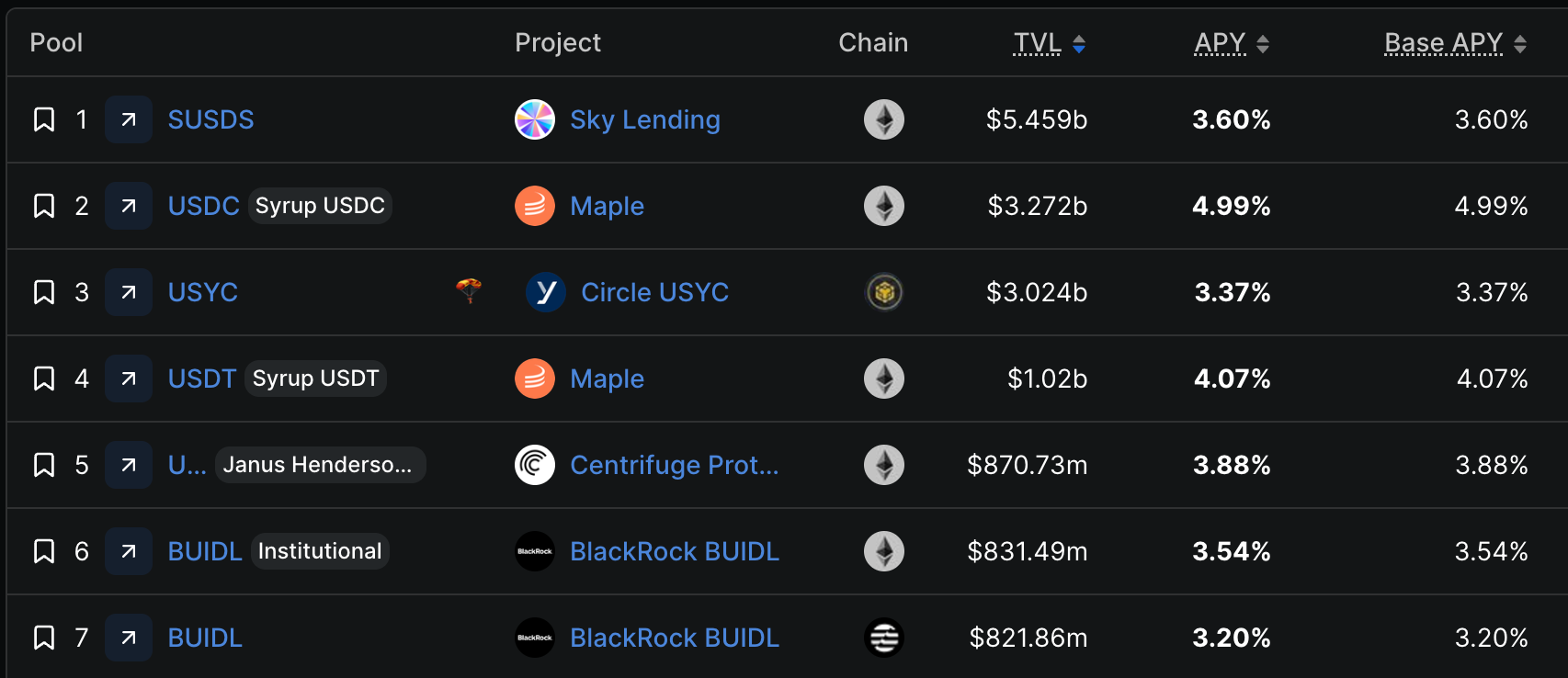
Lending yields on proven stablecoins are holding in the 3–5% APY range. Sky Lending’s sUSDS sits at the low end (3.60%), while Maple’s Syrup USDC leads at 4.99%. Institutional products — Circle’s USYC and BlackRock’s BUIDL — price between 3.2–3.4%.
Fixed Rate benchmark: 4-7%
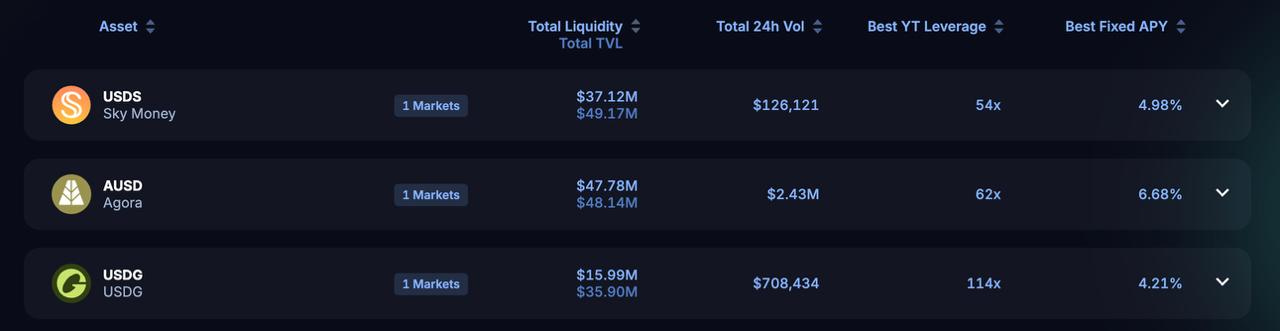
Fixed-rate (PT) benchmarks range 4–7%: USDG at 4.21%, USDS at 4.98%, and AUSD at 6.68%.
Earn Up to 12% on USD Stablecoin Farms:
Lending Rates Above benchmark
Robinhood Earn App for 7% on USDG:
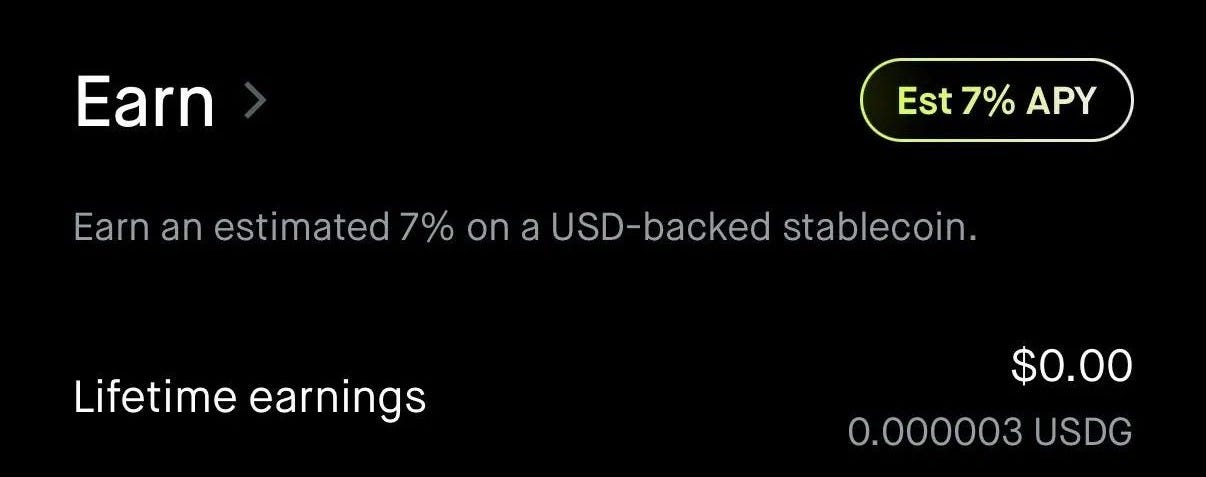
Robinhood Earn offers ~7% APY on USDG right inside the main app. It routes deposits into a Morpho vault curated by Steakhouse Financial, using Maple’s syrupUSDG. USDG is Paxos’s 1:1 USD-backed stablecoin. Yield comes from real borrower demand, and Robinhood added Lloyd’s of London insurance against exploits — rare for DeFi lending.
Risk — Low/Medium⚠️: The 7% is variable and may fade as an acquisition incentive — treat it as a projection, not a promise. Withdrawals depend on vault liquidity. syrupUSDG carries institutional-credit risk. Morpho and Robinhood Chain smart contract risk applies.
Lend Stablecoins on Aave Monad for >6% APR:

Aave’s Monad v3 market is showing 6–6.7% supply APY across the major stablecoins right now: USDT0 and USDC at 6.17%, and AUSD, GHO, and mUSD at 6.70%. The market is deep and liquid — $345.59M total size with $220.04M available — and carries a relatively clean risk profile since it’s Aave (one of the most battle-tested lending protocols) lending against stablecoins.
Risk & what to look out for⚠️: most of this APR comes from WMON incentive rewards, not organic lending yield. If those incentives end, the base supply rate drops to roughly 1%. So this is primarily an incentive farm — attractive while WMON rewards are live, but verify the campaign is still running before you size in, and don’t treat the 6%+ as a durable rate.
Given the deep liquidity and stablecoin-only exposure, it’s a solid low-risk place to park capital for as long as the incentives last. Aave and Monad smart contract risks applies.
Pendle – PT reUSD (USDC) – 10.7% Fixed APY (Ethereum – Pendle PT)

Pendle Principal Token on reUSD maturing December 10, 2026 — 147 days out. Buy at a discount today and redeem 1 USDC at maturity, locking in a fixed 10.7% APY. reUSD earns the greater of risk-free rate +250 bps or Ethena basis yield +250 bps, with off-chain deployment to reinsurance surplus notes. Instant redemption on reUSD is an advantage over most PTs.
Note that the WMON reward applies to your net lending position — AUSD supplied minus any AUSD, GHO, mUSD, USDC, USDT0, WETH, or USDe borrows you have open. Supply is 71.72% utilized ($14.34M of $20M cap) with $4.83M available liquidity.
Risk — Medium⚠️ The main risk here is PT price impairment before maturity. If the implied APY rises (the chart shows it’s been climbing — 10.7% now, down 0.94% over 7d in price terms), the PT’s market price falls, meaning you’d take a loss if you sell before Dec 10 rather than holding to maturity. This is only a paper risk if you hold to maturity, but real if you need to exit early. Separately, reUSD’s yield floor is partly indexed to Ethena’s basis — sUSDe conditions feed into what reUSD earns. And standard reUSD depeg risk applies. Pendle smart contract risk applies.
Morpho – Steakhouse Ethena USDtb Vault >10% APY (Ethereum – Lending)
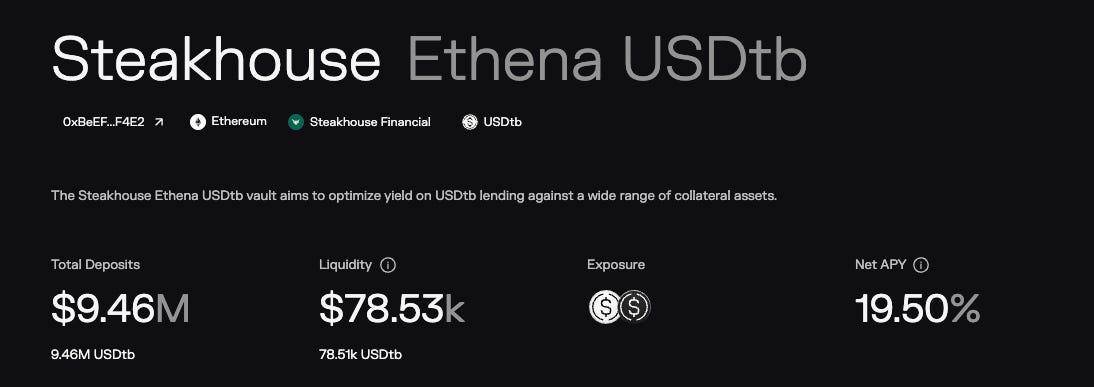
Supply USDtb — Ethena’s T-bill-backed stablecoin with reserves in BlackRock’s BUIDL fund — into the Steakhouse Ethena USDtb vault on Morpho.
Using the conservative ~10% figure here, though the vault is currently showing much higher due to a fresh Merkl campaign (19% total APR including 13% Merkl on top of the 6% vault rate). Steakhouse is one of the most reputable Morpho curators, with $1.89B curator TVL. $9.46M in the vault, 3-day timelock, 5% performance fee.
Risk — Low/Medium⚠️
The headline rate is spiking right now from a fresh Merkl campaign with only 9 days left — the 34% you might see on the Merkl dashboard is not sustainable, which is why the conservative ~10% is the honest number to plan around. After the campaign ends the rate normalizes toward the vault’s base yield. USDtb itself is one of the cleanest stables to lend (direct T-bill backing, no basis exposure). Note that borrowers of USDtb on Ethereum markets are excluded from the rewards. 5% performance fee applies. Morpho and Steakhouse smart contract risk applies.
Manage Leverage Trades Better & Safer Through DeFiSaver

How DeFi traders are quietly using DeFi Saver to open leveraged long positions more safely.
<Manage leverage trades better with DeFi Saver>
TL;DR
DeFi Saver gives you two ways to trade with leverage from one dashboard: spot-backed lending loops (one-click via Zap, best at 2–4x) or Hyperliquid perps (higher leverage, shorts, fast execution).
Its own toolkit is the reason to use it: Automation that repays or boosts your position by itself, plus stop loss, take profit, and trailing stops on lending positions — none of which money markets offer natively.
Loops and perps can even hedge each other directly from the same interface.
Opening a leveraged long directly on Aave, Morpho, or Euler gives you exposure but little protection. There’s no stop loss, no automated ratio management, and every adjustment requires manual transactions.
Open the same position through DeFi Saver and it comes with an automation layer designed to protect the position and reduce the need for constant monitoring:
Automation that manages the position on its own — deleveraging you away from liquidation before it ever gets close, or compounding you deeper into a winning trend
Exchange-style exits — stop loss, take profit, and trailing stops — on lending positions that natively have none of them
One-click everything — open, close, deleverage, or even swap the collateral under a live position, each in a single transaction
DeFi Saver now goes beyond lending. Hyperliquid integration brings perps into the same dashboard, with higher leverage, native hedging, and features not available in Hyperliquid’s native interface, including trailing stops, trailing entries, and one-step funding from mainnet.
This article is how those play out in practice, across the two ways to take a leveraged directional position through DeFi Saver — and it’s worth being clear-eyed about both.
1. Onchain Leverage – one click to open and automated management

Through DeFi Saver’s Zap, it’s one click — you’ll find ready-made leveraged transactions in the Trade section of the Quick Start page, like Long ETH up to 3.7x or Long WBTC up to 3.5x through Aave.
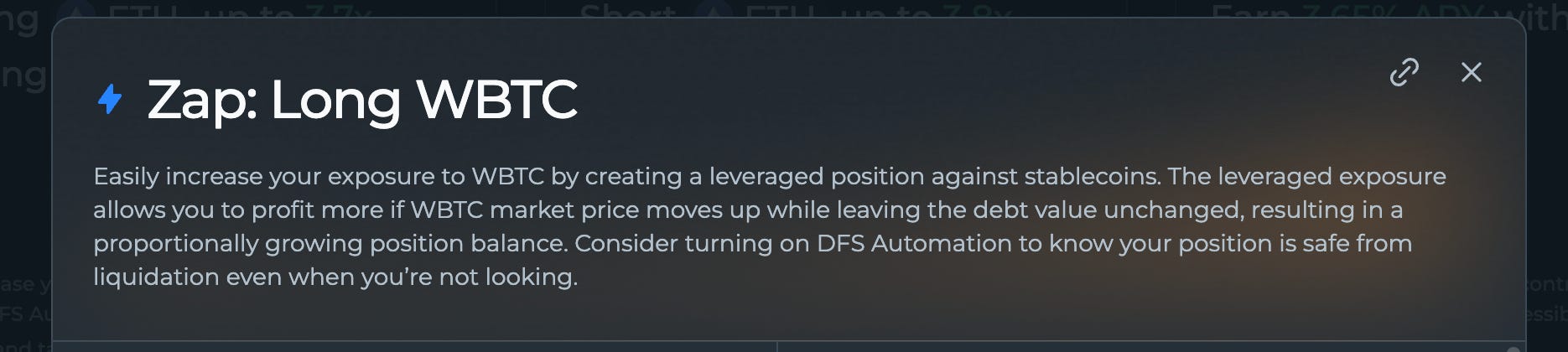
Opening one only takes about a minute. Choose Long WBTC, set your collateral, slide the leverage to 2x, and the interface lays everything out before you sign: your debt, Safety Ratio, liquidation price, and net APY — the visible cost of holding the leverage.
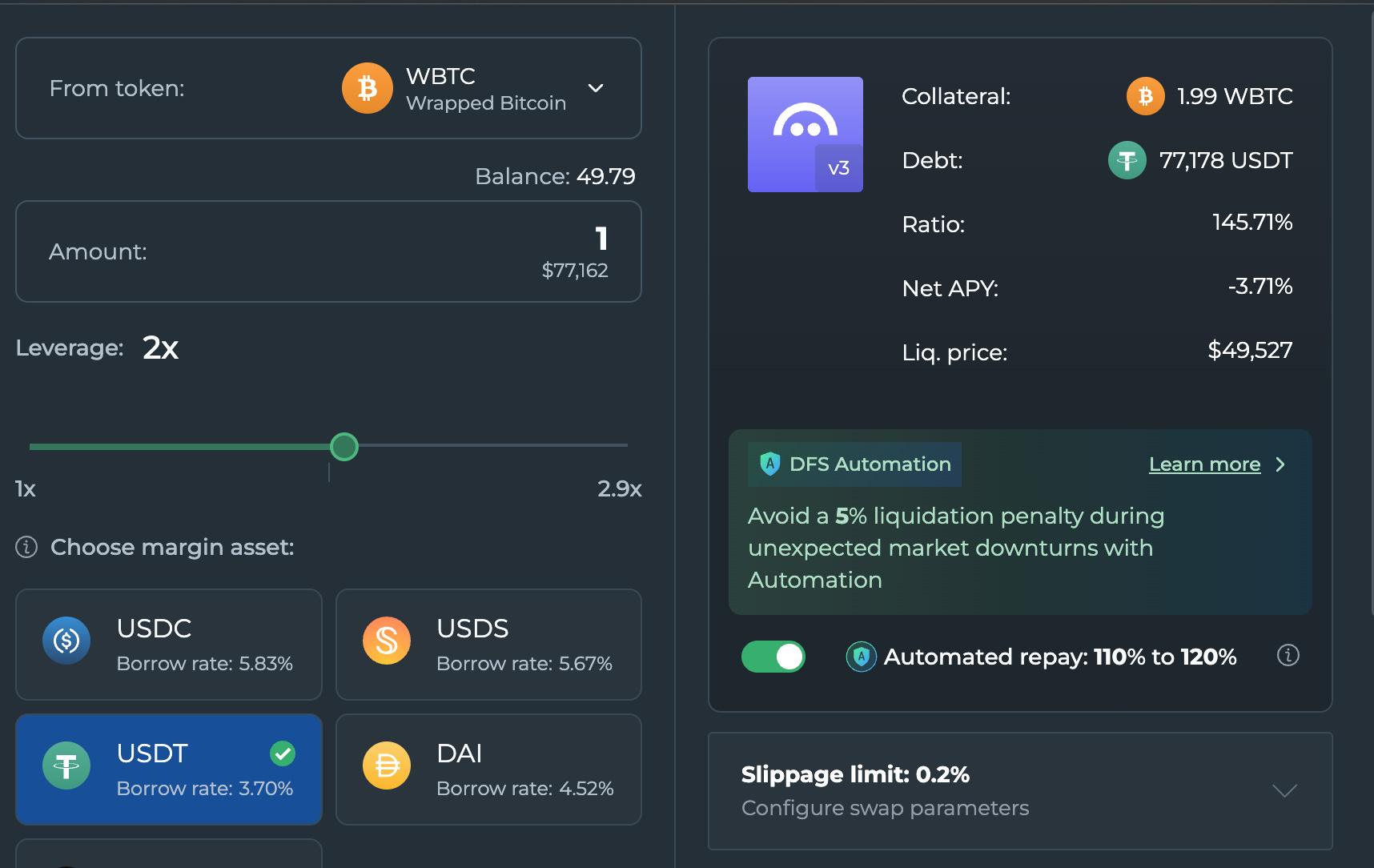
Confirm, and the position sits on Aave: 1 WBTC of margin, 2 WBTC of exposure, real collateral in a contract you control (the first transaction also deploys your Smart Wallet, the proxy contract that makes these multi-step operations possible in one click).
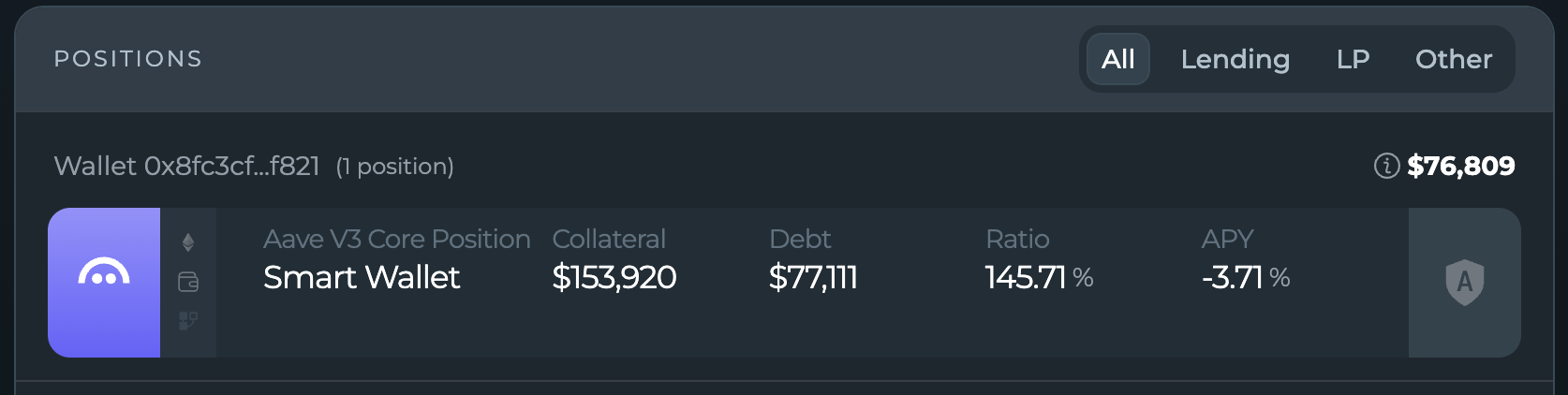
A position that takes one transaction and a minute of your time instead of five transactions and a spreadsheet. The second advantage is everything DeFi Saver does after you open: protecting the position on the downside while scaling it on the upside. Here’s what that looks like:
Stay Protected While Maximizing Returns with DeFi Saver

Automation helps traders maximize upside when positions move in their favor while protecting against liquidations when markets turn. It’s a critical risk-management feature that most lending protocols do not offer, and one that many traders don’t realize can be built on top of lending positions.
Let’s say you are long on WBTC:
Price drops below your floor → auto-Repay uses a slice of your collateral to pay down debt, pulling you back into the safe range before liquidation ever becomes a question
Price pumps above your ceiling → auto-Boost borrows more against the position and swaps it into more collateral, so your exposure grows with the trend
You give it a target range — for example, “if my ratio falls below 130%, Repay back to 145%; if it rises above 160%, Boost back to 145%” — and the system does two things autonomously:
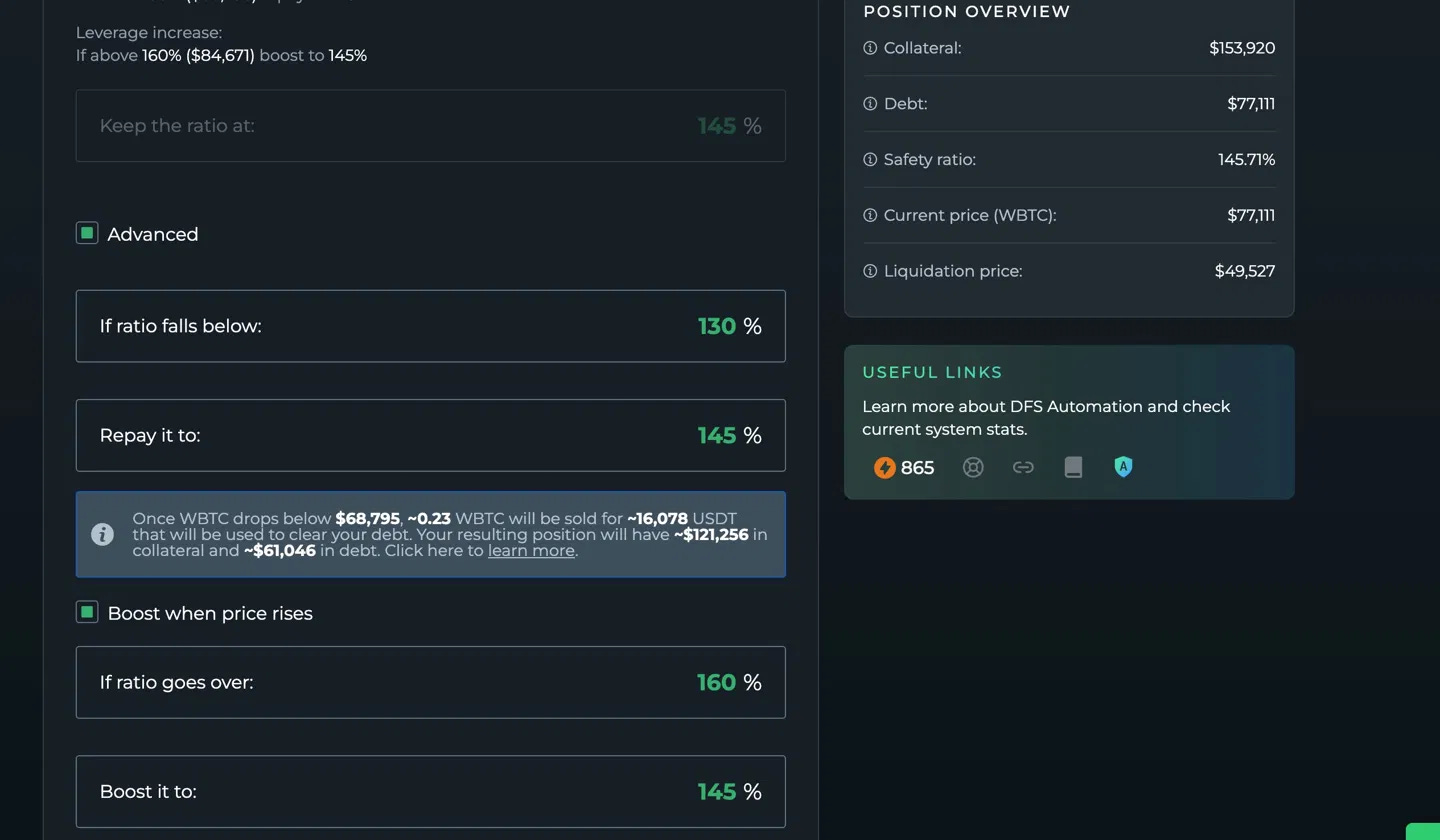
Set the ratio once, and the position scales itself on both sides. You can disable auto-Boost if you only want protection — most people start there and turn it on later.
This changes what a liquidation threshold means in practice. An unmanaged position drifts toward its threshold and hopes; an automated one gets steered back into range every time it slips.
Stop loss, take profit, trailing stop — on a lending position.
Stop Loss — fully close if the price drops below a level you set
Take Profit — fully close and lock in gains at a target
Trailing Stop — a dynamic stop that follows the peak and closes if the price retraces by your chosen percentage
No money market offers these natively. Through DeFi Saver, you can set a hard floor that fully closes the position, a target that locks in gains, or a trailing stop that follows the peak and closes only if the price retraces by your chosen percentage. Exchange-style exits, on a position that lives on Aave.
One-click position management.
Repay converts collateral into debt reduction in a single flash-loan transaction — six-plus manual steps collapsed into one. Full Close exits the entire position in one click, settling into either your collateral or the debt asset.
And Collateral Switch rotates your backing from, say, WBTC to ETH mid-trade in one transaction, with your directional bet staying live throughout — something that would normally mean unwinding and rebuilding the whole position. You can even set it to trigger at a price you choose.
One thing worth knowing about the instrument itself: these positions inherit the character of the underlying protocol. Liquidations on the lending protocols DeFi Saver integrates are usually partial — typically up to 50% of the debt on larger positions, though full liquidation is possible if health drops far enough — and prices come from oracles with deviation thresholds, so a thirty-second wick on one venue won’t necessarily move your liquidation math.
Loops cap out around 4–5x on major assets and are most comfortable at 2–4x, which fits how most conviction trades are sized: modest leverage, held for weeks. If your style calls for higher leverage, quick execution, or shorting, that’s what route two is for.
Trade Hyperliquid With More Control With DeFi Saver
Sometimes a perp is simply the right tool — higher leverage, instant execution, easy shorting.
DeFi Saver now has Hyperliquid built into the same dashboard, and the integration adds tools the native interface doesn’t have.

The headline is Trailing Stop Loss. Hyperliquid natively supports market, limit and conditional orders, but not trailing ones. Through DeFi Saver, your stop follows the position’s peak and closes it after a preset pullback — the same trailing logic available on lending positions, applied to perps. Trailing entries work too.
Funding the account is also simpler: you can deposit from Ethereum mainnet (or other supported networks) in basically any token, without manually bridging to Arbitrum first.
And because lending and perps now live in one interface, they can work together. The cleanest example: you’re long ETH via a loop on Aave and expect short-term chop — you can open an opposing Hyperliquid short directly from the lending position, in a few clicks, funded from your wallet or from the position itself. Hedged without touching the underlying trade.
Which route, when?
Use loops for high-conviction positions you want to hold for weeks or months. Use perps for higher leverage, short-term trades, or tactical shorts.
The advantage of DeFi Saver is that you don’t have to choose. Lending and perps live in the same dashboard, share the same automation layer, and can hedge each other when your short-term view differs from your long-term thesis.
Get Started Without Risking Real Capital
Never used DeFi Saver? Start with Simulation Mode — a sandbox with fake funds and no wallet needed. It’s the safe place to learn the core flows, though keep in mind not every feature is available there; some, like the automation strategies, you’ll only see live once you’re on-chain.
When you’re ready:
Pick the cheapest margin asset
Confirm slippage warnings before signing
Go to Automate and set up Automated Leverage Management
Optionally add Stop Loss, Take Profit, or Trailing Stop
The first transaction is the heaviest (Smart Wallet + approvals). Everything after that is fast and cheap.
<Do Leverage Trades Safer & Better on DeFi Saver>
Today in DeFi is proudly sponsored by DeFi Saver
New to leverage farming? Try DeFi Saver’s Simulation Mode at defisaver.com — or jump straight in via the Aave dashboard.
Follow @todayindefi to keep up with the latest DeFi news on Twitter.
Disclaimer: Projects or tokens mentioned in this newsletter are often experimental or unaudited. Do your own diligence before using or buying anything mentioned.