

Subscribe for daily free DeFi news covering launches, tradable catalysts, and actionable farming opportunities.
Today’s News Headlines:
- CLARITY Act Heads to Senate Floor
- Odos shuts down aggregator operations July 30
- BitMEX to cease operations in September
- Zilliqa discloses critical Ledger wallet vulnerability
- Axis opens institutional arbitrage vault onchain
- Zama launches encrypted trading venue beta
- VerusCoin bridge exploited for $7.5M
- Aave V4 deployment proposed for Tempo
- Covenant launches leveraged LP vaults on Monad

Find and execute the 15%+ stablecoin yields in minutes
Save time without checking every protocol manually. DeFi Saver’s Discover page surfaces rates across Aave, Morpho, Spark, and more, lets you simulate leverage before committing, and handles the full loop in one click. Stop leaving yield on the table.
<Discover Yields on DeFi Saver> | Today in DeFi is Supported by DeFi Saver
1. The big idea: getting paid to take on an obligation
If you hold crypto, you can just sit on it and hope it goes up. Covered calls and cash-secured puts are a different approach: you agree in advance to buy or sell at a specific price, and someone pays you cash today for that promise. That payment is called the premium, and it is the “yield” these products advertise.
The key thing to understand — and the part the marketing hides — is that you are the seller (the “writer”) of an option. You are not buying insurance; you are selling it. When Binance, OKX, or Bybit call these products “Sell High” and “Buy Low,” what you are actually doing under the hood is selling a call option and selling a put option, respectively. Understanding that you are short an option is the single most important mental model in this whole guide, because it tells you exactly how you make money (time passing, calm markets) and exactly how you get hurt (sharp moves against you).
There are two building blocks:
Covered call — you own the crypto and sell someone the right to buy it from you at a higher price. You get paid to cap your upside.
Cash-secured put — you hold stablecoins and sell someone the right to sell crypto to you at a lower price. You get paid to agree to buy the dip.
Both are income strategies, and both are what traders call “short volatility”: you collect a steady premium and quietly profit when nothing dramatic happens, in exchange for taking the pain when the market makes a big, fast move.
2. Options in five minutes
You already understand wallets, spot, perps, and funding rates. Options add a few new primitives:
Call option — the right (not obligation) to buy an asset at a set price.
Put option — the right to sell at a set price.
Strike price — the agreed price at which the buy/sell can happen.
Expiry/maturity — the date the option settles. Most crypto options are European-style (they can only be exercised at expiry, not before) and cash-settled (the difference is paid in cash rather than moving the actual coin).
Premium — the price of the option. The buyer pays it; the seller (you) receives it and keeps it no matter what.
Moneyness — an option is out-of-the-money (OTM) if exercising it would make no sense right now, at-the-money (ATM) near the current price, and in-the-money (ITM) if it already has intrinsic value. Option sellers generally sell OTM options.
Assignment — when the option you sold finishes ITM and you are forced to honor your obligation (sell your coin, or buy the coin).
Why crypto premiums are so juicy: the price of an option rises with implied volatility (IV) — the market’s expectation of how much the asset will move. Crypto is far more volatile than stocks, so crypto option premiums (and therefore the headline yields on these products) are much higher than anything in traditional finance. That is not free money: the yield is high precisely because the thing you are insuring against — a violent price move — happens more often in crypto.
3. Covered calls: earn yield on crypto you already hold
A covered call means you hold the underlying asset and sell an out-of-the-money call against it. It’s “covered” because if you get assigned, you already own the coin to deliver — you’re not caught short.
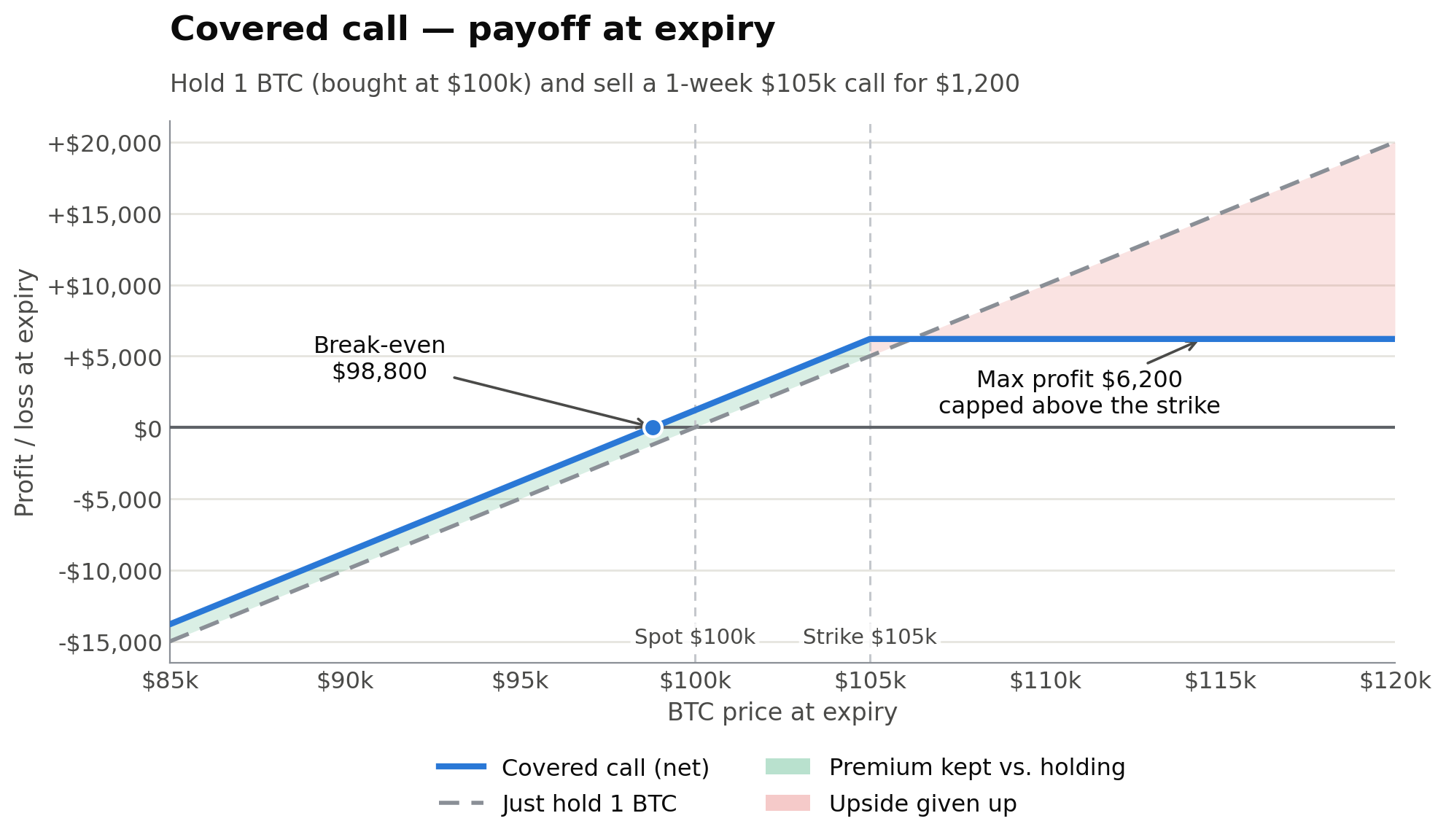
Suppose BTC trades at $100,000 and you own 1 BTC. You sell a 1-week call with a $105,000 strike (5% above spot) and collect a $1,200 premium (~1.2% of your position for the week).
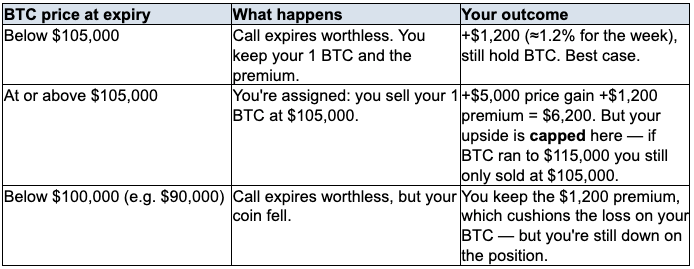
Who it’s for: someone who is neutral-to-mildly-bullish and genuinely willing to sell at the strike. The premium is your consolation for giving away the explosive upside.
The catch: your upside is capped, and you still eat the downside on the coin you hold (the premium is only a thin cushion). Covered calls underperform simply holding in a screaming bull market — this is exactly why Binance warns that its BTC Yield product “may underperform a direct holding of BTC, particularly in strongly rising markets.”
Where to do it
The simplest on-chain route is a packaged product: you choose the price you’d be happy to sell at and a short expiry, and the protocol writes the call and pays you the premium.

Rysk Finance lets you sell a covered call on ETH, BTC or HYPE directly to competing market makers — you pick the strike and expiry, and the premium lands in your wallet upfront (in USDT0). Non-custodial, on HyperEVM.
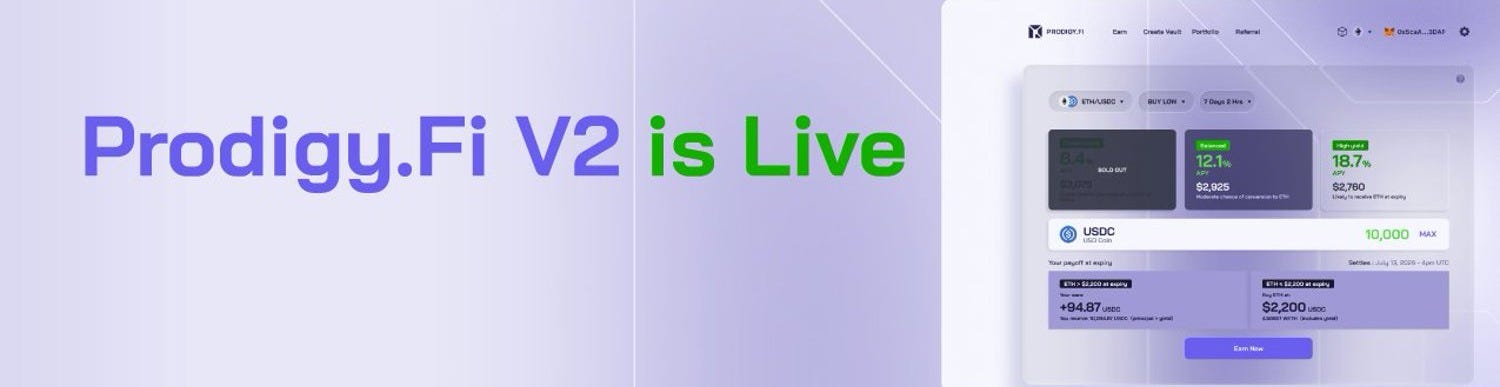
Prodigy.Fi offers “Sell High” dual-currency vaults on Base and Berachain: choose the target price and a short tenor and earn a fixed, quoted yield. Positions are fully collateralized, with no leverage and no liquidations.
You can also do this yourself on an options exchange — Derive on-chain, or Deribit — by writing the call from the full option chain, which gives you more control at the cost of more hands-on management (see Section 8). Whichever venue you use, the two dials that decide your yield and your odds of assignment — the strike and the expiry — work the same way, and Sections 5 and 6 cover how to set them.
4. Cash-secured puts: get paid to wait to buy the dip
A cash-secured put is the mirror image. You set aside stablecoins and sell an out-of-the-money put. It’s “cash-secured” because you’re holding enough cash to actually buy the coin if you’re assigned.
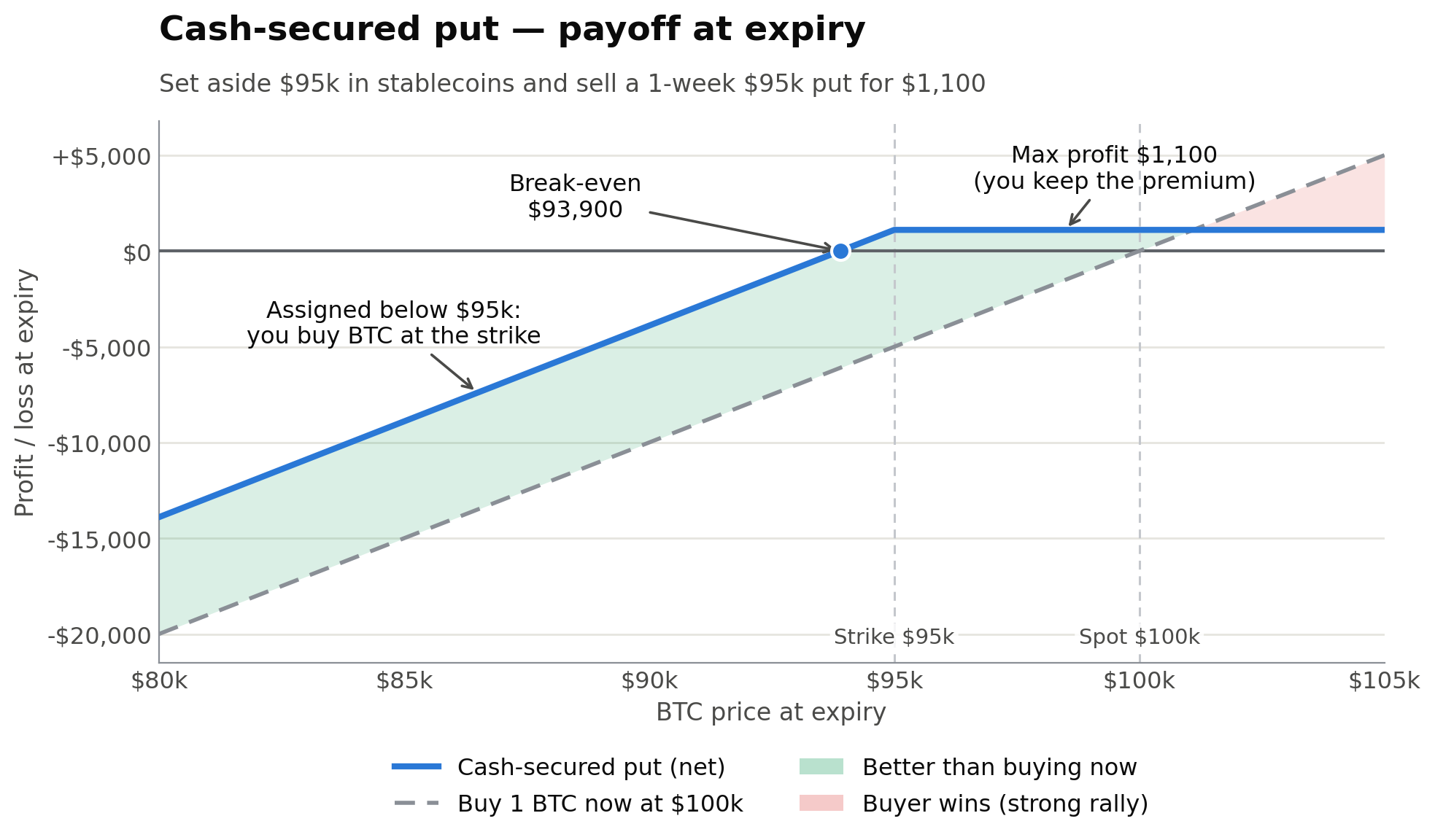
BTC trades at $100,000. You’d be happy to buy at $95,000. You set aside $95,000 in stablecoins and sell a 1-week put with a $95,000 strike, collecting an $1,100 premium (~1.16% for the week).
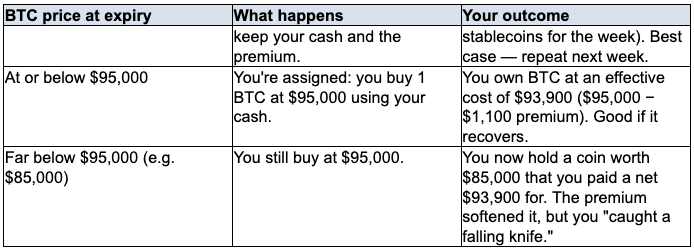
Who it’s for: someone who wants to accumulate a coin at a lower price and is happy to be paid while waiting.
The catch: when you get assigned, it’s usually because the market is falling — so you buy right as things look worst, and the price can keep dropping well below your strike.
Where to do it
The packaged route mirrors the covered call. You choose the price you’d be happy to buy at and a short expiry, and the protocol writes the put and pays you the premium up front.

Rysk lets you sell a cash-secured put by depositing stablecoins and naming your strike and expiry, with the premium paid to your wallet immediately (HyperEVM and Ethereum, non-custodial).

Prodigy.Fi offers “Buy Low” dual-currency vaults on Base and Berachain: set the price you’d buy at and a tenor, and earn a fixed yield whether or not you end up assigned.
Or write the put yourself on Derive or Deribit for full control over strike and expiry (see Section 8). Either way, how to choose that strike and expiry is covered in Sections 5 and 6.
The Wheel: combining the two
A popular systematic loop ties these together. You sell cash-secured puts until you get assigned and end up holding the coin. Then you switch to selling covered calls against that coin until it gets called away, leaving you back in cash. Then you sell puts again. Round and round — hence “the wheel.” It’s just covered calls and cash-secured puts run back-to-back, and every leg collects premium.
5. Choosing your strike price
Strike selection is the main dial you control, and it’s a single, unavoidable trade-off: more premium versus more risk of assignment.
Strike far from spot (deep OTM): smaller premium, but a lower chance of being assigned — for a covered call that means more room to enjoy the coin’s rise; for a put, a bigger discount before you’re forced to buy.
Strike close to spot (near ATM): fat premium, but a high chance of assignment. You’re getting paid more precisely because you’re more likely to have to sell your coin (or buy the dip).
Delta as a cheat code: an option’s delta doubles as a rough estimate of the probability it finishes in-the-money. A call with 0.25 delta has roughly a 25% chance of being assigned. Income sellers often live in the ~0.15–0.30 delta zone — meaningful premium, but assignment only maybe 1 in 4 or 1 in 6 times. Packaged products that hide the Greeks just show you a target price and an APR instead; the same trade-off is still there, you just read it off the yield.
The honest question to ask yourself:
For a covered call: “At what price would I genuinely be happy to sell this coin?” Sell the call there. If you’d hate to part with it below $120k, don’t sell a $105k call for a bit of extra yield.
For a cash-secured put: “At what price would I genuinely be happy to buy?” Sell the put there. Assignment should feel like a win, not a trap.
Don’t get hypnotized by APR. A near-ATM weekly that shows 120% APR is advertising how likely you are to get assigned. High yield is compensation for high risk, every single time.
6. Choosing your maturity (expiry / tenor)
The second dial is how far out you sell. Crypto venues span everything from 1-day to multi-month.
Short-dated (1–7 days) — the norm for packaged dual-currency vaults and short-dated on-chain products. Premium decays fast in your favor (see theta below), annualized yields look enormous, and you reset your view often. The costs: you make a decision every few days, and you’re more exposed to a sudden move right near expiry (”gamma risk”).
Longer-dated (weeks to months) — available on Deribit, Derive, and Rysk. Bigger absolute premium up front, far less babysitting, but your capital is committed longer and the price has more time to wander through your strike.
Absolute vs annualized: a 1%-a-week premium annualizes to something eye-watering (~50–70%+), but only if you successfully roll it ~52 times a year and never get run over. Two bad assignments can erase months of premium. Judge these products on a full-cycle basis, not on the best-week screenshot.
Watch the calendar: selling an option that expires right after a known catalyst (a major macro print, an unlock, a token launch) pays more because the risk is real. Don’t sell through an event unless you specifically want that bet.
7. The Greeks — and how price moves change what you sold
The “Greeks” measure how an option’s value responds to different forces. You don’t need the math, but as a seller you should know that you are short the option, so the signs flip relative to a buyer. Here’s what matters:
Delta — sensitivity to the underlying price, and (handily) a proxy for assignment probability. This is the first-order effect: as spot moves toward your strike, the option you sold gains value and assignment gets more likely.
Theta (your friend) — time decay. Every day that passes, an OTM option loses a little value. Since you sold it, that decay is your profit. Theta is the engine of the entire yield. It accelerates as expiry approaches, which is why sellers love short tenors.
Vega (your enemy) — sensitivity to implied volatility. If IV spikes (panic, a violent move), the option you sold jumps in value — a mark-to-market loss for you, and a higher chance of assignment. You want calm or falling volatility. You are “short vega.”
Gamma (the whipsaw) — how fast delta changes. Sellers are “short gamma,” which bites hardest near the strike close to expiry: a small price move can flip you from safe to assigned very quickly.
Rho — sensitivity to interest rates. Minor for the short-dated crypto trades most of these products use; safe to mostly ignore.
How underlying price movement changes the value of the instrument you sold: remember that the “instrument” is an option you are short, so rising option value is bad for you (you’d have to pay more to buy it back, and you’re closer to assignment) while falling option value is good (it decays toward zero and you keep the full premium). This table sums up the forces:

In one sentence: you are rooting for boring, sideways, low-volatility markets and the steady passage of time; your enemy is a big, fast move — especially one that accelerates as expiry approaches.
8. Doing it yourself: options exchanges (the manual route)
The packaged products in Sections 3 and 4 are the easy on-ramp: pick a strike (or target price) and an expiry, and the protocol writes the option for you. If you want full control — any strike, any expiry, and the ability to roll or close whenever you like — you sell the option yourself on an options exchange. It’s more hands-on, but you set every parameter and can manage the position actively.
Derive (formerly Lyra) is the largest on-chain options exchange — a hybrid order-book-plus-AMM running on its own Optimism-stack L2 (Derive Chain). You pick any listed strike and expiry, sell the call or put, and post margin; options are European and USDC-settled, on BTC, ETH, SOL and HYPE. It’s non-custodial with no KYC (though the front-end geoblocks the US and Australia). If you want a middle ground between fully manual and fully packaged, Derive also runs automated yield vaults.
Rysk sits between packaged and manual: you still choose the strike and expiry, but you request a quote and market makers fill you, with the premium paid to your wallet upfront (in USDT0) on HyperEVM. It’s a good option if you want to name your own terms without babysitting an order book.
Deribit is the heavyweight if you want maximum liquidity: it is the dominant crypto options venue (consistently around 85%+ of global BTC options open interest), so pricing is tight and size is deep. You sell OTM calls or puts from the full chain; options are European and cash-settled. The trade-offs are that it is centralized and custodial, requires KYC, and restricts some jurisdictions (US clients now route in via Coinbase Financial Markets as of May 2026).
How a manual covered call actually goes: pick an expiry, choose an out-of-the-money strike (use delta as your guide — see Section 5), sell/write the call, and collect the premium immediately. At expiry it either expires worthless — you keep the premium and the coin, and can sell another — or it finishes in-the-money and you’re assigned, delivering the coin at the strike. A cash-secured put is the mirror: sell an OTM put, hold the stablecoins, and either keep the premium or get assigned and buy the coin. If you want to dodge an impending assignment, you “roll” — buy the option back and sell a new one further out in time or strike.
A note on centralized “Dual Investment” products
Centralized exchanges package these exact trades for retail. Binance, OKX, and Bybit all sell “Sell High” (covered-call) and “Buy Low” (cash-secured-put) products under a “Dual Investment” or “Dual Asset” label, and Binance recently launched a managed covered-call vault called BTC Yield. They’re liquid, need no wallet or gas, and are genuinely simple to use.
The catch is that they are custodial and KYC’d, geo-restricted (generally no US access), not principal-protected, and they often take a cut of the premium or limit which strikes and expiries you can choose — and you are still the option seller carrying exactly the risks this guide describes (capped upside on a call, buying a falling knife on a put). Because our focus is on-chain and self-custodial, we don’t cover them in depth here — but if you understand the DeFi versions above, you already understand these.
9. A practical checklist before you sell your first one
Only sell calls at a price you’d be happy to sell, and puts at a price you’d be happy to buy. If assignment would upset you, your strike is wrong.
Respect the asymmetry. These strategies win small and often, and lose big and rarely. Size positions so one bad week can’t wreck you.
Read the headline APR as a risk gauge, not a promise. Higher advertised yield = higher probability of assignment, always.
Vet the protocol. Prefer audited, battle-tested contracts and understand exactly where your collateral sits — several earlier DeFi option vaults suffered exploits or heavy losses. In DeFi the smart-contract risk is yours.
Know your custody model. On a centralized venue your coins sit with the operator (counterparty risk). On-chain they sit in a smart contract (contract/oracle risk). Pick your poison consciously.
Mind the fine print: not principal-protected, platform cuts of your premium, slippage tolerances, lock-ups, and no early exit on many packaged products.
Check access & taxes for your jurisdiction — KYC, geo-restrictions, and how premium income is taxed where you live.
Start small. Run one cycle end-to-end, ideally including one assignment, before scaling up. Assignment is a feature of these strategies, not a bug — but you want to feel it once while the stakes are low.
10. Glossary
Premium — the cash you receive for selling the option; the “yield.”
Strike — the agreed buy/sell price.
Expiry / maturity / tenor — when the option settles / how long until it does.
OTM / ATM / ITM — out-of / at- / in-the-money.
Assignment — being forced to honor the option (sell your coin, or buy the coin).
Implied volatility (IV) — the market’s expected movement; the main driver of premium.
Short volatility — a position (like these) that profits from calm and loses from big moves.
The Greeks — delta (price), theta (time), vega (volatility), gamma (rate of delta change), rho (rates).
The Wheel — selling cash-secured puts until assigned, then covered calls until called away, repeatedly.
Educational content only — not financial advice, and not a recommendation of any protocol or venue. Selling options carries real risk of loss, including being forced to sell below market or buy above it. Details change quickly in crypto; verify current terms on each venue before trading. As of July 2026.