

Subscribe for daily free DeFi news covering launches, tradable catalysts, and actionable farming opportunities.
Today’s News Headlines:
Aave added leverage to its V4 Ethereum and Avalanche markets on Aave Pro. Users can now open a leveraged position in a single step.
Fluid paused swaps after a security review using Mythos 5.2. Lending, borrowing, withdrawals, and liquidations still work, and Fluid says funds are safe.
Pump.fun announced a “block0 fee” on its launchpad starting Dec. 4. The fee is meant to stop sniping so traders get a fairer shot at buying new tokens.
Jupiter added Meria, a European institutional staking provider, to its JupSOL validator set. The move brings institutional staking into Solana liquid staking.
Citrea opened a cBTC Earn Vault that pays early depositors 60% APY with CTR incentives. cBTC is Citrea’s trust-minimized BTC on its Bitcoin layer.
Rabby added TWAP and scaled orders to its perps trading. TWAP splits a large order over time, and scaled orders spread it across prices.
BNB Chain released a litepaper for a new Layer 1 built for trading, payments, and AI agents. It won’t have its own token, since it uses BNB.

Find and execute the 15%+ stablecoin yields in minutes
Save time without checking every protocol manually. DeFi Saver’s Discover page surfaces rates across Aave, Morpho, Spark, and more, lets you simulate leverage before committing, and handles the full loop in one click. Stop leaving yield on the table.
<Discover Yields on DeFi Saver> | Today in DeFi is Supported by DeFi Saver
TL;DR
ETH fell 27% (Oct 27–Nov 25). DeFi fees fell 11%, launchpad volume 43% and spot DEX fees about 30%.
Hyperliquid’s fees rose 30% to $101.6M. Its stock and index perps roughly doubled and are now about 29% of its volume.
Prediction markets held up. Kalshi grew 22%, while Polymarket’s volume held steady and its international revenue rose 19%.
Derive grew options volume 19% to $3.82B while rivals shrank, lifting its share from 64% to 78%.
The common thread: traders moved from buying tokens to trading price moves, events and non-crypto assets. Each section covers how to use the project and what can go wrong.
The selloff hit token buying hardest
ETH went from $2,321 to $1,691, and Bitcoin fell 25%. Stablecoin supply has shrunk for seven weeks in a row, and perps open interest fell 32%. The worst hit were the token-buying activities: launchpads (−43%), trading apps (−59%) and spot DEX fees (−30%, on volume that actually rose 5%).

Three projects grew anyway. All three serve traders who want something other than a crypto token: US stocks, real-world events and options. We checked each week by week, so the growth held after the crash.
All comparisons: Oct 27–Nov 25 vs Sep 27–Oct 26, from DefiLlama and each project’s own data unless noted.
1. Hyperliquid: stock perps doubled
Hyperliquid’s perps fees rose 30% to $101.6M, 57% of all perps fees DefiLlama tracks, even as its open interest fell 36%. (The perps sector looks down 7.5% overall, but that’s one venue: Papertrade’s fees fell from $65.7M to $12.6M after its October launch spike. Without it, perps fees rose about 31%.)
The growth came from builder markets (HIP-3), which third parties deploy. The biggest is trade.xyz, with about 98% of builder volume, listing mostly stocks, indices and commodities. Builder volume rose 87%, and its stocks and indices roughly doubled. On Nov 25, stock-linked contracts were about 27% of all Hyperliquid volume.


How to use it:
Trade stock perps. Check the builder prefix, because the same ticker can have different rules on different builders (on Nov 27, Nvidia allowed 10x on trade.xyz and 25x on Entropy). They’re cash-settled: price exposure, not shares. trade.xyz and Entropy exclude US persons.
Earn from the venue. HLP, Hyperliquid’s own vault, showed 14.97% APR on Nov 27. It has a 4-day withdrawal lock, and depositors take losses when it loses; its largest daily drop from Sep 28 to Nov 27 was about 0.31%.
Risks:
Weekends: these trade 24/7 while stocks don’t, so you can be liquidated over a weekend or at the open.
Oracle errors: a thin Korean pre-market trade moved trade.xyz’s SK Hynix price in July and triggered liquidations.
Leverage: at 50x on an index, a move under 2% liquidates you.
<Trade stock perps on trade.xyz>
2. Prediction markets: Kalshi grew 22%, Polymarket held steady
Kalshi grew the most: its volume rose about 21% to $19.3B (DefiLlama). But it’s a regulated US exchange, not onchain, so most readers can’t use it.
Polymarket, the onchain leader, held steady on volume, but its international revenue rose 19%, and it takes about 94% of tracked prediction-market fees. Its weekly fees rose almost every week from late September, dipped once in the crash, and recovered.

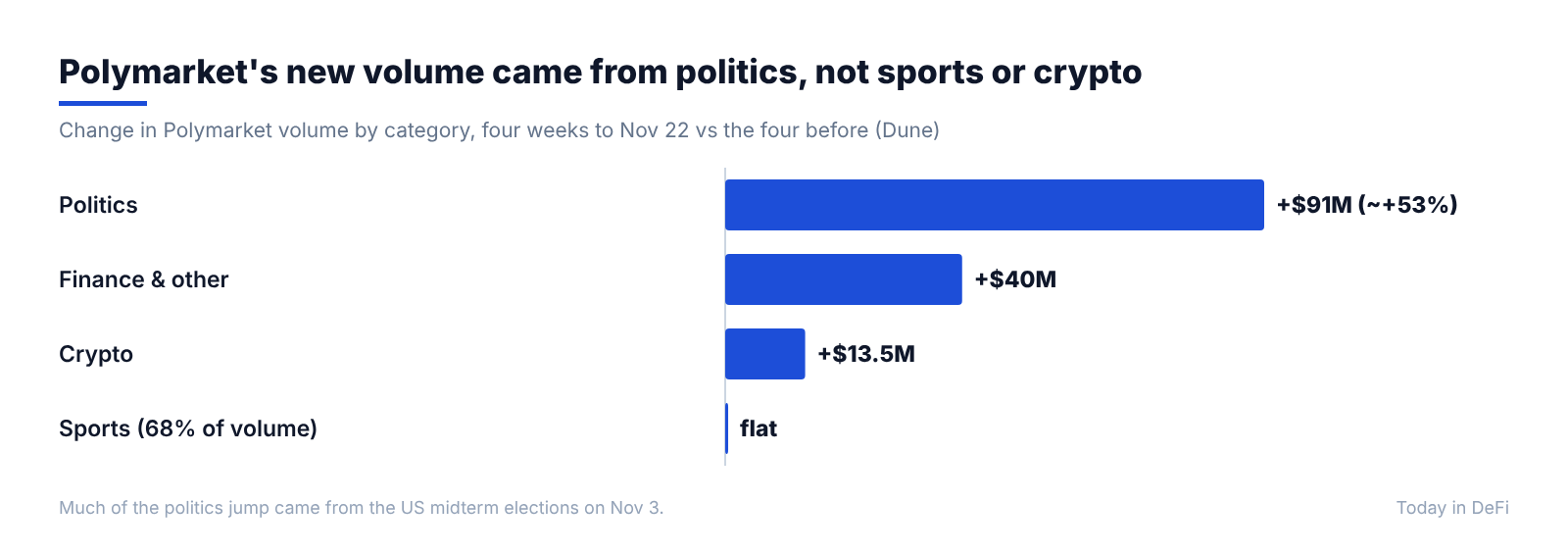
Sports is its biggest category but isn’t growing, accounting for about half of Polymarket International’s volume over the last two weeks. The extra activity this month came from politics, around the Nov 3 midterms.
How to use it:
Use the right platform. US users need a separate, regulated US exchange and must confirm their state allows the contract. The international platform excludes the US, Taiwan, and others.
Read the rules before you buy. A winning share pays $1 and a losing one $0, so the named source, the deadline, and the exact wording decide everything.
Risks:
Disputes: an outcome can be challenged within two hours and go to a UMA vote, which delays payouts.
Access can change fast: Michigan stopped new sports contracts on Oct 28, and Louisiana restricted event contracts on Nov 13.
No token yet: a POLY token was confirmed in 2025, but nothing is scheduled. Fake airdrop links are common.
<Open Polymarket>
3. Derive took the growth in on-chain options
On-chain options grew just 5.2% to $4.87B, while Derive grew 19%, from $3.20B to $3.82B. That’s more than all of the sector’s growth: Paradex fell 31% and Pacifica 7%. (DefiLlama shows Derive V3 alone at +87%, but that’s its migration from the older version. Both versions together grew 19%.)

Derive has also listed non-crypto options: gold, Nvidia, the S&P 500, the Nasdaq-100, WTI crude, and Anthropic. They’re still small, so the move to stocks seen on Hyperliquid is just getting started.
How to use it:
Buy options to cap your risk. Pick the underlying, expiry, strike and call or put. Buying limits your loss to the premium; selling covered calls earns the premium but gives up gains above the strike. On the new markets, check order-book depth first.
Hedge without liquidation (an example, not a recommendation). Holding 10 ETH and worried about a drop? A perps short covers the downside, but cancels your upside, costs funding and can be liquidated. A put about 10% below today’s price costs a one-time premium, covers losses beyond the strike, and keeps your upside.
Vaults are too new to judge. Check each vault’s size, withdrawal cooldown and fees before depositing.
Risks:
Thin markets: volume is concentrated in BTC and ETH, and Anthropic options have traded only a few dozen times.
Sellers can lose big on sharp price or volatility moves, and vault cooldowns slow your exit.
What shrank
Launchpads: volume −43%, fees down 44–50%.
Spot DEXs: volume +5%, but fees −30%, likely as trading moves to low-fee venues such as the prop AMMs in our Metric Guide.
Jupiter Perps: fees doubled during the two crash weeks, then fell back to about $3M a week. Busy in the crash, but not a trend.
What would change our view?
Hyperliquid builder volume falls back toward its October level (about $16B a week).
Polymarket’s weekly fees drop below about $26M, or its revenue fades now that the midterms are over.
Derive’s options share slips, or Paradex recovers.
trade.xyz runs into trouble. It carries about 98% of builder volume.
Regulators act: New York’s suit against Polymarket US is pending, and onchain stock perps are a gray area for US users.
If those hold, the activity that survives this market is trading stocks, events, and options onchain, not buying new tokens. We’ll track all three in the Onchain Outlook.
Data: DefiLlama, Hyperliquid API, Keel, Dune, Derive, and Polymarket docs. Figures checked Nov 26–27, 2026.
Follow @todayindefi to keep up with the latest DeFi news on Twitter.
Disclaimer: Projects or tokens mentioned in this newsletter are often experimental or unaudited. Do your own diligence before using or buying anything mentioned.