


Subscribe for daily free DeFi news covering launches, tradable catalysts, and actionable farming opportunities.
Key Takeaways:
Regime: Neutral, crypto lagging.
Cool CPI drove equities and gold to records, but Bitcoin held near $63K — the fifth straight week a risk-on backdrop skipped crypto. ETFs bled $56M, and supply stayed flat. Ether was the exception, outholding Bitcoin on ETF flows and exchange reserves.
Capital is flowing into yield
Yield-bearing dollars led every inflow — USYC +$391M, USDY +$311M — while USDC posted the week’s largest outflow at −$400M. On-chain, Monad and Robinhood Chain grew through the same incentivized loops, but the fresher stories sit lower: a Korean consumer wallet pulling deposits on 7% USDT, and reinsurance- and RWA-backed collateral proving borrowable across the ONyc stack.
Projects to watch:
Cap deposits crossed $100M, +87% in the month — the cleanest fundamental catalyst. Ether.fi launched its crypto neobank with token buybacks funded from every revenue line, a genuine re-rating.
What to watch this week:
Wednesday’s FOMC minutes are the main catalyst — a hawkish read revives rate-hike risk. Treasury’s promised “unprecedented” Iran sanctions land the same week and could firm up oil prices.

Find and execute the 15%+ stablecoin yields in minutes
Save time without checking every protocol manually. DeFi Saver’s Discover page surfaces rates across Aave, Morpho, Spark, and more, lets you simulate leverage before committing, and handles the full loop in one click. Stop leaving yield on the table.
<Discover Yields on DeFi Saver> | Today in DeFi is Supported by DeFi Saver
1) This Week’s Signal: The Rotation Into Yield Went Fully Clean
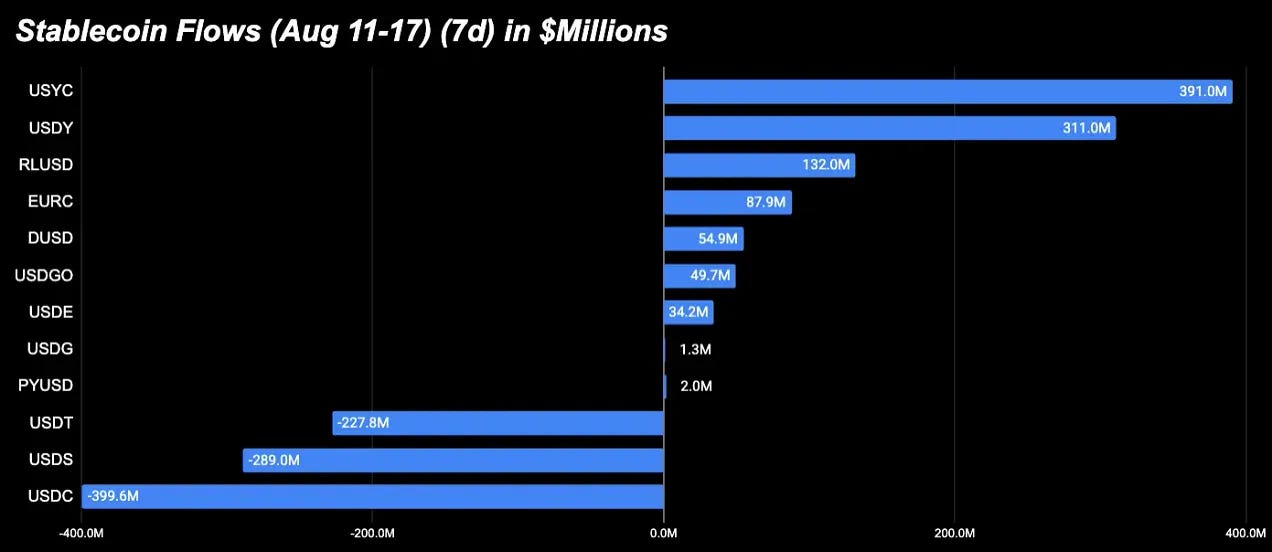
For three weeks the dollars entering crypto have preferred yield over settlement. Every stablecoin that gained was yield-bearing or treasury-backed, and every meaningful loser was a plain settlement dollar.
USYC (+$391M) and USDY (+$311M) topped the board for the third straight week, with RLUSD (+$132M), EURC (+$87.9M) and USDe (+$34.2M) behind them. On the other side, the three largest deployment dollars all shrank: USDC led all outflows at −$399.6M, with USDS (−$289M) and USDT (−$227.8M) following.
USDC is the tell. It grew $338.6M last week and is the single largest loser this week — a hard reversal for the main deployment dollar, in the same week ETF flows turned red. This isn’t capital favoring yield at the margin. It’s capital actively leaving the settlement layer for instruments that pay.
The reason is structural, not a one-week mood. Since the GENIUS Act barred payment-stablecoin issuers from paying yield, large holders have no reason to park idle balances in non-yielding USDC or USDT when tokenized treasuries return 4%+. The same rotation shows up on-chain in the ONyc stack below, where reinsurance- and RWA-backed collateral is being levered rather than just held — and it’s the same fight now holding up the CLARITY Act in the Senate. The regulation and the flow are one story.
What it means: the on-ramp isn’t refilling with deployable capital. Money is present but parked in yield, which is why a friendly macro week keeps failing to move crypto price.
2) Risk Regime: Rates Back Up, ETH Outperformed BTC in Flows
Total stablecoin supply 7d change +$29.84M (+0.01%), to $300.8B
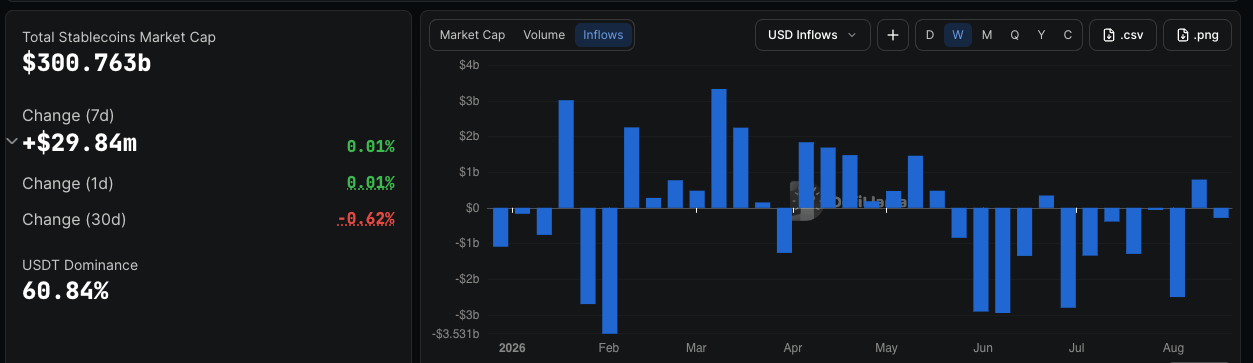
Flat. Supply was essentially unchanged after last week’s $873M expansion — a second week of stabilization rather than a resumption of contraction.
Aave / Sphere Rates: funding snapped back up, credit flat.
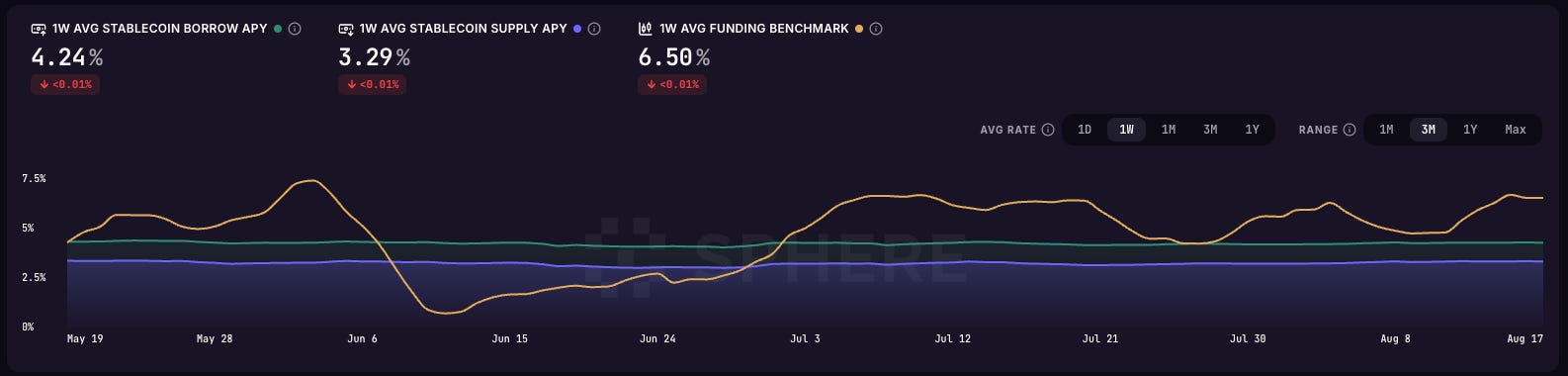
Sphere’s borrow (4.24%) and supply (3.29%) APYs held unchanged, but the funding benchmark jumped to 6.50% from 4.58% last week, blowing the spread over borrow back out to ~2.26pp. The leveraged-long premium that came off a week ago returned in full.
ETF flows - BTC turned negative; ETH held its ground
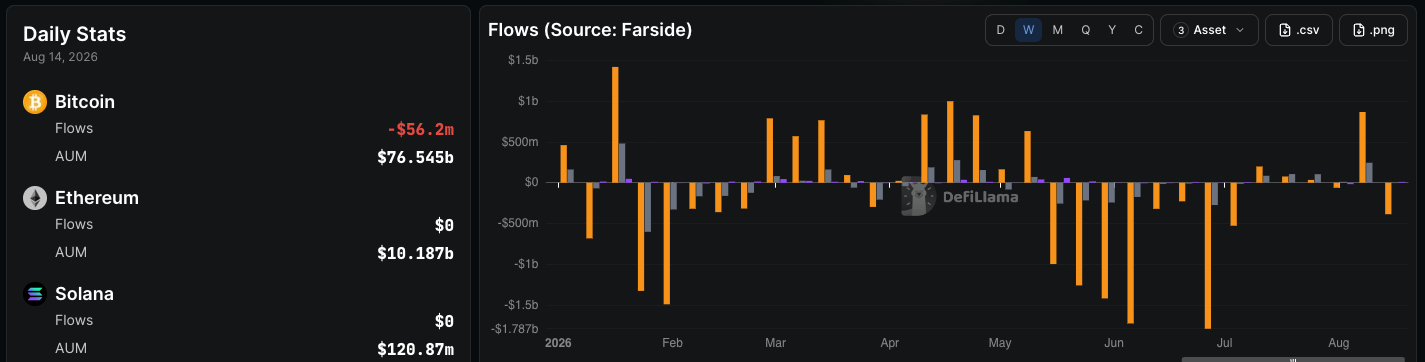
Spot Bitcoin ETFs reversed to red, a $56.2M outflow that erased the momentum from last week's $853M haul. Ethereum ETFs held roughly flat near zero — no longer adding at the prior weeks' pace, but not bleeding the way bitcoin did. The regulated bid didn't rotate toward ETH so much as it rotated away from BTC, and ETH was the one that didn't crack — the same relative-strength pattern the exchange reserves show below.
Centralized Exchange Flows: The BTC/ETH divergence widened.

Bitcoin reserves climbed to ~2.735M as the price fell to ~$63.3K; Ethereum reserves continued to fall to 15.1M as ETH left exchanges. Off-exchange accumulation is the constructive read, and it’s been ETH’s for a month.

On the bitcoin side, rising reserves normally signal selling — but three hardware wallet scares in a month (Coldcard, Trezor, SafePal) may be pushing coins onto exchanges for custody reasons rather than for sale.
ETH to BTC Comparison: Holding the Reclaim
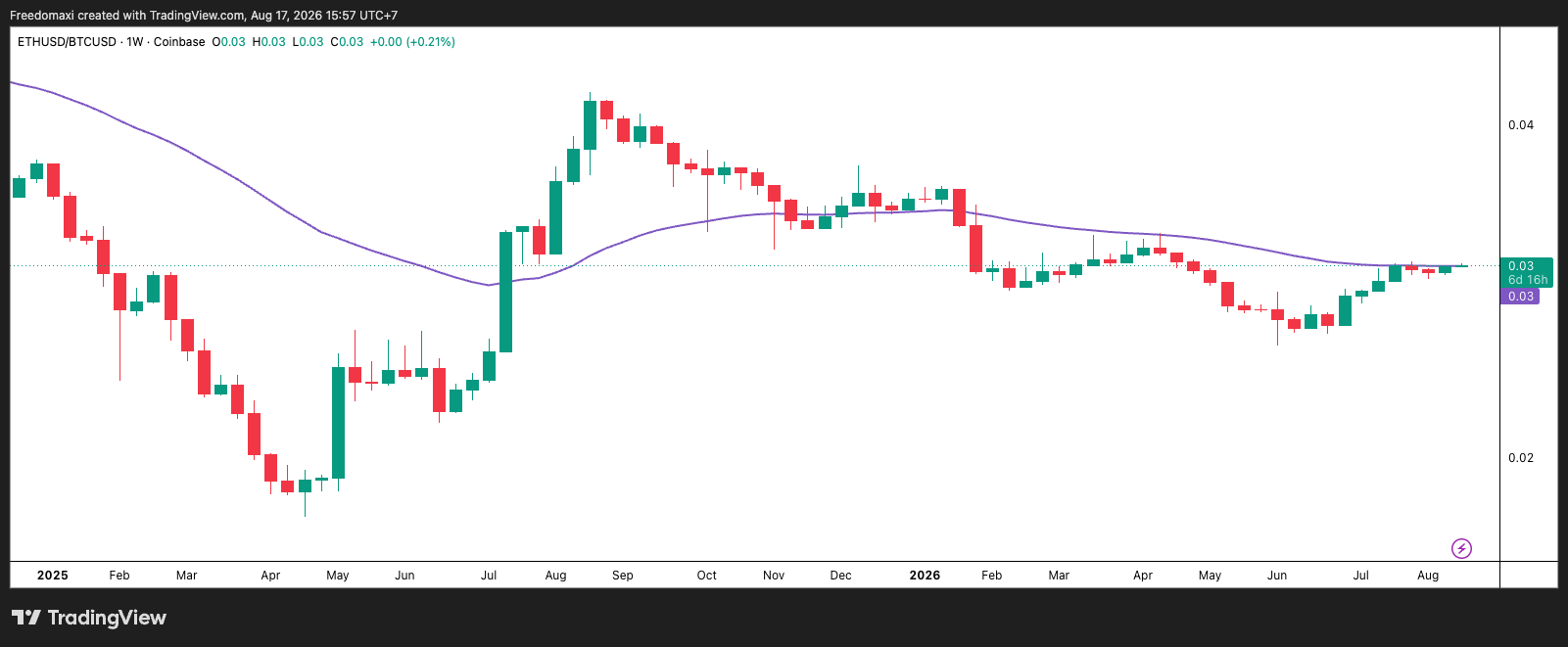
The ratio closed above its flattened 20-week average again; the reclaim from July is now holding roughly six weeks — consistent with ether continuing to leave exchanges.
Macro in 3 Lines
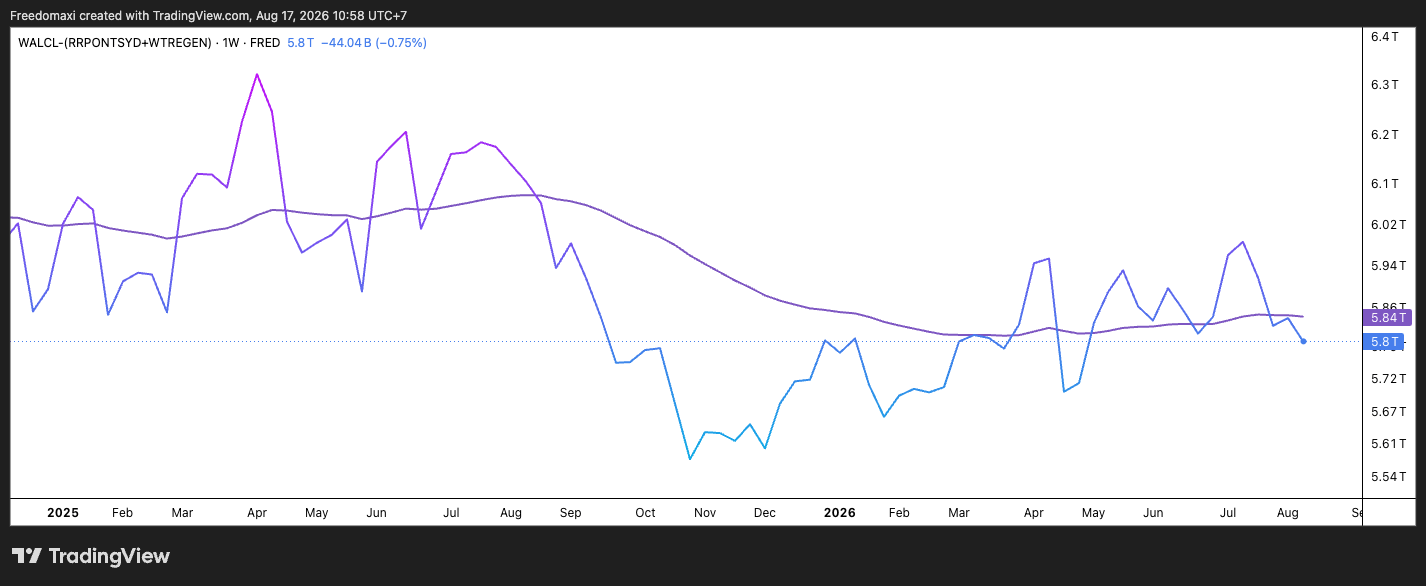
Liquidity: net liquidity slipped 0.75% back below its 20-week average — the one macro gauge that actually moved.
The print: cool July CPI (3.4% headline, 2.5% core) cut September hike odds to ~34% and sent the S&P and Russell 2000 to records — but bitcoin closed lower and lost ground even to gold, the fifth straight week a risk-on tailwind skipped crypto.
Watch this week: Wednesday’s FOMC minutes are the main catalyst — a hawkish read revives hike risk. Treasury’s promised “unprecedented” Iran sanctions land the same week and could firm oil.
3) Chain Flows: Incentivized Loops Are Doing the Heavy Lifting

Monad — $715.2M (+$54.0M 7d, +$152.2M 30d)
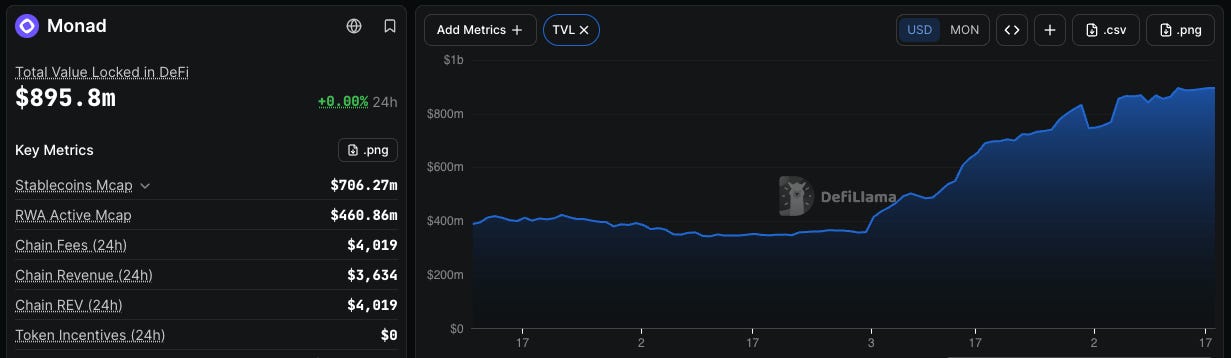
Cheap borrows against yield-bearing collateral. Aave ($660M market) anchors it, with Maple's syrupUSDC ($198M, collateral-only) as the base of the loop; Merkl incentives keep borrow costs at 3.4–3.9%, making the carry against syrupUSDC's native yield profitable. That pulled in the week's biggest single inflow, USDT.
Robinhood Chain — $640.1M (+$57.9M 7d, +$244.1M 30d)

Largest absolute gainer, with both sides of the loop now paid. USDe (+$34.3M) outgrew USDG (+$22.1M) because Ethena now pays 4.5% for posting USDe as collateral, on top of the Steakhouse vault’s 7% on USDG — so users are incentivized to supply and to lever. Lighter’s perp platform (+$20.7M) added a genuinely different demand source, taking tokenized stocks like SPY as collateral.
Morph — Exchange-Wallet Distribution Keeps Compounding a Small Base
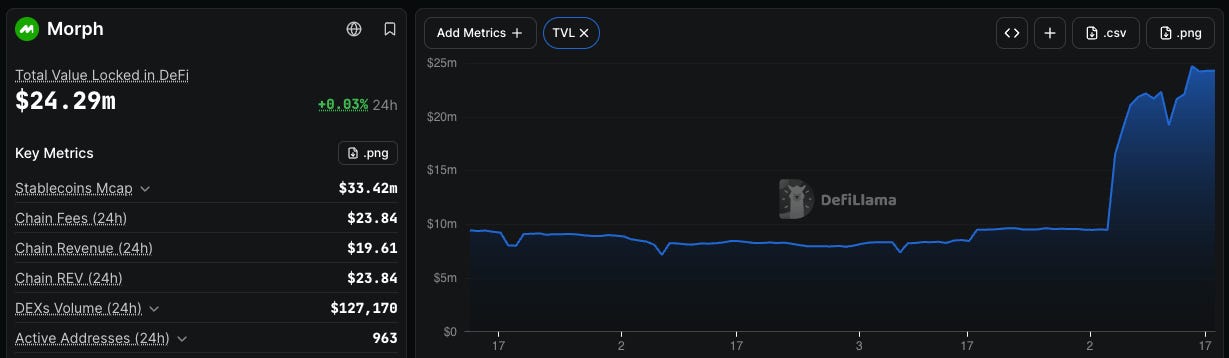
Stablecoin market cap: $35.4M | +$4.9M (7d) | +$20.5M (30d)
Morph remains the smallest chain in the cohort and the most concentrated: every dollar of growth is USDC, with USDT flat at $7.1M. The chain’s stablecoin base has more than doubled over 30 days on a single distribution channel. This week’s increment came from Bitget Wallet launching a USDC Earn Vault with Morpho on August 11, paying up to 10% APY with one-tap subscription, no minimum period, and anytime withdrawal (Bitget Wallet, August 11); Morph amplified the launch as the ecosystem’s default home for idle USDC (Morph, August 11).
The pattern is consistent with the Gauntlet vault launch that drove the prior month’s growth — Morph is compounding through one retail funnel rather than diversifying its depositor base, so the pace should continue to track Bitget distribution and the incentive budget behind it.
4) Structural Shifts: Fomo Is Eating Share in a Shrinking Market
fomo is the fastest-growing trading front end in crypto, and it is growing in a shrinking market. Solana swap volume rose from ~$8M/day in early June to $48.5M on 13 August (~4.5x) while Solana DEX volume fell ~30%; weekly fees hit a record $3.2M.
Pump.fun is still an order of magnitude larger (PumpSwap ~42% of Solana DEX volume; $34M launchpad fees) but flat since June, and is now copying fomo’s feed and reportedly paying its top traders to switch. fomo’s growth is real and clean (no token, no incentives) but rests on a KOL migration wave, small tickets paying 1-2% effective fees, and a live memecoin cycle. Volume was back to $23.6M by 15 August.
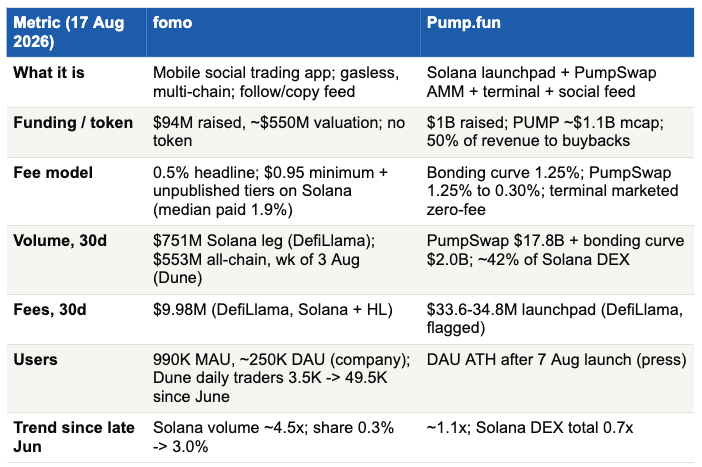
What’s driving Fomo’s growth:
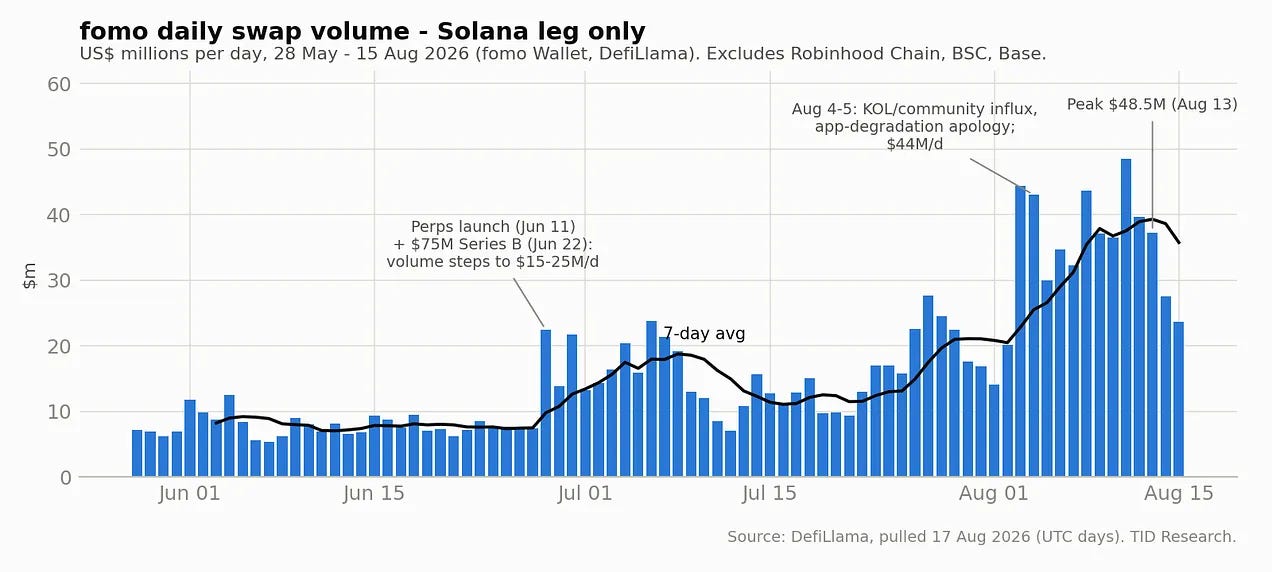
Three inflections: late June (after perps and the Series B); 4-5 August (to $44M/day, ‘the largest influx of users to date’ per the co-founder); the 13 August peak, then a slide. Drivers, by strength of evidence: KOL crews moving audiences into the in-app follow graph (Dune daily traders 19.9K to 49.5K in four weeks); product cadence; Robinhood Chain and BSC memecoin cycles; airdrop expectation.
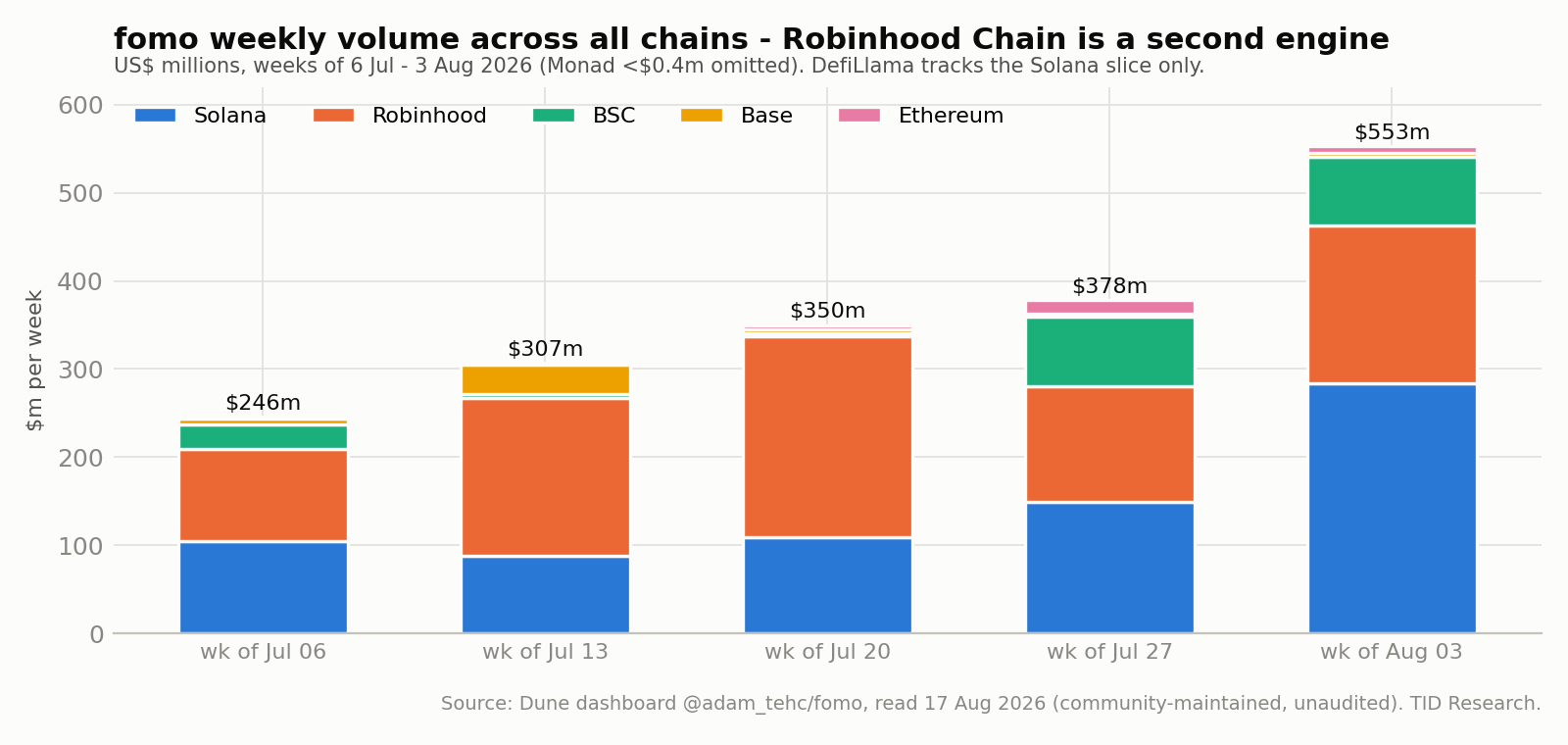
Figure 2. fomo weekly volume, all chains (Dune).
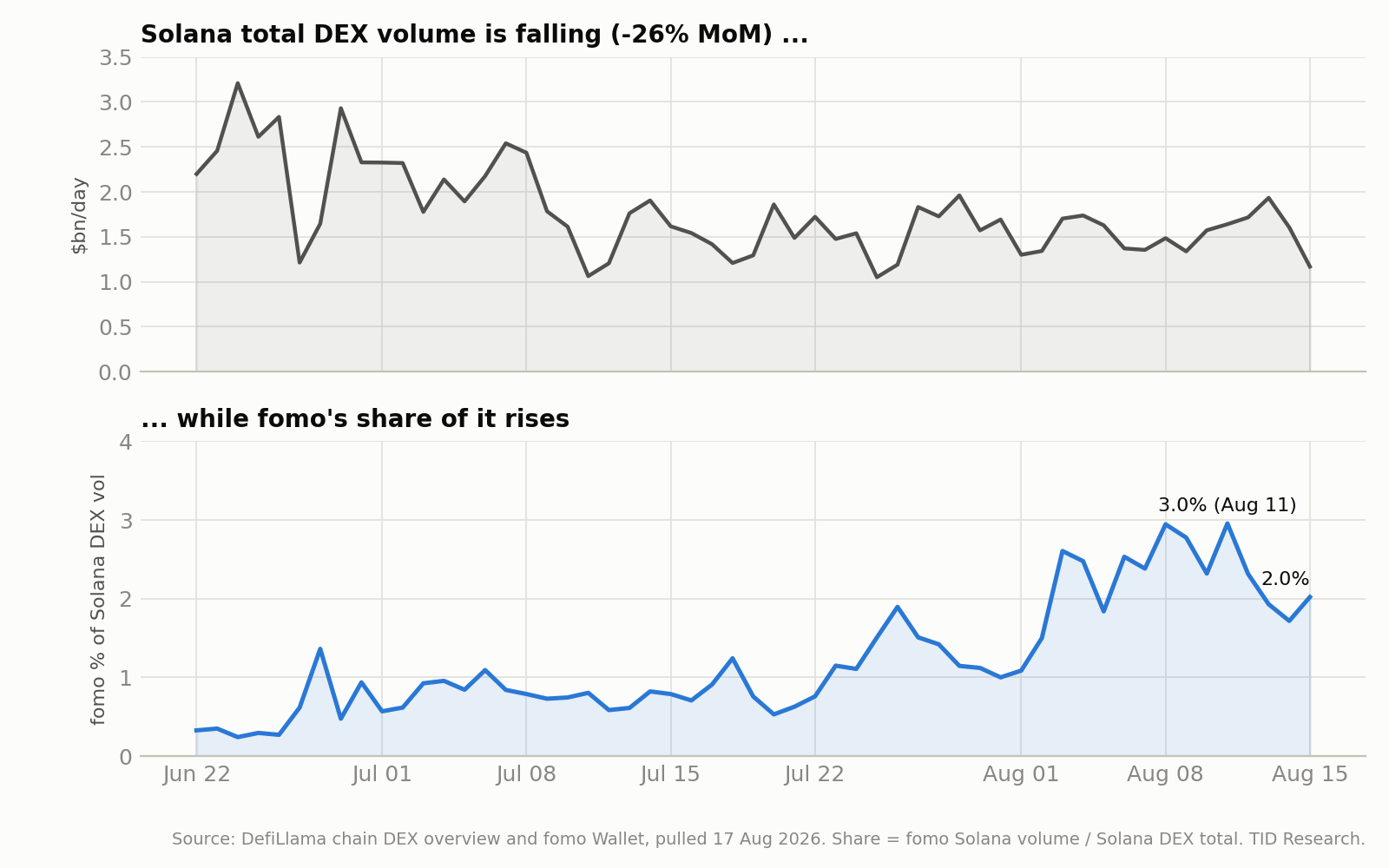
Figure 3. Solana DEX volume vs fomo’s share (DefiLlama).
fomo is not riding a memecoin tide: Solana DEX volume is down 26% month-on-month while fomo’s share went from 0.3% to 3.0%, taken from terminals and wallets.
Why it is succeeding
Distribution moved inside the venue: follow graph, P&L card and copy button are one surface. Pump.fun’s 7 August feed is an explicit copy.
The customer is the small-ticket retail trader, and the fees are built for it: an audit of 467,867 Solana fee transactions found 89% of trades under $190, paying 54% of fees. Take is ~1.35% of volume, several times a terminal, viable because this user is not fee-sensitive.
One cross-chain balance when memecoin activity fragmented; Pump.fun is Solana-only.
Head-to-head
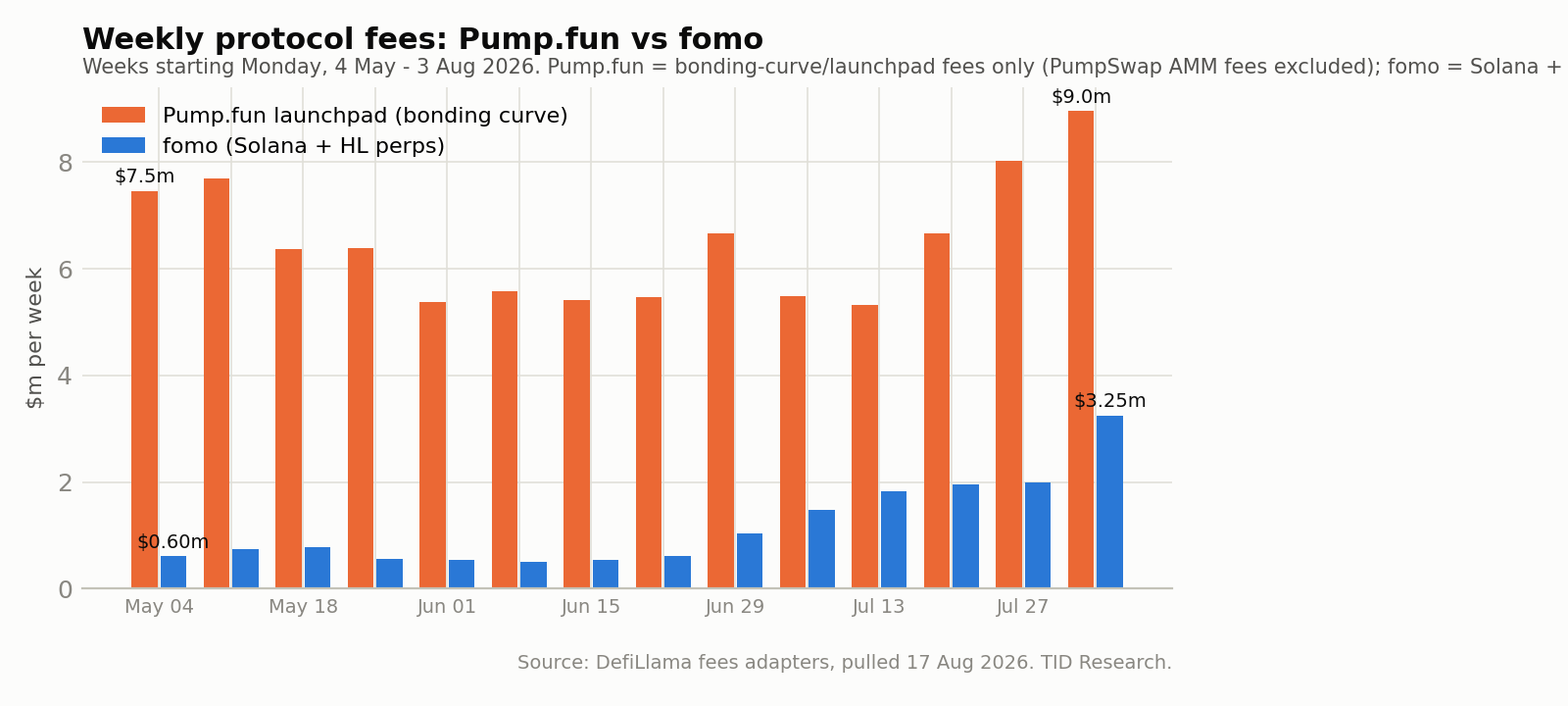
Figure 4. Weekly fees (DefiLlama).
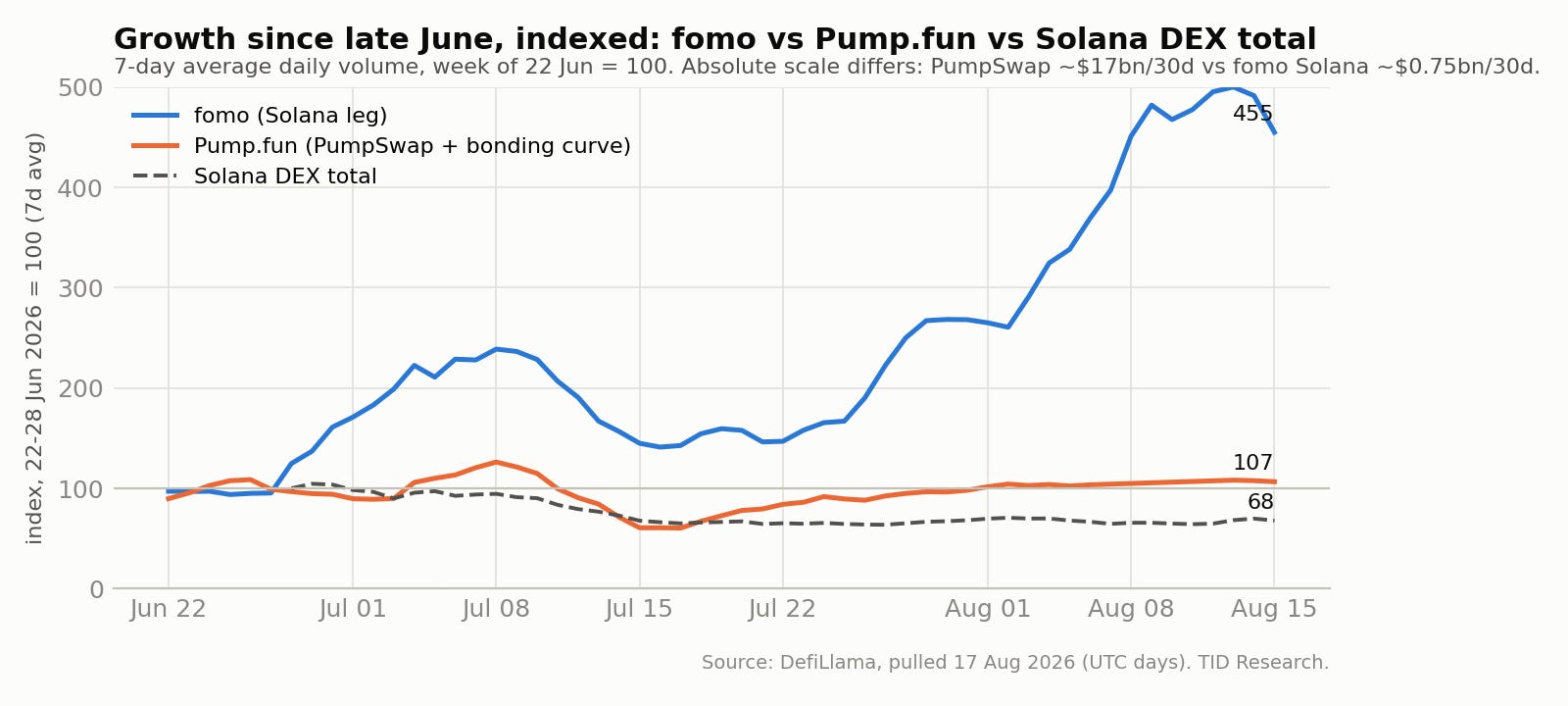
Figure 5. Indexed 7-day-average volume (DefiLlama).
Pump.fun wins on scale (fees 3x, volume ~20x, a token that owns the cash flow); fomo wins on growth (volume 4.5x vs 1.1x, weekly fees 6x vs 1.6x since June). The audit cleared fomo of front-running, wash trading and sandwiching but confirmed fees above the advertised rate (median 1.90%) and poor fills on ~1 in 7 trades. Pump.fun’s response - a leaked $20K sign-on plus $30K/month exclusivity offer to fomo’s top traders (unconfirmed) and a zero-fee terminal - targets the KOL graph that drove August.
Will it continue?
Only if the KOL cohort stays despite Pump.fun’s payments, small-ticket users tolerate a now-legible fee schedule, memecoin volume holds, and execution improves. Watch: daily Solana volume vs the July $15-25M band; Dune weekly volume vs $553M and daily traders vs 49.5K; share of Solana DEX volume vs 3.0%; named-trader migrations.
For DeFi users: a distribution and revenue signal and a possible token, not a venue - sub-$200 Solana trades are among the most expensive routes available; Pump.fun is cheaper for the same trades.
5) Project & Protocol Discovery
Token Movers Spotlight

Bedrock (BR) — The visible catalyst doesn’t match the move: OP rewards were renewed on the uniBTC/USDC Morpho market (Aug 13), and Bedrock’s Alpha Selini vault hit 96% capacity. An incentive top-up rarely explains a 59% swing on its own, so the price appears to be ahead of the identified catalyst.
Cap (CAP) — The clearest case. USD deposits crossed $100M (+87% on the month), lifting total capital to $340M (Aug 13), alongside a published private-credit thesis for stcUSD. Three straight weeks of gains on sustained institutional deposits — fundamentals, not a re-rating.
Ether.fi (ETHFI). Launched its crypto neobank (Aug 13): tokenized stocks and metals, portfolio borrowing via a dedicated Aave V4 instance, and ETHFI buybacks funded from every revenue line. Cash is now ~65% of revenue on ~$100M July card spend. A product launch plus programmatic buybacks — a genuine re-rating.
f(x) Protocol (FXN) — Funding on f(x)’s leveraged BTC/ETH positions dropped to zero (Aug 13) versus ~9-11% on Aave, with no liquidations despite volatility — a real, specific edge that looks more attractive against this week’s broader funding-rate spike elsewhere.
Unitas (UP) — Binance Wallet’s Booster Earn S3 (Aug 13) — deposit XAUt, share $200K in UP over 60 days — plus a Tether Gold push. Fits the gold-yield rotation; the move is proportionate to a fresh reward pool on a low-float token, not a fundamentals shift.
Today’s News Headlines:
- Synthetix proposes to retire sUSD
- Monad buyback ended with fewer holders
- Venice AI surpassed $100M annualized revenue
- Compound approved $52M Expansion budget
- Pendle raised deposit caps accross all PT collateral
- Re’s reUSD launches on Kamino
TVL Gainers and their Movers - Ranked by absolute $ inflow:
Upshift — The Axis Origin Vault Lands, Adding $67M of USDx in a Single Day

TVL: $346.9M | +$74.5M (7d) | +$123.1M (30d)
Upshift posted the largest absolute gain in the cohort, and it traces to one event: Ethereum TVL rose $71.9M of the $74.5M total, with $67.3M of USDx appearing on August 11 alone. That is the Axis Origin Vault settling. Upshift launched the vault in late July with a $50M cap on pre-deposits in USDT, USDC, or USDx, wrapping Axis’s market-neutral cross-venue arbitrage into a tokenized asset (Upshift, July 29); demand filled the cap in 22 hours, prompting a raise to $100M with $58M committed inside the first day (Upshift, July 31).