


Today’s News Headlines:
- DefiTuna exploited for $580K on Solana
- Galaxy launches institutional Morpho vaults via Fireblocks
- Cascade loses $1.34M in liquidation manipulation attack
- Aave V4 incentives live on Avalanche
- Ethena launches USDe and sUSDe on Monad
- Ondo partners with SBI to tokenize Japanese assets
- Pyth goes live on Robinhood Chain
- Pendle launches one-click PT looping
- Revert launches Stable Hooks for Uniswap V4
- Visa launches stablecoin platform for global merchants
Robinhood Chain went live on July 1, and roughly two weeks in it is sitting at approximately $180M TVL. One notable feature of the chain: Robinhood has stated there is no native token, and no chain-wide airdrop has been announced. This means the opportunities for DeFi users are concentrated in two areas — the yield products built on top of the chain, and a small set of ecosystem applications that have their own live or confirmed token programs.
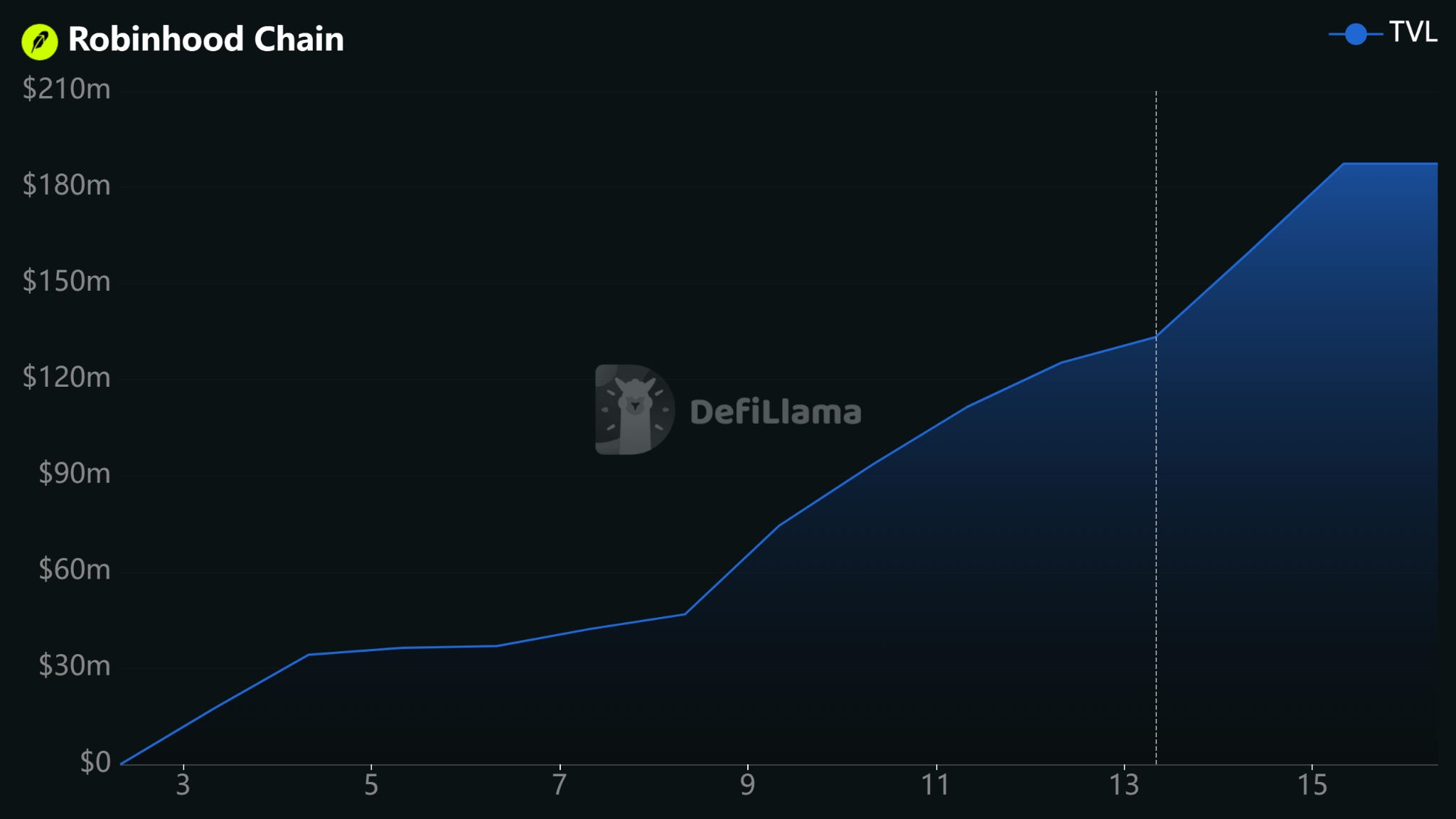
For context: Robinhood Chain is an Arbitrum-built Ethereum L2 (Arbitrum Orbit), settling to Ethereum, with gas paid in ETH. Robinhood is covering all gas fees for the first 90 days. The default dollar is USDG, Paxos’s stablecoin and the flagship asset of the Global Dollar Network. TVL is concentrated in two protocols — Morpho (~$90M) and Uniswap (~$55M).

The 7% USDG vault (Robinhood Earn)
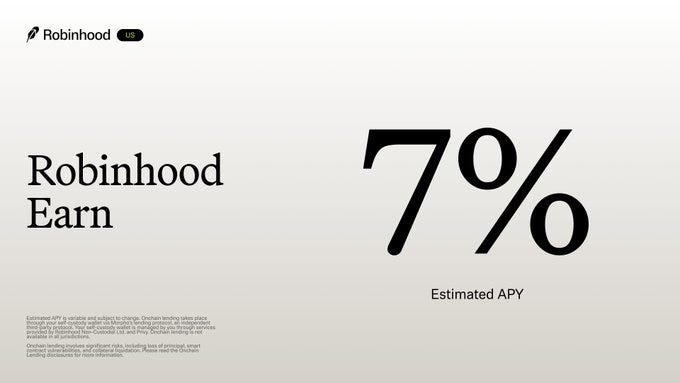
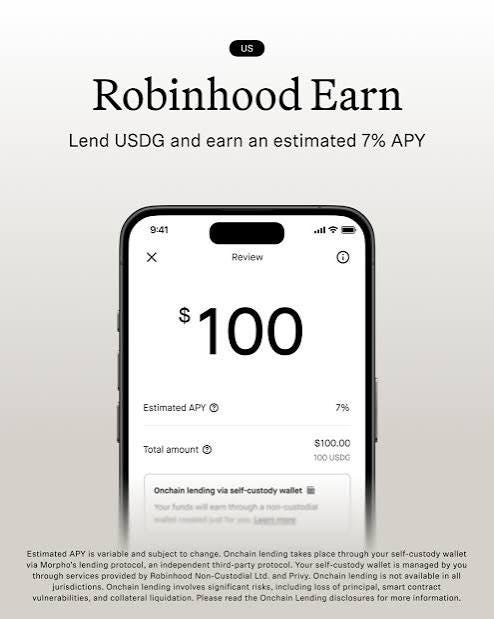
This is Robinhood’s own in-app product, and accessing it that way matters: the ~7% APY is specific to the Robinhood app. Users buy USDG in Robinhood Crypto, move it into a self-custody wallet (Privy-powered, built into the app), and lend it out through “Robinhood Earn.”
Underneath, this is a Morpho vault — specifically the Steakhouse Financial–curated “Steakhouse USDG” vault (0% management and performance fees), which routes deposits into Morpho Blue markets against three collateral types: USDe (Ethena), syrupUSDG (Maple), and spUSDG (Spark). Ethena is currently the largest collateral source, having seeded the vault with $50M, which accounted for most of the growth to $100M+ TVL in the vault’s first week.
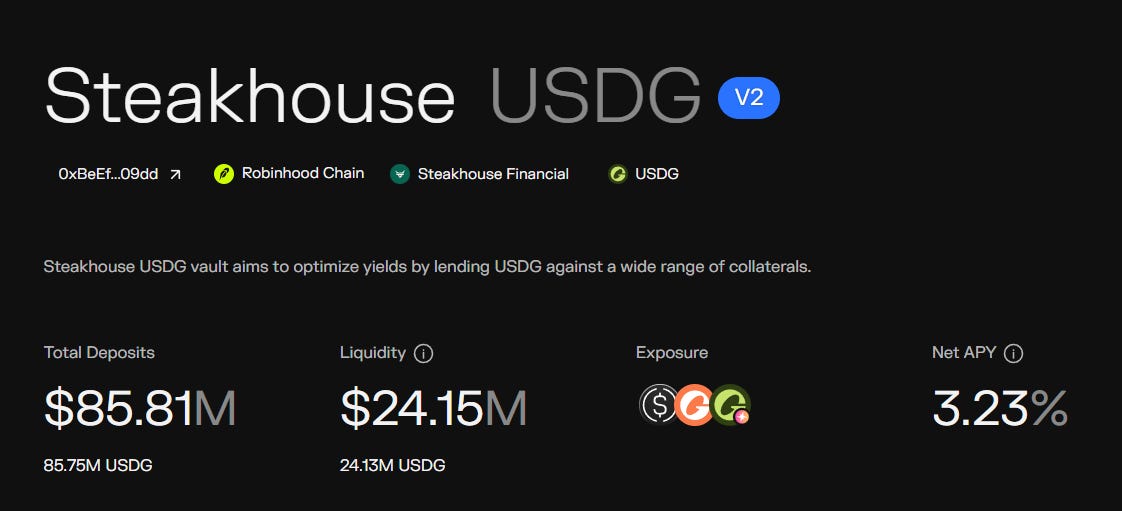
One point worth being explicit about: if you pull up this same vault directly on Morpho’s website or app rather than through Robinhood, you will only see the vault’s native lending rate — approximately 3.23%. The gap between that and the 7% figure comes from a Merkl-funded incentive layer that Robinhood distributes to depositors who route through its own app; this incentive isn’t reflected in Morpho’s interface.
One factor that meaningfully changes the risk profile here relative to a typical DeFi lending position: deposits are backed by cyber-exploit insurance through Lloyd’s of London, arranged via RELM. This is worth dwelling on rather than treating as a footnote. Smart-contract exploits are historically one of the largest sources of loss across DeFi, and one of the hardest risks for an individual user to actually diligence — even experienced users generally can’t fully audit a protocol’s codebase, and a clean third-party audit history is no guarantee against a future exploit.
It’s important to be precise about scope, though: the coverage applies specifically to cyber/smart-contract exploits. It does not cover a USDG depeg, yield compression, or the Merkl incentive being reduced or removed, and the product remains outside FDIC/SIPC protection. But for the exploit-risk slice specifically — arguably the single hardest category to independently underwrite as a retail user — this is a genuine structural advantage over farming similar vaults without insurance behind them.

Looping USDe / syrupUSDG / spUSDG against USDG
The same three collateral assets used in the Earn vault can also be looped directly on Morpho, which is the more DeFi-native version of the same underlying trade. Before getting into the mechanics, it’s worth knowing what each of these assets actually is, since they’re less familiar than a standard stablecoin.

syrupUSDG is Maple Finance’s yield-bearing version of USDG. Depositing USDG into Maple’s institutional lending pools returns syrupUSDG, which accrues yield from Maple’s overcollateralized lending business to institutional borrowers — currently around 4.6%. It functions similarly to a yield-bearing wrapper such as syrupUSDT or syrupUSDC: you hold syrupUSDG, and its value accrues relative to USDG over time.

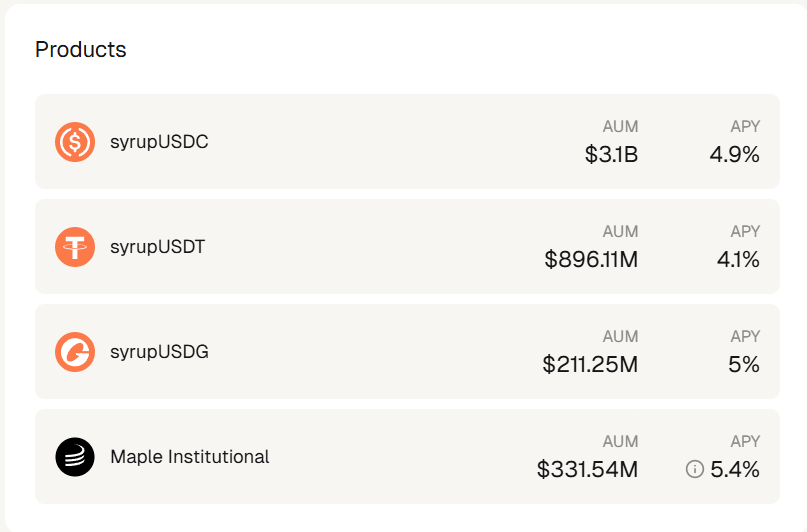
spUSDG works the same way but through Spark (part of the Sky/MakerDAO ecosystem). Depositing USDG into Spark’s savings product returns spUSDG, which accrues yield from Spark’s lending and investment strategies — currently around 3.2%.

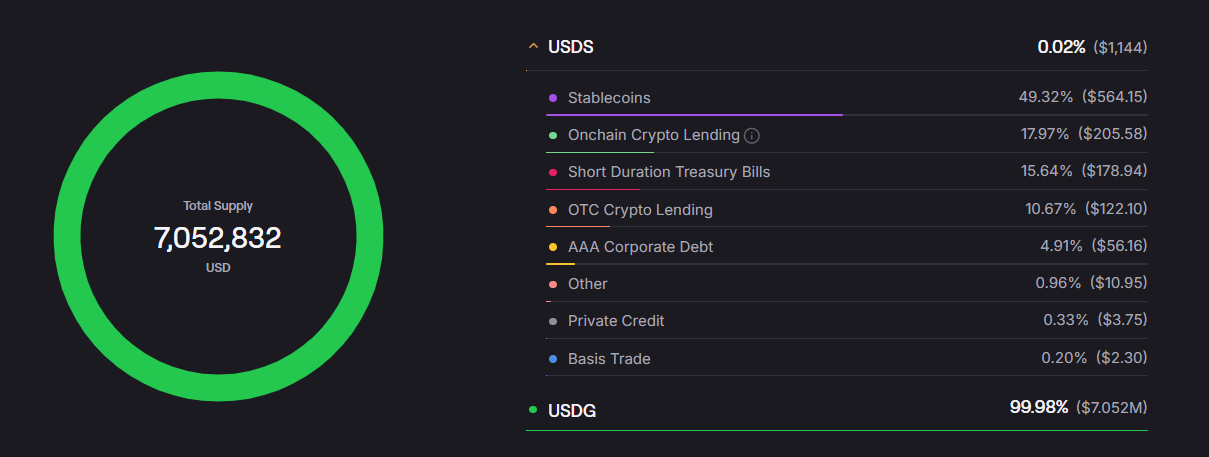
USDe itself, Ethena’s synthetic dollar, is not natively yield-bearing — the yield-bearing version of Ethena’s dollar is normally sUSDe (staked USDe), not plain USDe. So on most chains, holding or looping plain USDe wouldn’t earn anything on its own. What makes it loopable here specifically is a Robinhood Chain incentive: Ethena is running a reward program that pays an additional ~4.5% directly to USDe posted as collateral in these Robinhood Chain Morpho markets.
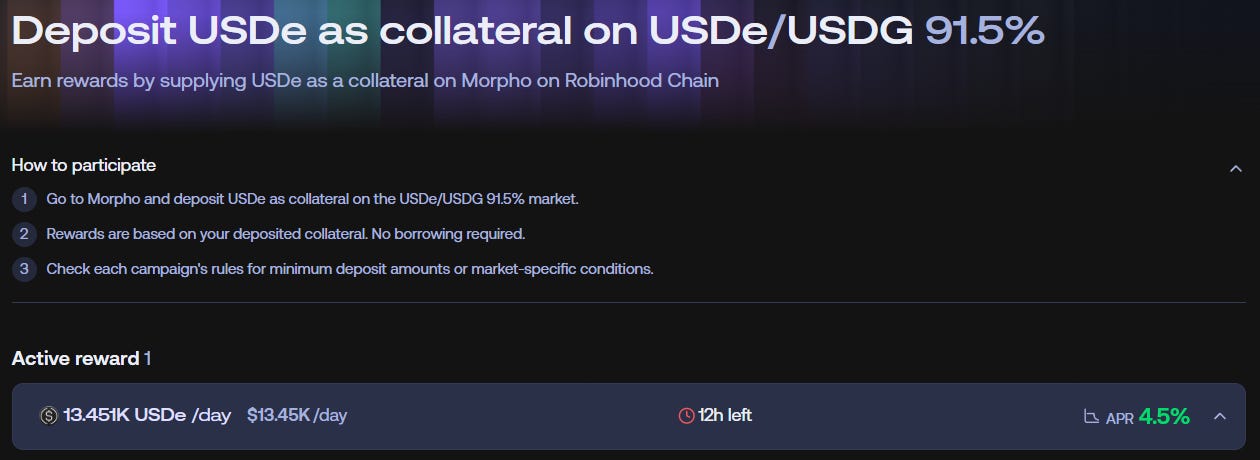
That 4.5% isn’t USDe’s normal protocol yield — it’s a promotional rate Ethena is offering to bootstrap USDe collateral on this specific chain, functioning much like the Merkl incentive on the USDG side of the Earn vault. Worth keeping in mind that this rate is a subsidy tied to Ethena’s push into Robinhood Chain, not a structural feature of USDe itself, and it can be reduced or ended.
With that context, the loop mechanics: post USDe, syrupUSDG, or spUSDG as collateral, borrow USDG, swap back into the collateral asset, and repeat. As of last week, collateral-side yields were syrupUSDG ~4.6%, USDe ~4.5% (via the Ethena incentive above), and spUSDG ~3.2%, against the USDG borrow-side rate. Looped, this produces an estimated 15–20% ROE.
Two caveats are relevant before sizing a position. First, per-market LLTVs (liquidation thresholds) for these specific Robinhood Chain markets are not published in any static reference — Morpho’s interface renders them client-side, so checking app.morpho.org/robinhood-chain directly before opening a position is advisable rather than assuming a figure. Second, no additional points multiplier was confirmed on top of this loop — no Ethena Sats boost or Maple/Spark points program tied to the Robinhood Chain deployment were verifiable at time of writing, beyond the collateral-side yields already described above.