


Subscribe for daily free DeFi news covering launches, tradable catalysts, and actionable farming opportunities.

Find and execute the 15%+ stablecoin yields in minutes
Save time without checking every protocol manually. DeFi Saver’s Discover page surfaces rates across Aave, Morpho, Spark, and more, lets you simulate leverage before committing, and handles the full loop in one click. Stop leaving yield on the table.
<Discover Yields on DeFi Saver> | Today in DeFi is Supported by DeFi Saver
This letter is dedicated to curated Stablecoins and ETH farms this week.
We’ll be covering:
Up To 10% APY on USD Stablecoins
Up To 8% APY on ETH
Farm Safer and Better Post Kelp
Advanced Farms For up to 25% ETH APY and 25% Stable APY
1. Earn Up to 10% on USD Stablecoin Farms:
Morpho Sentora PYUSD - 5% APY (Ethereum · Lending)
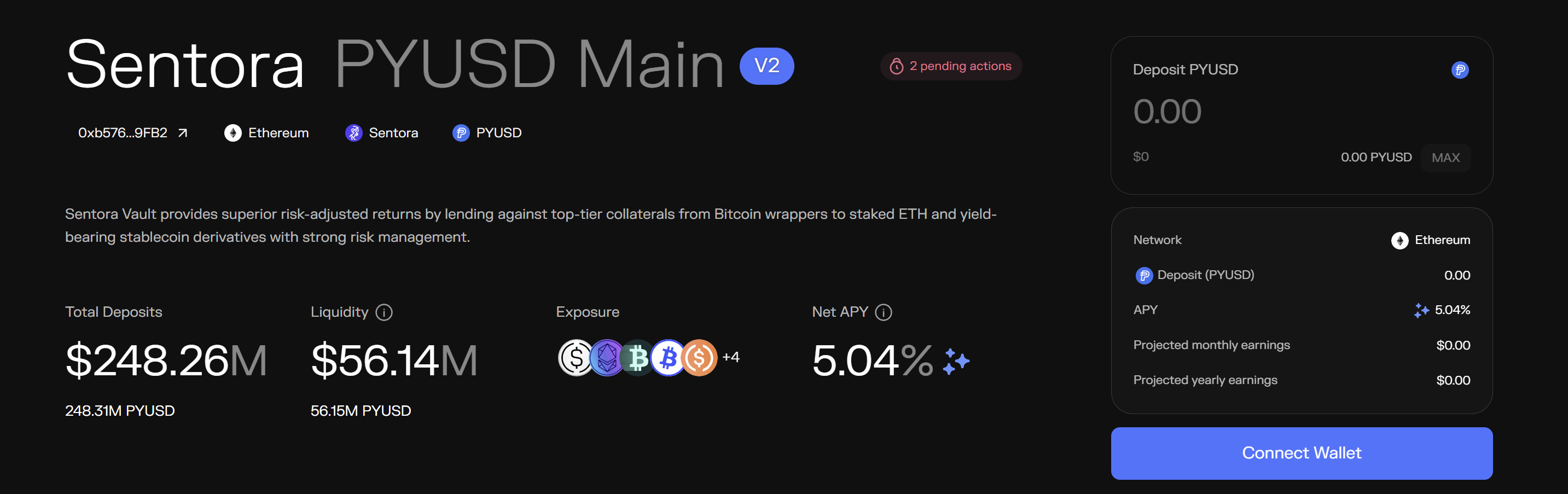
Lend PYUSD (Paxos-issued, NYDFS-regulated, T-bill-backed) into Sentora’s curated Morpho vault. Earn borrower interest plus a 5% PYUSD bonus. Collateral includes sUSDe, weETH, and cbBTC.
⚠️PYUSD is one of the safest stables available. The risk is the sUSDe collateral under current peg pressure — if it depegs, borrower ratios tighten and the vault faces bad debt risk. Sentora curator risk and standard Morpho smart contract risk also apply.
Superform USDC Vault - 9% APY (Ethereum · Vault)

Aggregator vault routing USDC into Morpho Steakhouse Prime and Gauntlet Prime. Instant mint and redemption.
The 9% headline breaks down as roughly 3% base lending yield + 6% in sUP (Superform’s native token), distributed once per month. That means your actual cash yield is lower — you’re partly betting that sUP holds value.
⚠️Most yield is in sUP tokens — if sUP price falls, real returns shrink. Morpho smart contract risk applies, plus a thin Superform contract layer on top. Base USDC lending exposure is conservative.
Auto Finance monUSD 10% APY (Monad · Vault)
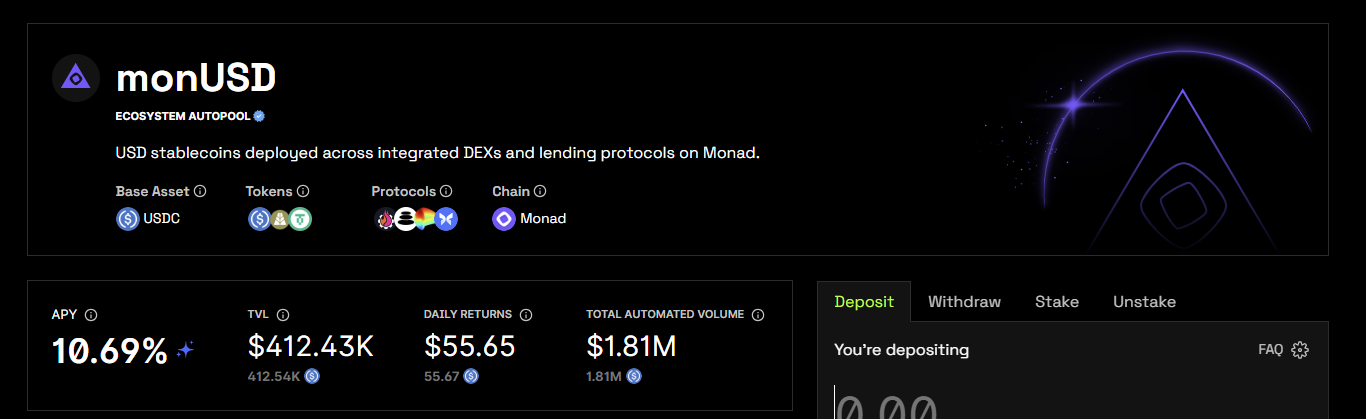
One-click vault routing into Morpho Steakhouse Prime on Monad, with a 6% WMON incentive on top. Instant mint and redemption. Straightforward passive position with no lock-up.
⚠️Steakhouse is a conservative curator. Primary risk is WMON token price exposure on 6% of the yield, plus a thin Auto Finance contract layer. Monad network risk exists as a newer chain.
Euler Prime USDtb Vault - 6% APY (Ethereum · Lending)
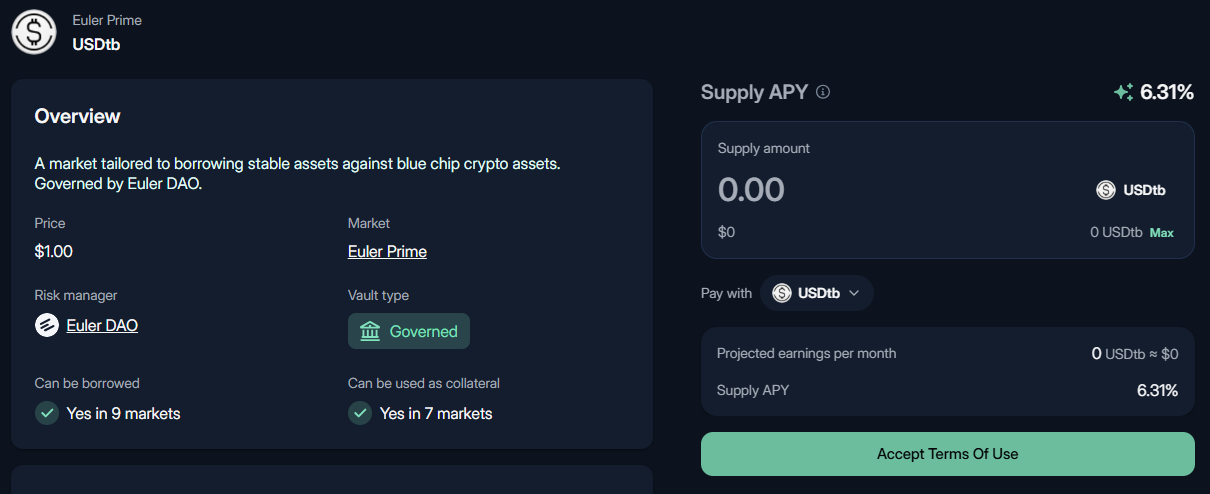
Lend USDtb — Ethena’s T-bill-backed stablecoin (BlackRock BUIDL reserves) — into Euler’s lending vault. Earn interest from borrowers plus a 3% USDtb bonus. Borrowers post sUSDe as collateral.
⚠️USDtb itself is clean. The risk is the sUSDe collateral borrowers post — under peg pressure this week. If sUSDe depegs, collateral ratios tighten and the vault faces potential bad debt. Monitor the vault’s health factor on Euler.
apxUSD PT · Jun 18 2026 - 14% APY (Ethereum · Fixed yield)
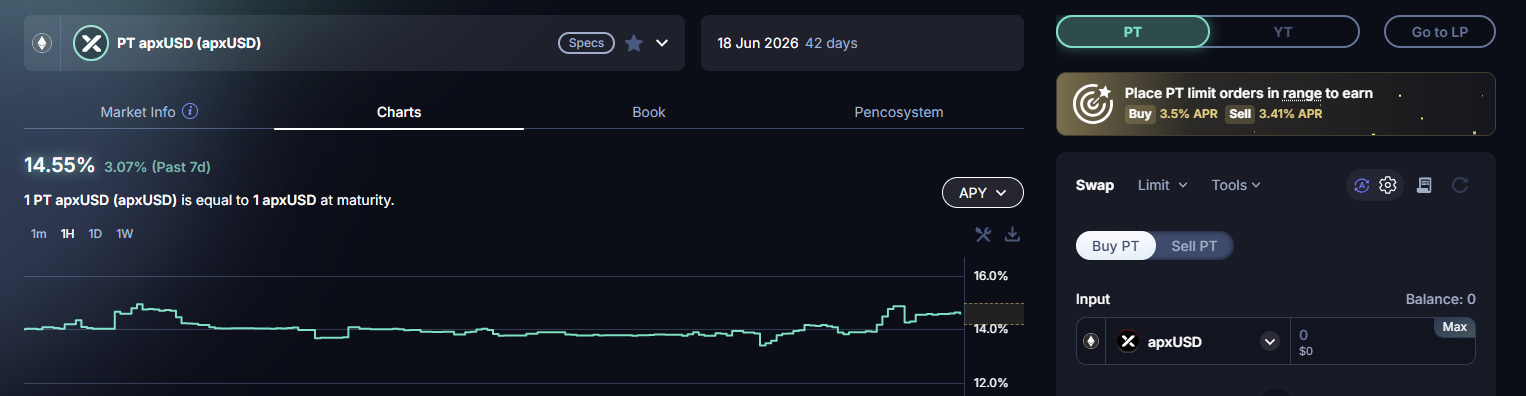
Pendle Principal Token backed by apxUSD, which is collateralized by Strategy’s STRC preferred equity (~11.5% monthly dividends). Buy at a discount today, redeem at face value on Jun 18 — locking in a fixed 14% APY.
⚠️STRC is volatile preferred equity — it fell to $90–93 twice in the past six months. A STRC discount weakens apxUSD’s backing and the PT may not redeem at full value. Corporate credit exposure to Strategy, not smart contract risk. Size conservatively.
Lists of Up To 8% ETH APY
Balancer WETH/rETH LP - 8% APY (Ethereum · ETH LST LP)
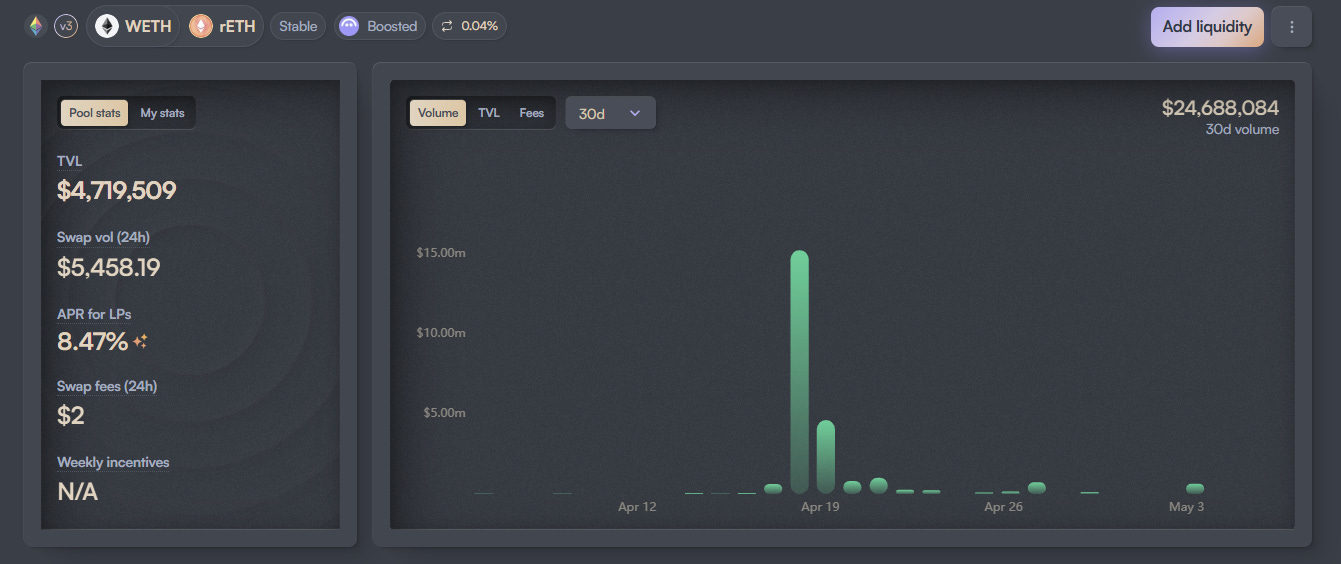
Balancer pool pairing WETH with rETH (Rocket Pool’s LST). Both assets track ETH closely, keeping impermanent loss low. Earn trading fees plus 6% in RPL rewards by Merkl.xyz.
⚠️6% of yield is in RPL tokens — price exposure on that portion. rETH carries Rocket Pool smart contract risk. Impermanent loss is minimal but not zero, as rETH trades at a slight premium to WETH from staking yield accrual.
StakeDAO Curve WETH/ETHx LP - 7% APY

Curve pool pairing WETH with ETHx (Stader Labs’ LST), boosted via StakeDAO’s collective veCRV lock for 2–3x CRV rewards without personal lockup. Earn trading fees plus boosted CRV that auto-compounds.
⚠️CRV rewards can drop if gauge voting shifts. ETHx carries Stader smart contract risk. Impermanent loss is low given ETH-correlation. CRV and StakeDAO each add a thin extra contract layer.
Morpho Steakhouse Prime ETH - 4.6% APY (Monad · Lending)
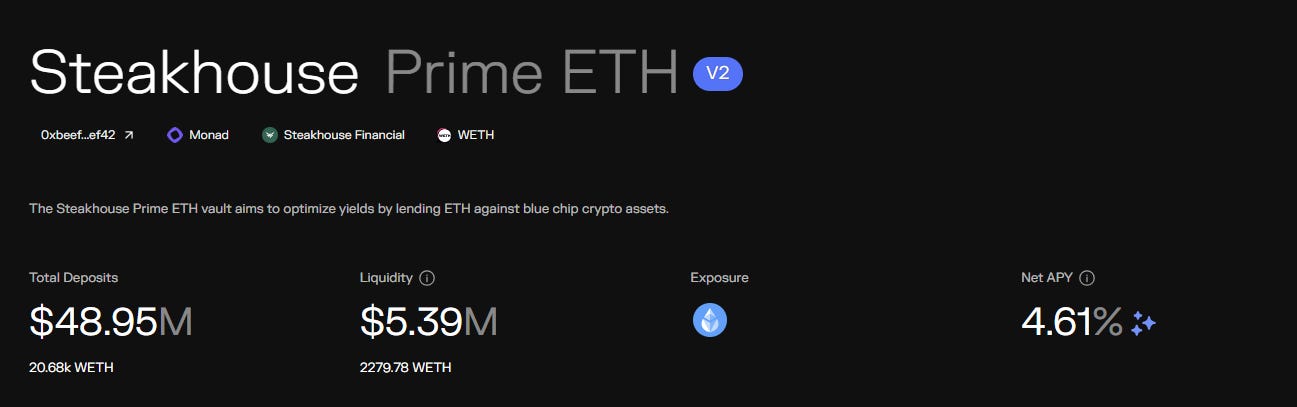
Lend ETH into Steakhouse’s curated Morpho vault on Monad. Borrowers post wstETH as collateral. Earn borrower interest plus a 3% WMON bonus. No lock-up, passive position.
⚠️wstETH collateral is battle-tested — risk is a Lido slashing event tightening collateral ratios. WMON token exposure on 3% of yield. Morpho smart contract risk. Monad network risk as a newer chain.
Farming Safer and Better Post-KelpDAO

After the rsETH incident, a lot of capital fled DeFi — some of it rightly so, some of it pure panic. Protocols with zero rsETH exposure saw liquidity leave anyway, leaving behind better yields for farmers who actually understand the risk. This guide breaks down what happened, what’s actually safe, and where the opportunities are right now.
The rsETH incident, and why it spread so far
On April 18, KelpDAO’s cross-chain bridge was exploited for $292 million in rsETH. The contagion spread much further than the actual damage. Protocols with zero rsETH exposure also saw capital leave simply because the whole ecosystem felt unsafe. That’s the overreaction and the opportunity.
If you’re still stuck in an affected position
DeFi Saver’s Collateral Switch lets you move out of frozen ETH markets even at 100% utilization by operating on aWETH directly.
What’s actually affected
Not every protocol took damage — the structure matters
Avoid for now:
Aave - Pooled design meant rsETH collateral directly impacted ETH suppliers. ETH markets frozen, bad debt ongoing. Markets are unfreezing and recovery is progressing — but conservative farmers should wait for full normalization.
Compound - Multiple WETH, USDC and wstETH markets paused across mainnet and L2s. Recovery is underway and markets are reopening — worth monitoring, but exercise caution for now.
Unaffected
Spark Had proactively removed rsETH as accepted collateral before the exploit. Zero direct exposure. Absorbed over $2.4B in inflows from Aave in the aftermath — a direct signal of where risk-aware capital moved.
Morpho Isolated market design meant bad debt in one vault literally cannot touch another. Only $1M affected across 2 of 500+ vaults — a rounding error. The architecture did exactly what it was designed to do.
Liquity V2 No rsETH exposure. ETH-native, no cross-chain bridged collateral in its design. BOLD staking continues normally.
Specific markets only
Fluid Protocol had some rsETH exposure in certain markets. However, GHO and USDT lending markets on Fluid had zero rsETH exposure and remain fully operational. Stick to these specific markets.
Spark and Morpho coming through clean wasn’t luck. Spark had pre-emptively removed rsETH, and Morpho’s isolated architecture was built for exactly this kind of failure. These are reusable principles, not one-time outcomes.
What’s available on Discover — filtered to unaffected protocols and yield opportunities
The Yield tab on DeFi Saver’s Discover page is where lending and staking opportunities are surfaced. It lets you filter by protocol, collateral token, and chain, and shows you:
Supply APY
Estimated annual profit on a given amount
Market size, and withdrawable liquidity all in one place
From Discover to open position, here’s what the flow looks like:
Step 1: Filter to unaffected protocols
Open the Yield tab. The first thing you’ll want to do is filter down to protocols that had no rsETH exposure.
Hit the protocol dropdown and select: Spark, Fluid, Morpho, Liquity V2, LlamaLend, and Yearn. Deselect everything else. This immediately cuts the noise from 240+ options down to only the markets worth looking at right now.

Deselect everything else. This immediately cuts the noise from 240+ options down to only the markets worth looking at right now.
Step 02 — Check Withdrawable and utilization first, APY second
With the filter applied, you’ll see a table of opportunities sorted by Supply APY. Before you look at any rate, check these two columns first:
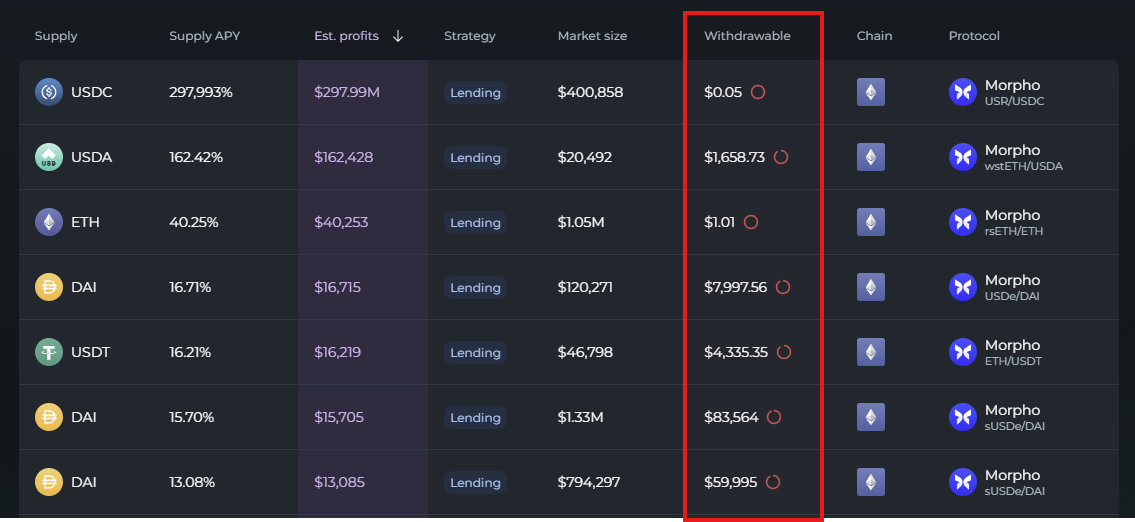
This is where most farmers go wrong. They sort by APY and click the highest number. The Withdrawable column tells you whether you can actually exit, and you can use this to make sure that the withdrawable liquidity is much more than your deposit. The orange circle next to it signals high utilization, meaning most of the supplied assets are currently borrowed. 90%+ utilization means you can supply, but exiting may be slow or impossible until borrowers repay.
Below 85% is comfortable, 85-95% is the caution zone.

Market size is the second filter. The USDA market at 162% APY on $20K of supply is real, but a single position can move the rate fast and the exit liquidity is thin. Bigger markets offer rate stability. Use both columns to size your position before you ever look at the rate.
Note on ETH markets: most are at 90-95% utilization right now. This is NOT ALWAYS a protocol risk; in this case, it’s a temporary squeeze from the 20-day unstaking queue for wstETH and weETH. Fundamentals are solid, but treat it as a market to monitor rather than enter blindly.
Step 3 — Pay attention to or filter through the Strategy column too

The Strategy column tells you what you’re actually doing with your money. Three main types appear in the Discover Yield tab:
This matters for risk assessment.
Lending exposes you to whoever is borrowing against your supply.
Staking exposes you to the protocol’s mechanics and reward source.
Savings vault adds curator risk on top — someone is making allocation decisions for you, so you need to trust their decisions.
There’s also the swap option for yield-bearing stables
One thing the Discover page doesn’t surface but is worth knowing: DeFi Saver’s Exchange feature lets you swap directly into yield-bearing stablecoins like syrupUSDC.
Step 04 — Click into the farm to see what’s underneath
The Discover row shows you the headline numbers. The detail page shows you what’s actually backing the yield. Always click through before supplying. Take Steakhouse PYUSD on Morpho at 7.5% APY:

The vault description states it lends PYUSD against blue-chip crypto and RWA collateral including Lido’s wstETH, blending traditional yields with on-chain rewards, curated by Steakhouse Financial. That single paragraph tells you four things: what you’re supplying, what it’s lent against (your real exposure), where yield comes from, and who’s making allocation decisions. wstETH-backed lending on Morpho is structurally clean — wstETH wasn’t affected by rsETH, the market is isolated, and the curator has a track record. The Protocol column tells you where the market lives. The detail page tells you what it actually is.
Where to farm now
Here’s what’s worth looking at right now across the unaffected protocols. Note that yields have normalized somewhat from the post-incident spike, and these are current live rates, not the elevated rates seen immediately after April 18.
Stable lending on Fluid (~5-6% APY)

Fluid’s GHO market sits at 6.40% with $3.42M withdrawable on an $18.5M market — comfortable exit liquidity. USDC and USDT lend at 5.78% and 4.95% respectively, both clean of rsETH exposure. There’s also syrupUSDC at 4.94% accessible via the Exchange tab — passive yield-bearing stable, no managing positions, no exposure to the incident. Together, these are the conservative floor for stablecoin farmers. Boring, but actually working.
Morpho lending — bigger size, higher yields (4.5-7.5% APY)

Morpho’s isolated markets stack a lot of clean opportunities. cbBTC/USDC at 4.05% on a $1.28B market with $139M withdrawable is the deepest. wstETH/USDT at 5.50% offers higher yield against blue-chip LST collateral. sUSDS/USDT at 3.29%, WBTC/USDC at 3.74% — all sit on $100M+ market sizes with healthy withdrawable amounts.
Some of these markets show high utilization rings, but the underlying market size is large enough that withdrawable still runs into the millions — a different situation from a small market locked at 95%.
Curated vaults — passive exposure, no babysitting

For hands-off farmers, curated vaults handle allocation for you. Steakhouse PYUSD leads at 7.5%, lending against blue-chip crypto and RWA collateral. Smokehouse DAI at 6.4% is fully liquid. Yearn V3 DAI (5.0%) and USDT (4.9%) spread capital across Fluid, Morpho, Spark, and similar venues.
The Yearn vaults had brief Aave exposure during the incident, but the curators withdrew fast, and withdrawable is now 100%. That’s the value of paid management: someone’s watching for you.
BOLD staking on Liquity V2 (11.08% APY)

yBOLD Staking runs at 11.08% APY, with the vault managed by Yearn’s auto-compounder reallocating across Liquity V2 stability pools. ETH-native, no bridged collateral, no rsETH connection. Yield comes from Liquity’s borrowing fees and liquidation penalties.
The principle across all of these is the same: clean structure, real liquidity, transparent exposure. Post-incident, the market is rewarding farmers who look at what’s underneath rather than chase the biggest number.
Even the unaffected protocols carry risk
“Unaffected by the rsETH incident” doesn’t mean risk-free. Every farm in this guide carries some combination of the following, and you should size positions accordingly.
Smart contract risk
All DeFi positions depend on code working as intended. Audits reduce this risk but don’t eliminate it. Morpho, Spark, Liquity, and Fluid are all audited and battle-tested, but a previously unknown bug or exploit can surface at any time. The longer code has been live with significant TVL, the more comfort you can take — but never zero.
Curator and management risk
For Savings vaults like Steakhouse PYUSD or Yearn V3, you’re trusting a curator to make allocation decisions. The Yearn Aave situation during the incident is the cleanest example — the curators reacted fast and withdrew, but the speed of that decision is the variable. A slower curator on a future incident could leave you exposed.
Oracle and depeg risk
Lending markets depend on price oracles. If an oracle feeds a wrong price, even briefly, liquidations can cascade. Stablecoin farms also carry depeg risk — sUSDe, USDA, GHO, BOLD, crvUSD all rely on different stability mechanisms. Understand which one backs the asset you’re holding.
Withdrawable can change fast
Today’s healthy withdrawable can become tomorrow’s locked liquidity if borrow demand spikes. Markets at 70% utilization can hit 95% in days. Check before entering, and check periodically while positioned. The Portfolio tab makes this easy.
Yields are not promises
Every APY shown — including in this guide — is a snapshot. Reward incentives end. Borrow demand fluctuates. A 7% vault today might be 4% next month or jump to 10%. Plan for variability, not for the headline number to hold.