Subscribe for daily free DeFi news covering launches, tradable catalysts, and actionable farming opportunities.
Today’s News Headlines
- Neutrl pauses NUSD operations amid reserve concerns
- Securitize shares plunge after $21.7M Q2 loss
- Ondo integrates tokenized STRC into Saturn
- EtherFi migrates Cash card backend to Aave
- Trezor shipping partner breach exposes customer data
- Tether completes first full financial audit
- Attackers drain $25.6M across multiple assets
TL;DR
Ethereum’s next upgrade, Glamsterdam (targeting Q4 2026), could triple mainnet block capacity — and reset gas fees structurally lower.
That means gas-gated strategies — active LP rebalancing, tight-margin looping, frequent position management — could pencil out on mainnet again. Rough threshold to watch: strategies that need under ~$15/tx start becoming viable, versus $50+ today.
A second major change, ePBS, brings block-builder auctions on-chain, cutting reliance on a handful of opaque relay companies and making MEV more transparent.
Also landing: ETH transfers up to 71% cheaper, larger smart contracts, and 4x faster LST withdrawal queues.
What to watch: public testnets (expected in the coming months) and whether validators actually vote block capacity upward after activation — the fee relief depends on it.

Find and execute the 15%+ stablecoin yields in minutes
Save time without checking every protocol manually. DeFi Saver’s Discover page surfaces rates across Aave, Morpho, Spark, and more, lets you simulate leverage before committing, and handles the full loop in one click. Stop leaving yield on the table.
<Discover Yields on DeFi Saver> | Today in DeFi is supported by DeFi Saver
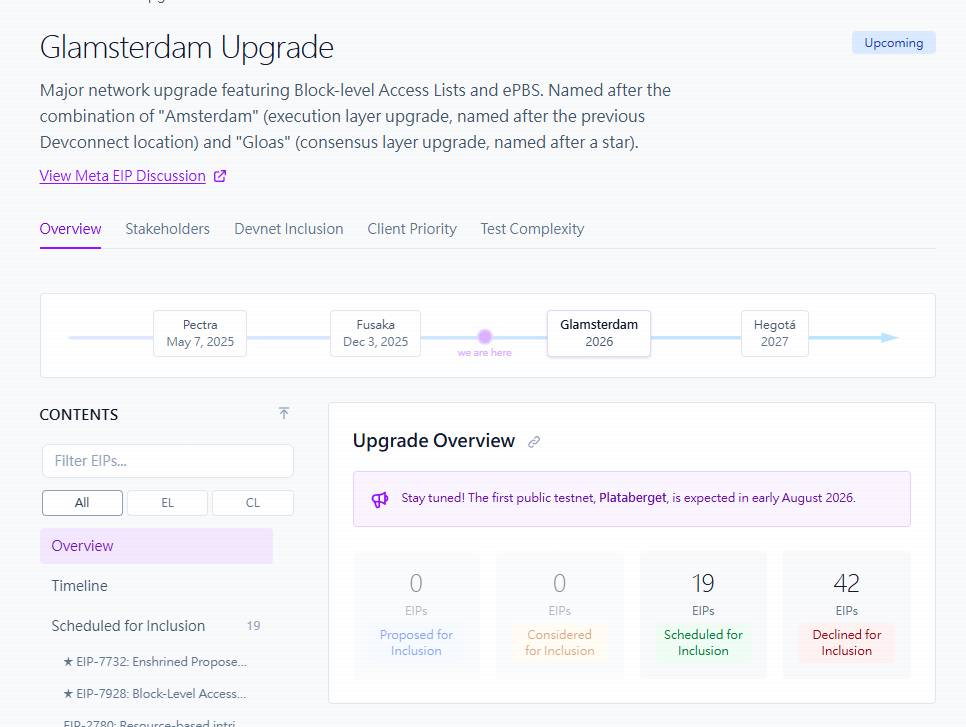
What is Glamsterdam?
For years, gas costs have quietly priced retail LPs and active strategy runners out of Ethereum mainnet. Rebalancing weekly, running tight-margin loops, managing smaller positions — all of it made more sense on an L2 once mainnet gas ate the returns. Ethereum’s next major upgrade, Glamsterdam, is aimed directly at reversing that.
Glamsterdam is widely seen as the most significant Ethereum change since the Merge in 2022. It’s two upgrades combined — “Gloas” (consensus layer) and “Amsterdam” (execution layer) — and unlike recent forks such as Dencun and Fusaka, which focused on making L2S cheaper, this one rebuilds Ethereum mainnet itself.
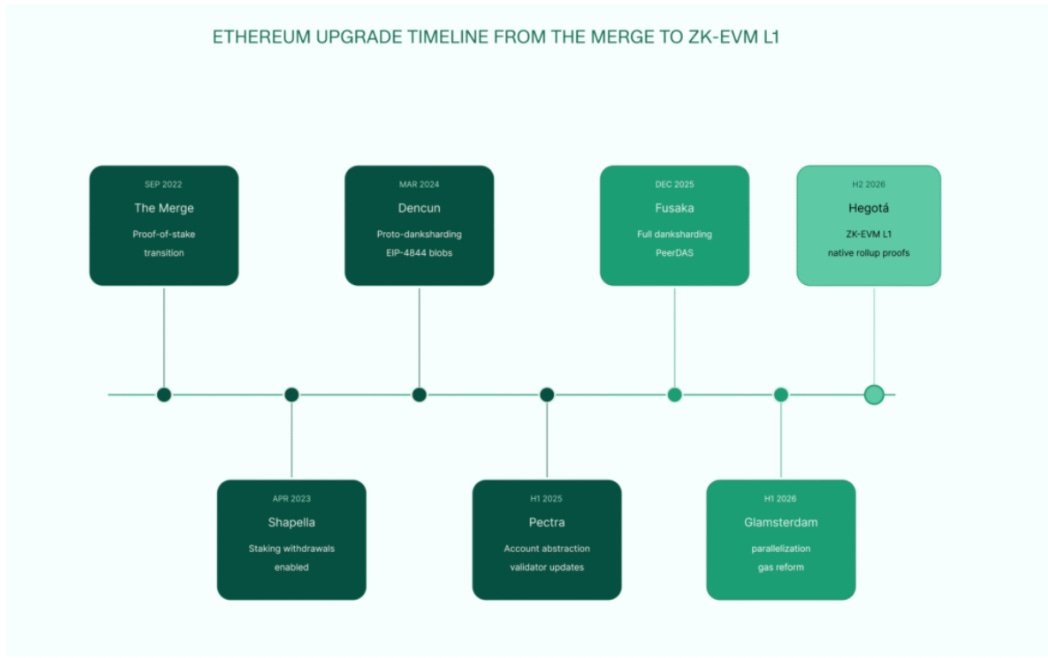
Q4 2026 is the official target per the Ethereum Foundation’s roadmap. The feature set is locked, and testing is underway, though Ethereum upgrades tend to run late — early 2027 remains realistic.
What’s included — and what it means for you
Glamsterdam bundles roughly ten improvement proposals (EIPs), but two flagship changes define the upgrade. Everything else supports them.
Triple the capacity (Block-Level Access Lists)

Ethereum processes transactions one at a time — not from lack of computing power, but because it doesn’t know in advance which transactions might touch the same data. It’s a supermarket with one checkout lane because nobody knows what’s in anyone’s cart until they reach the front.
Block-Level Access Lists (BALs) fix this by having every block carry a manifest of which accounts and storage each transaction will touch. Once the network knows what’s in every cart, non-overlapping transactions can process simultaneously. Today’s blocks are capped at 60 million gas; developers are testing at 150 million and targeting 200 million — more than 3x today’s throughput.
For DeFi, this is the change with the most upside for LPs and gas-sensitive strategies. If capacity triples over the following year, mainnet fees could reset structurally lower — reviving smaller LP positions, frequent rebalancing, tighter-margin looping, and active management that only whales can currently afford.
It also narrows the cost gap with L2s, signaling Ethereum wants to compete on L1 capacity again rather than treating mainnet purely as a rollup settlement layer.
Two catches:
The fork itself doesn’t raise the gas limit — validators vote it up gradually after activation as the network proves it can handle the load, so fee relief arrives over months, not on launch day.
And parallel processing only helps when transactions don’t overlap — a hundred people swapping in the same hot pool still queue behind each other.
A fairer path from your wallet to the chain (ePBS)

Most users never see this: validators don’t actually build the blocks they propose. About 90% of Ethereum blocks are assembled by specialized “builder” firms — the MEV industry. Between validators and builders sits a middleman called a relay. Relays aren’t part of the Ethereum protocol; nobody elected them.
A handful of them handle nearly all blocks, and a relay can quietly leave a transaction out of a block with no recourse — which is exactly how sanctioned transactions have been filtered from parts of the network before.
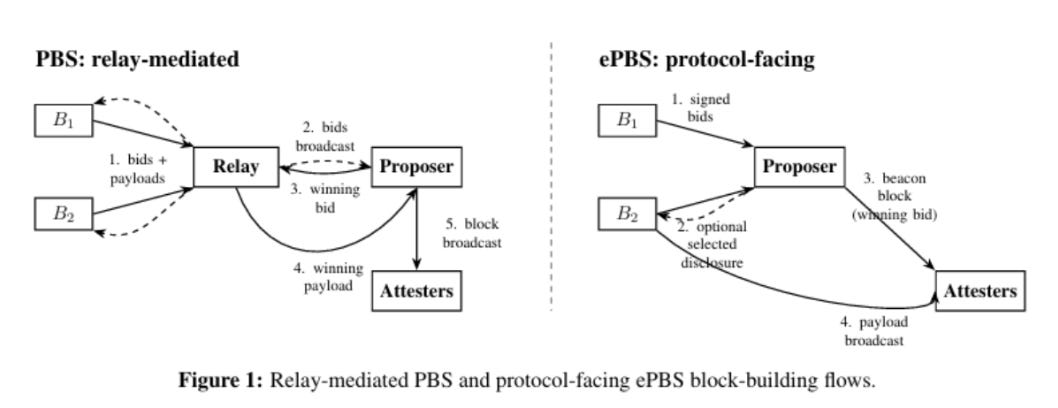
Enshrined Proposer-Builder Separation (ePBS) brings this whole arrangement inside the protocol and removes the middleman. Builders become official on-chain participants. Their bids for the right to build each block are signed and visible to everyone.
Payment is automatic: if a builder wins a bid and fails to deliver the block, the validator keeps the payment, and the builder eats the loss — no trusted intermediary holding anyone’s money. A rotating committee of 512 validators checks every slot to confirm that the block was delivered on time.
For DeFi users, this means transaction inclusion no longer depends on the private policies of two or three relay companies — the censorship pressure point that’s worried Ethereum users for years loses its structural foothold.
For active traders, the builder bidding war becomes publicly visible for the first time, which means better data on execution quality, and possibly some margin competed back toward users as better inclusion or pricing — though how much is one of the genuinely open questions post-launch.
There’s also a subtle structural change: builders get about nine seconds to broadcast their blocks instead of two. That breathing room is what makes bigger blocks physically practical, but it also slightly reshapes the last-moment bidding dynamics that high-frequency strategies live in — worth its own study if you run latency-sensitive strategies.
Two caveats:
ePBS makes the MEV industry accountable, not extinct — sandwich attacks don’t disappear.
And validators can still take direct bids the old way, so relays may fade gradually rather than vanish overnight. Triple the capacity (Block-Level Access Lists)
Also worth knowing
A handful of smaller changes round out the upgrade:
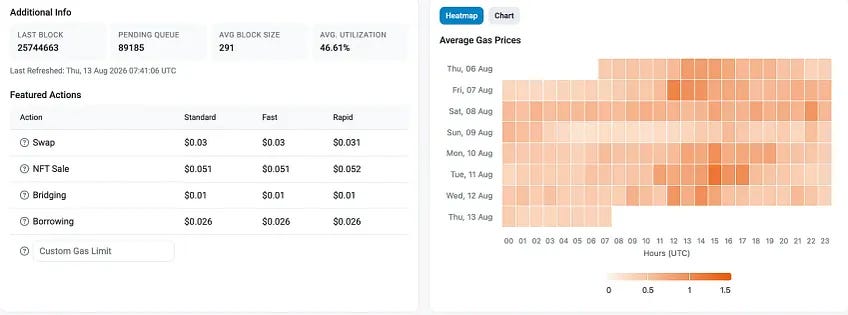
ETH transfers get up to 71% cheaper at activation, while storage costs rise as computation gets cheaper — protocols with hardcoded gas assumptions should get reviewed before the fork.
Smart contracts can be nearly 3x larger, easing the need for multi-contract workarounds in complex DeFi protocols.
LST exit capacity quadruples — withdrawal queues that stretch for weeks during stress events should clear far faster, reducing the discount stETH/rETH can trade at when queues back up.
Two anticipated features — faster block times and FOCIL (a stronger anti-censorship mechanism) — were deferred to the next upgrade, Hegotá.
What’s not in it
Two anticipated features were deferred to the next upgrade (Hegotá): faster block times — the 12-second slot stays — and FOCIL, the strongest proposed anti-censorship mechanism. Glamsterdam substantially improves the censorship picture; it doesn’t finish the job. And don’t expect faster trade confirmations from this fork.
Timeline and what to watch
Development has been on track since Fusaka shipped on mainnet in December 2025. The feature set locked on June 17, 2026, fixing the core bundle at roughly ten EIPs — from that point, the question stopped being “what’s in it” and became “when.” The official roadmap still lists Q4 2026, with testing currently underway at 2.5x today’s block capacity.
Next up: public testnets, historically a two-to-four-month process, followed by a mainnet date announced a few weeks out. Given that Fusaka itself slipped several months past early estimates, slippage into early 2027 wouldn’t be surprising. Treat it this way: the changes are certain, the quarter is probable, the exact date is unknown.
The bottom line
No action is required from wallet holders today — no migrations, no token swaps, and anyone claiming otherwise ahead of a major fork is running a scam.
But for LPs and strategy runners, now is a reasonable time to revisit which mainnet strategies were shelved purely on gas grounds, and at what fee level they’d pencil again.
The real test comes after activation: whether validators actually vote capacity up, and whether fees fall as much as the upgrade promises. We’ll be watching both closely.
For sponsorships, questions, or news tips, reach us at: support@todayindefi.com