

Subscribe for daily free DeFi news covering launches, tradable catalysts, and actionable farming opportunities.
Aave V4: The Unified Liquidity Routing Layer
Aave V4 introduces a “Hub and Spoke” architecture designed to address structural limitations found in Aave V3. This update shifts the protocol away from isolated market structures to a consolidated liquidity model. The primary objectives of V4 are to unify liquidity, improve capital efficiency through automated yield strategies, prevent rate pollution, and provide a modular framework for developers to create specialized lending markets.

The Problem with Aave V3
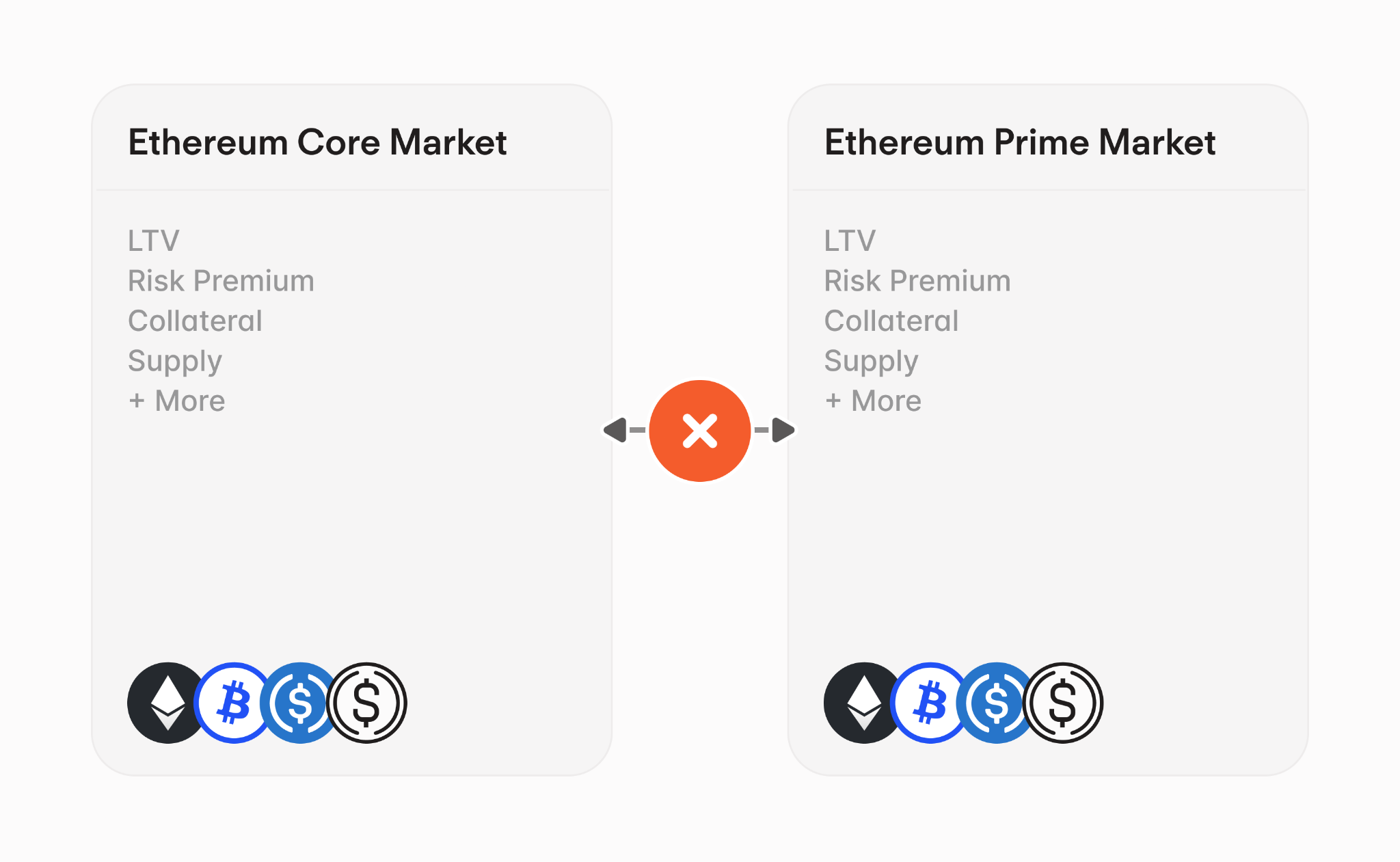
Aave V3 relies on independent markets (e.g., Ethereum Core vs. Ethereum Prime). Each market required its own isolated liquidity pool and unique asset mix.
The Limitations:
Liquidity Silos: Assets supplied to one market could not be utilized to meet borrowing demand in another.
Bootstrapping Friction: New markets with specialized features or unique risk profiles had to build liquidity entirely from scratch.
Capital Inefficiency: Fragmented capital limited economies of scale and hindered the support of novel assets.
Core Architecture: The Hub and Spoke Model
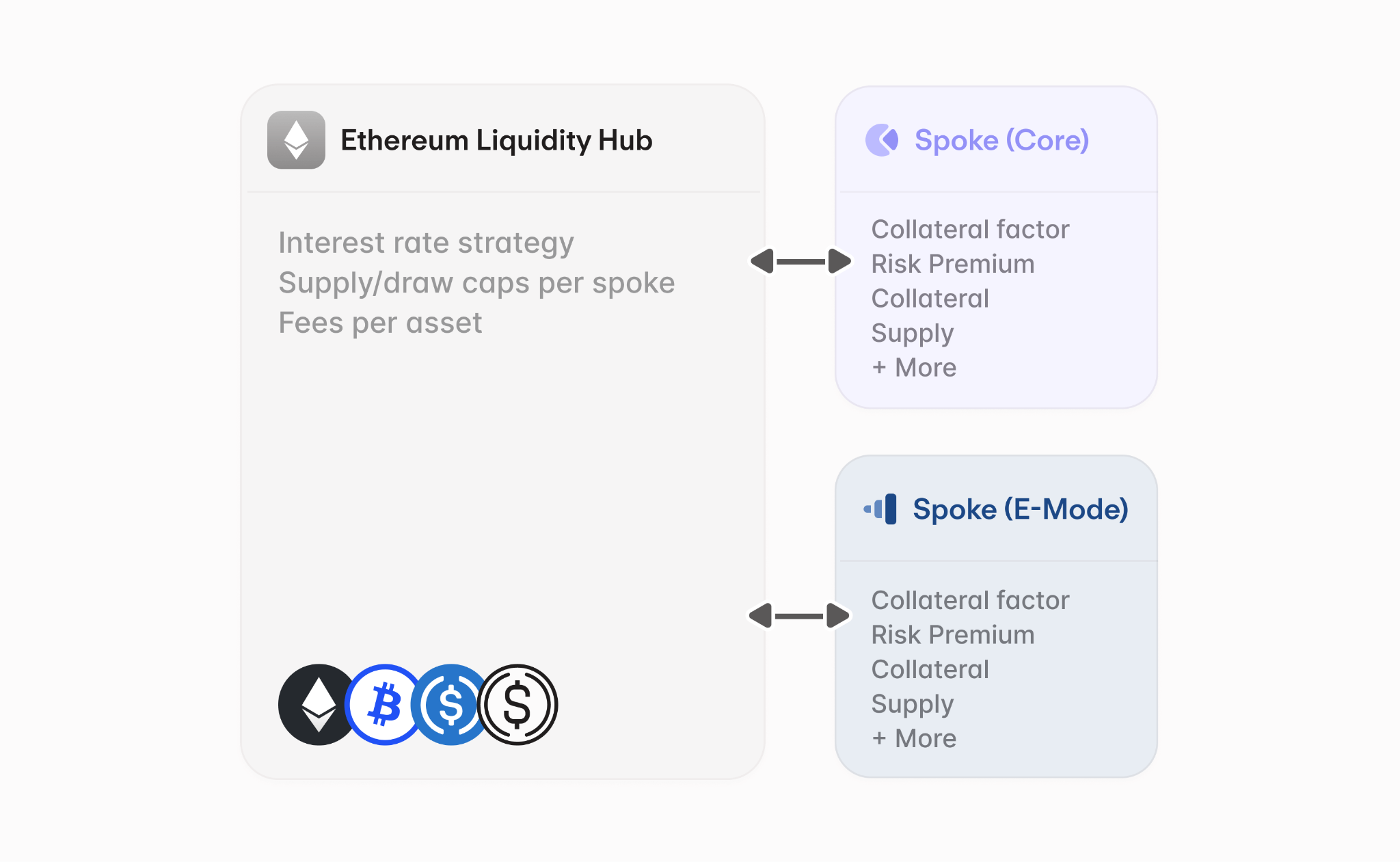
Aave V4 solves liquidity fragmentation by cleanly separating backend accounting from the frontend user experience.
The Liquidity Hub (The Engine)
The Hub acts as the protocol’s central bank and ultimate vault. All supplied assets are pooled here, though users never interact with the Hub directly.
Risk Enforcement: The Hub acts as the ultimate enforcer of solvency. It guarantees that total borrowed assets never exceed total supplied assets.
Credit Limits: It establishes strict, hard caps on how much liquidity any connected Spoke can draw from the central pool.
The Spokes (The Storefronts)
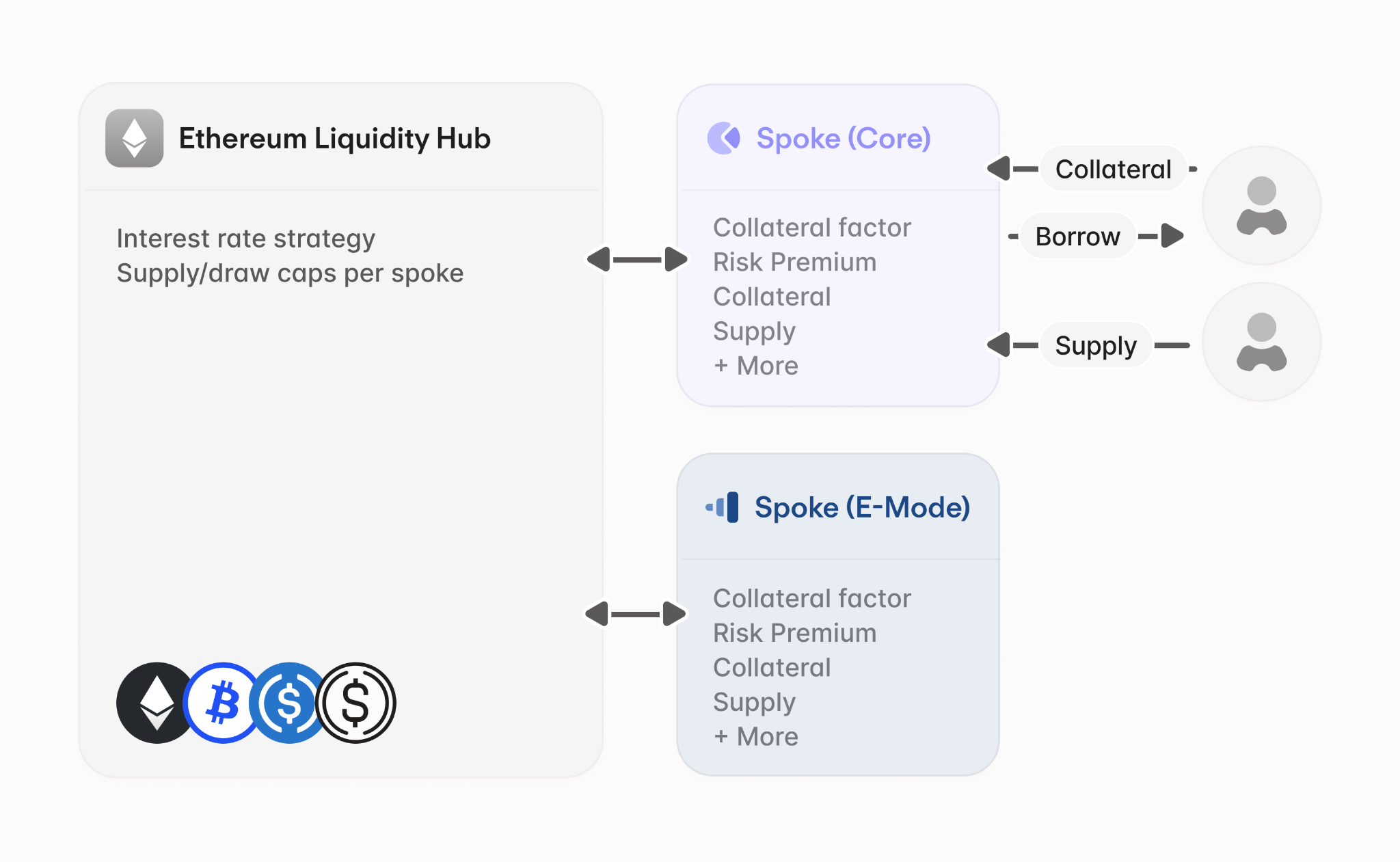
Spokes are the entry points and user-facing components of the protocol. Whenever a user supplies or borrows assets, they interact through a specific Spoke.
Customizable Parameters: Each Spoke connects to the Hub but operates with its own distinct risk settings, collateral rules, and price oracle integrations.
Isolated Risk Management: Spokes manage individual user positions and are equipped with independent safety switches. If an issue arises in one Spoke, it can be paused without freezing the entire protocol.
Why V4 Matters to Users?
For Lenders
Yield Optimization: Through the new Reinvestment Module, capital that previously remained idle to facilitate withdrawals can now be algorithmically deployed into low-risk, liquid external yield strategies (e.g., tokenized U.S. Treasuries). This is designed to increase the baseline yield.
Liquidity Consolidation: By pooling assets in a central Hub rather than distributing them across fragmented pools, the protocol aims to reduce instances of “utilization lock,” thereby improving the reliability of withdrawals under normal market conditions.
Risk Stratification: Suppliers can allocate capital to specialized Spokes with varying risk profiles (such as Real World Assets or novel tokens), allowing for targeted risk-reward strategies.
For Borrowers
Prevention of Borrowing Cost Pollution: In monolithic liquidity pools, high-yield strategies (such as sUSDe looping during periods of high funding rates) drive up stablecoin utilization, artificially inflating borrowing costs for all users. This “pollution” negatively impacts participants executing lower-margin strategies, such as RWA stablecoin loops. V4 isolates high-demand use cases into specific Spokes, protecting baseline borrowing costs for standard users.
Rate Stability: Drawing from a unified liquidity pool allows the protocol to absorb large borrowing demands more smoothly. This structural change is designed to reduce the broader interest rate volatility often seen in smaller, isolated liquidity pools.
Capital Efficiency: Dedicated E-Mode Spokes offer optimized Loan-to-Value ratios for correlated assets (e.g., borrowing USDC against USDT, or ETH against Liquid Staked ETH), facilitating more capital-efficient borrowing.
Expanded Collateral Options: Because the protocol isolates risk at the Spoke level rather than exposing the entire liquidity pool, Aave governance can systematically approve a wider variety of collateral assets, including lower-liquidity tokens or off-chain assets.
<Explore Aave on DeFi Saver now>
Supported Spoke Archetypes
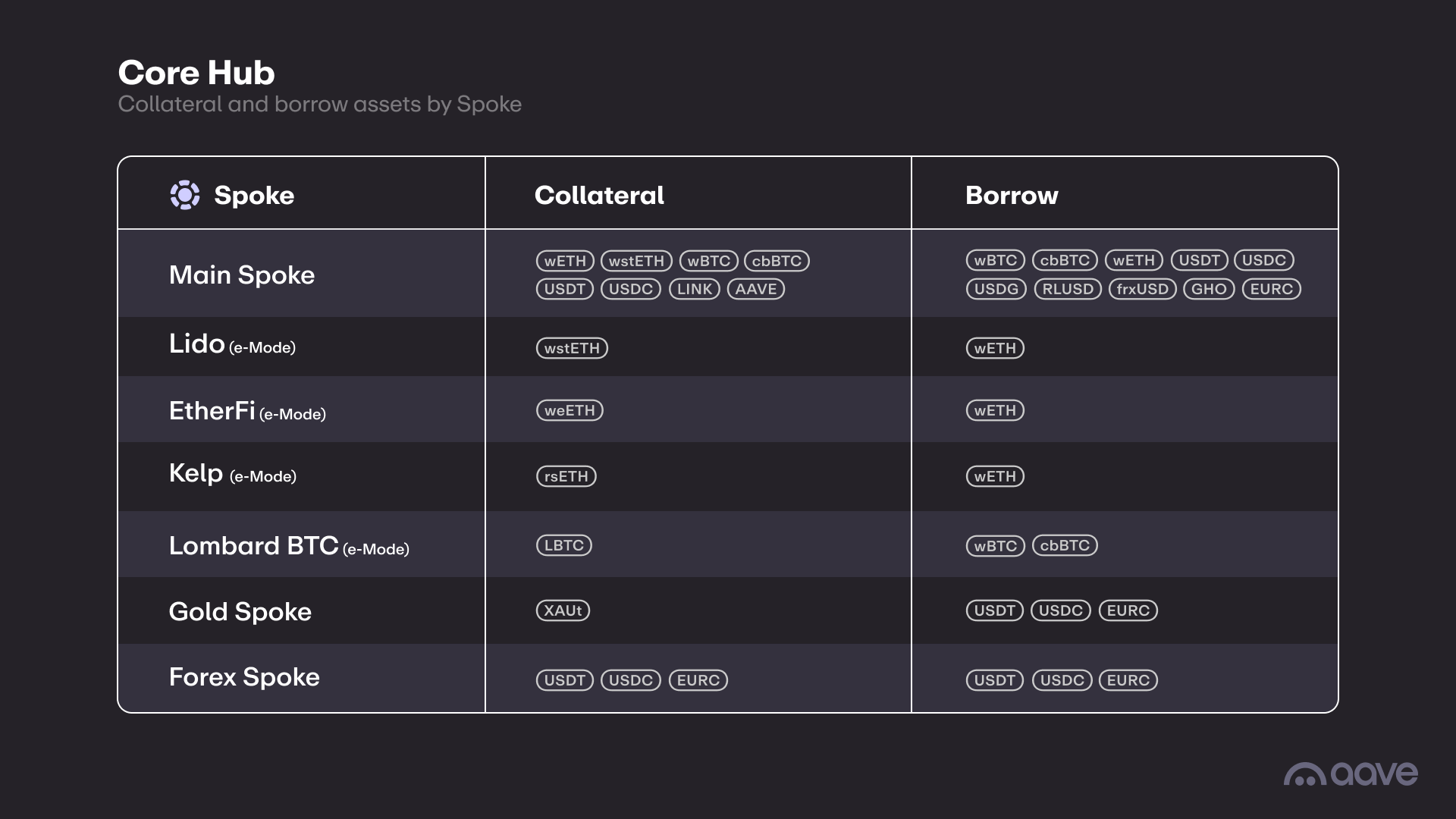
The modularity of V4 allows builders to design highly specialized markets that plug directly into Aave’s deep liquidity. Examples include:
E-Mode Spokes: Dedicated environments for correlated assets (e.g., stablecoins or Liquid Staking Tokens). These Spokes isolate the risk of high-leverage looping strategies while offering users enhanced borrowing power.
Isolation Mode Spokes: Designed for listing brand new or highly volatile tokens. The Hub grants these Spokes a strict “credit limit,” allowing the safe onboarding of novel assets without exposing the core protocol to bad debt.
RWA (Real World Asset) Spokes: Tailored for assets like tokenized Treasury Bills. These Spokes feature customized access controls (KYC/AML), legal compliance mechanisms, custody requirements, and redemption rules.
Capital Efficiency: The Reinvestment Module
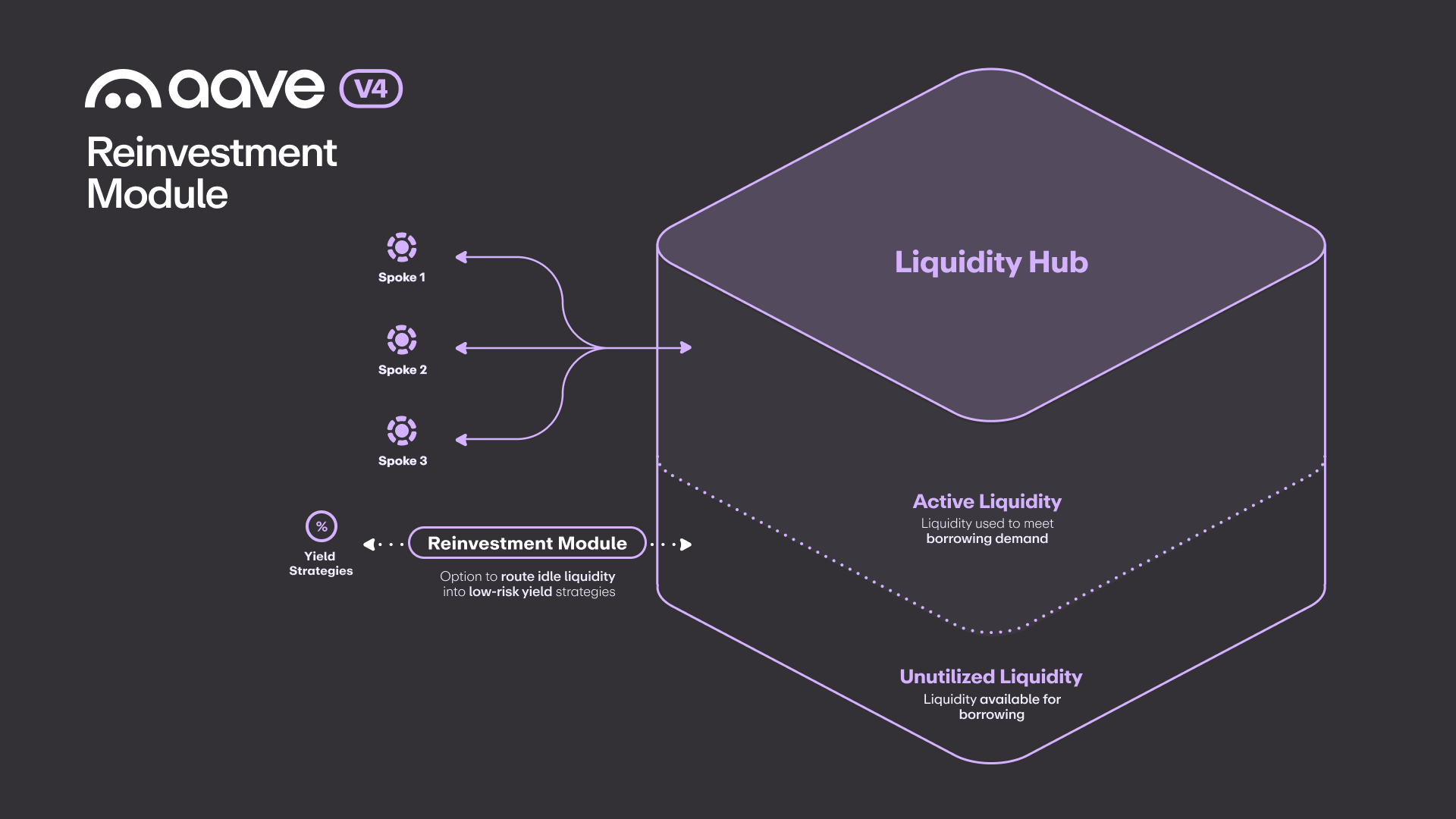
Historically, lending protocols required large amounts of capital to remain idle to process instant withdrawals (sometimes up to 30% for stablecoins). Aave V4 addresses this through the Reinvestment Module.
Active Yield Generation: This opt-in, governance-approved feature automatically deploys idle liquidity from the Hub into low-risk, highly liquid yield strategies (such as short-term Treasury equivalents).
Dynamic Rebalancing: If borrowing demand spikes or withdrawal requests increase, the module automatically rebalances to replenish the Hub.
User Benefit: Lenders receive a higher baseline Annual Percentage Yield (APY) without sacrificing withdrawal liquidity.
Limitations and Shortcomings vs Aave V3 & Morpho
While V4 solves liquidity fragmentation, the Hub and Spoke design introduces distinct limitations when evaluated against previous iterations and alternative protocols.
Governance Complexity (vs. Aave V3): The transition from monolithic markets to a modular model drastically increases the parameter management burden for the Aave DAO. Governance must now constantly monitor and adjust Hub credit limits, Spoke-specific risk configurations, and Reinvestment Module strategies, increasing operational overhead and execution friction compared to V3.
Systemic Centralization Point (vs. Morpho): While Spokes successfully isolate asset and collateral risk, the Liquidity Hub acts as the central accounting engine for the entire protocol. If a critical vulnerability is exploited within the Hub’s core accounting logic, it poses a systemic risk to all pooled liquidity. In contrast, Morpho’s fundamentally independent vaults ensure that a smart contract failure remains strictly isolated to a single vault with zero contagion risk.
Permissioned Bottlenecks (vs. Morpho): Morpho allows any user to deploy a customized lending vault in a fully permissionless manner. While Aave V4 encourages modularity through custom Spokes, connecting a newly built Spoke to the Liquidity Hub—and securing the necessary credit limit to function effectively—still requires formal approval from Aave DAO governance. This creates a bottleneck that prevents truly permissionless, rapid market creation.
Smart Contract Footprint (vs. Aave V3): The decoupling of liquidity provision (Hub) and risk management logic (Spokes) requires a much larger and more intricate smart contract architecture. This added complexity increases the attack surface and makes protocol auditing significantly more challenging than the relatively straightforward design of Aave V3.
A word on risk
V4 is new code, treat it like it is
Four audit firms and a public Sherlock contest with 900+ participants reviewed V4 before launch with zero high or critical findings. But new code always carries more unknown risk than code battle-tested under billions in real positions. The conservative supply caps at launch reflect that. V3 is not being deprecated — for large positions that need depth right now, V3 is still the better venue. Use V4 for its structural advantages and let it prove itself over the next few months.
<Explore Aave on DeFi Saver now>
For sponsorships, questions, or news tips, reach us at: support@todayindefi.com
Follow @todayindefi to keep up with the latest DeFi news on Twitter.
Disclaimer: Projects or tokens mentioned in this newsletter are often experimental or unaudited. Do your own diligence before using or buying anything mentioned.