

Subscribe for free daily news headlines, weekly news recap, on-chain trading outlook, airdrops, and actionable farming opportunities.
Find and execute 15%+ stablecoin yields in minutes
Save time without manually checking every protocol. DeFi Saver’s Discover page surfaces rates across Aave, Morpho, Spark, and more, lets you simulate leverage before committing, and handles the full loop in one click. Stop leaving yield on the table.
<Discover Yields on DeFi Saver> | Today in DeFi is Supported by DeFi Saver
Farming Benchmarks:
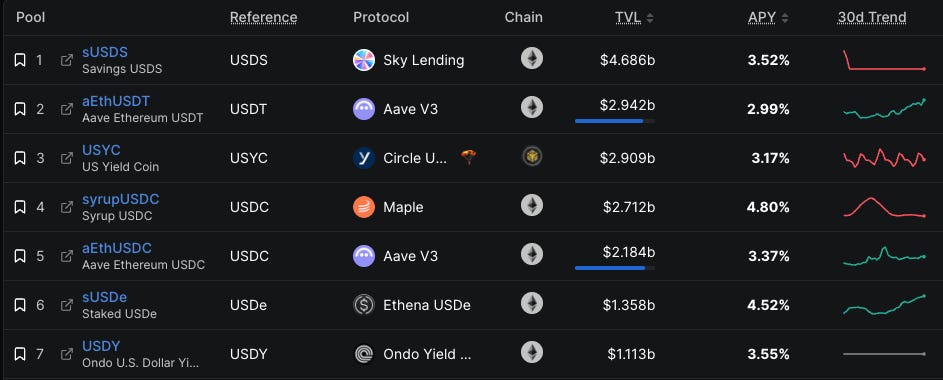
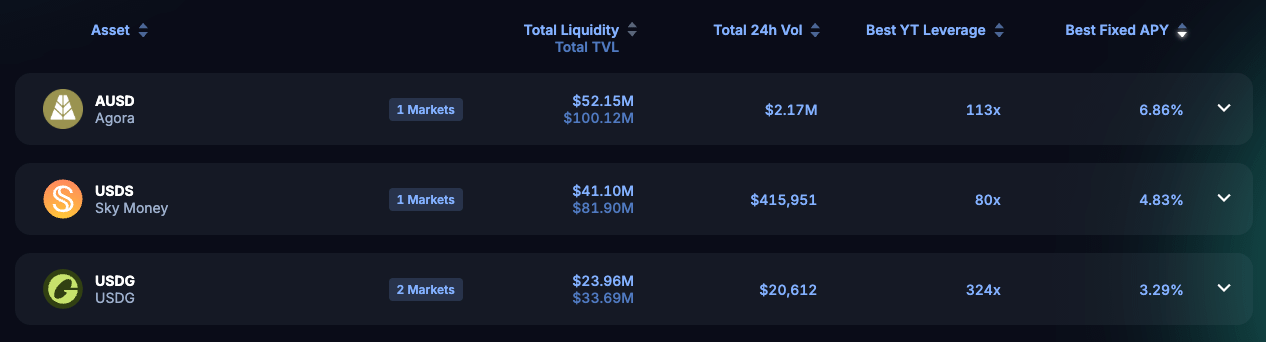
Every farm below beats that baseline. When a rate looks too good relative to this range, that gap is usually the incentive/emissions component, not organic yield — check the breakdown in each card.
Earn up to 11% on Stables and >5%on ETH:
Morpho (Arbitrum – Lending vault) – Bitget x Steakhouse USDT0 – 10.10% APY

A Morpho vault curated by Steakhouse Financial, co-branded with exchange Bitget. You deposit USDT0 (LayerZero’s omnichain USDT); the vault auto-allocates across isolated Morpho markets pairing USDT0 against different collateral types. Yield comes from borrower interest at each market’s utilization-based rate — running near 95% utilization, so yield sits close to the max borrow rate.
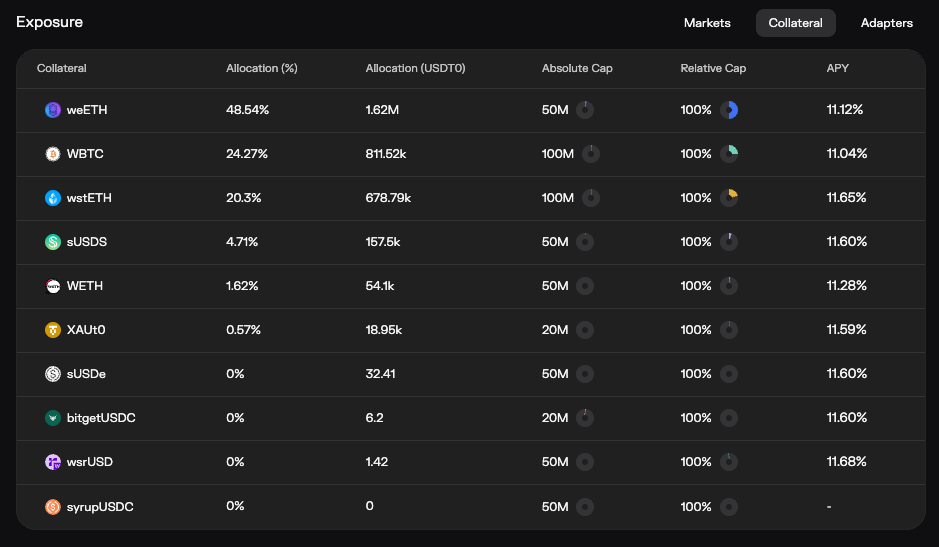
Exposure breaks down as weETH (48.5%, Ether.fi’s restaked ETH backed by staked ETH plus EigenLayer restaking), WBTC (24.3%, custodied 1:1 by BitGo), wstETH (20.3%, Lido’s wrapped staked ETH), and sUSDS (4.7%, Sky’s savings token backed by USDS reserves of crypto and RWA/Treasuries). Everything else — XAUt0, sUSDe, bitgetUSDC, wsrUSD, syrupUSDC — is dust, not real exposure. TVL is $3.34M with only $156K available.
Risk — Medium ⚠️
You're lending USDT0 against ETH/BTC-linked collateral, not stables — if ETH or BTC crash faster than liquidations can clear (86% LLTV, ~95% utilization), the vault can absorb bad debt. Liquidity is thin, so a rush of withdrawals could leave you in a queue. Steakhouse is reputable ($2.33B curated TVL), but this specific vault is smaller and newer than their flagship products, and allocation can shift without your action.
Pendle (Ethereum – Fixed yield) – PT reUSD, 10 Dec 2026 – 11.04% Fixed APY

This is Re Protocol’s reUSD (re.xyz) — not Resupply’s reUSD, a different token entirely. It’s a tokenized senior tranche of a reinsurance capital pool. Buying the PT means USDC converts to reUSD, and you lock a fixed 11.04% rate until Dec 10 by selling away the variable yield. This isn’t typical DeFi yield: reUSD capital funds licensed reinsurers backing real catastrophe/property insurance risk.
Offchain-deployed capital earns SOFR + 250bps; onchain-deployed capital earns the 7-day trailing sUSDe rate + 250bps — the yield source is genuinely uncorrelated to crypto.
reUSD sits at the top of a 3-layer capital stack: losses hit the reinsurer’s own equity (~$77M) first, then reUSDe (the mezzanine tranche), and only then reUSD. Re’s own stress test estimates ~0.03% probability of reUSD impairment even under a severe 135% combined-ratio loss scenario. TVL is $206.42M, underlying APY 7.06%.
Risk - Medium ⚠️
Tail/catastrophe risk is real — “estimated 0.03%” is a model, not a guarantee, and a large enough event could theoretically blow through both buffer layers. Redemptions are capped (20%/day protocol-wide, 10%/day per wallet) and can queue quarterly if the onchain buffer drops below 1% of supply. Fixed-rate duration risk applies on the Pendle side: if reUSD’s real yield rises above 11.04% before maturity, you underperform versus holding reUSD directly, and exiting early if Pendle’s TVL shrinks could mean selling at a discount. Re Protocol has a small track record versus a household name.
StakeDAO/Curve (Ethereum – Boosted LP) – USD3/scrvUSD – 9.76% APR

A Curve stable-pool LP between two yield-bearing tokens — neither side is raw USDC/USDT. scrvUSD is Curve’s “Savings crvUSD”: staked crvUSD (Curve’s decentralized, overcollateralized stablecoin minted via LLAMMA) that auto-compounds PegKeeper profits plus crvUSD borrower interest — one of the more battle-tested yield-stable wrappers in DeFi.

USD3 (”Web 3 Dollar”) is a Reserve Protocol RToken, not pegged 1:1 by design — it’s an overcollateralized basket of other yield-bearing stables whose composition Reserve’s DAO can change via governance, currently trading ~$1.11 as its redemption value accrues. Yield stacks three ways: Curve trading fees, CRV emissions boosted 2.27x via StakeDAO’s veCRV lock, and natural appreciation of both underlying tokens. TVL is $698K, with $332K of that deposited specifically through StakeDAO.
Risk — Low-Medium
This is genuinely one of the more sustainable, lower-risk LPs featured — both sides are overcollateralized and yield-bearing rather than relying purely on emissions. Impermanent loss or peg-slip risk applies if scrvUSD and USD3 drift in relative value. USD3's governance risk is real — Reserve's DAO can change the underlying basket. The 2.27x boost isn't guaranteed; it depends on StakeDAO's veCRV position and gauge weights, which shift with Curve governance. TVL is thin enough that larger trades can move the peg more than on blue-chip Curve pools.
IPOR – Liquity ETH Carry Vault – 5% Spot APY

The vault currently optimizes wstETH rates by collateralizing it in a Liquity Trove, borrowing BOLD at the branch-specific fixed rate, and deploying the BOLD into a Curve BOLD/USDC LP — all programmatic, with conservative LTV constraints and continuous monitoring of borrow spreads, peg stability, and unwind capacity.
Leverage expands only when net carry is positive and contracts automatically if spreads invert or liquidation buffers deteriorate.
<Farm the Liquity ETH Carry on Ipor> | Today in DeFi is supported by Liquity
Risk — Medium-Low
(1) your WETH is converted to wstETH or rETH and deposited as collateral on Liquity V2 to mint/borrow BOLD — standard CDP liquidation risk applies here if wstETH’s value drops relative to the debt;
(2) the borrowed BOLD is then supplied into the BOLD/USDC Curve pool to farm BOLD from PIL emissions and CRV rewards — this adds impermanent loss exposure and CRV emissions risk on top of the borrowing position;
(3) LTV targets a relatively conservative 55%. BOLD itself carries peg risk as its a CDP stablecoin without strong arbitrage mechanisms.
This Week’s Farming News:
Venus Core launches negative APYs for borrowing USDT and USDC at rates reaching -23.4%, offering leverage opportunities through October 14.
Binance Wallet introduces a Hold to Earn program for USDe, offering up to 4.75% APR in promotional rewards.
Superform’s SuperTSLA launches pre-deposit on Base, offering up to 100% APY on tokenized Tesla stock.
Exponent Finance announces over $10K in renewed rewards for ONyc and srONyc markets on Solana, enabling up to 80% APY by placing limit orders or providing liquidity.
PancakeSwap launches Infinity pools on Robinhood Chain, offering a 90% fee share to LPs, enhancing LP incentives across pools like WETH/USDG and NVDA/USDG.
Hylo Vault's USDC cap is raised to $5M, allowing users to lend USDC for up to 11.2% APY, including hyUSD rewards.
Today’s News Headlines:
Variational sets VAR TGE for Q4 2026
Pendle lists PT tokens for Partners Group fund
NYSE/Blockchain.com explore tokenized NYSE stocks
Pyth becomes approved distributor of Nasdaq Basic
CME Group to launch Bitcoin Cash, Uniswap futures
Strategy repurchased $139.3M worth of STRC shares
$20K in USDC Rewards Live on DeFi Saver’s Compound Institutional Market
TL;DR
Compound’s new Institutional Market runs on curated blue-chip collateral only (ETH, wstETH, WBTC, cbBTC) — structurally lower-risk than most DeFi yield.
DeFi Saver has its own separate reward allocation — up to $20K in USDC — outside Compound’s native cap. It’s still open.
Borrowers get a real LTV edge, strongest on ETH (~5pp higher than Compound’s retail market); existing leveraged positions move in with Loan Shifter, one transaction.
Once you’re in, DFS’s usual automation layer — Auto-Boost, Stop Loss, Trailing Stop — works here too.
<Farm 5%+ USDC APR on Compound’s Institutional Market>
DeFi Saver is offering up to $20K in USDC rewards for users depositing into Compound’s Institutional Market through its app. The campaign runs for three months(until December 8), with rewards distributed at the end based on how long your USDC was supplied.
Rewards are one reason to use DFS, but the bigger edge comes from how the position can be managed. The Institutional Market offers a more selective collateral set and higher LTVs, while DeFi Saver adds one-transaction position management and automation on top.
A lower-risk collateral set
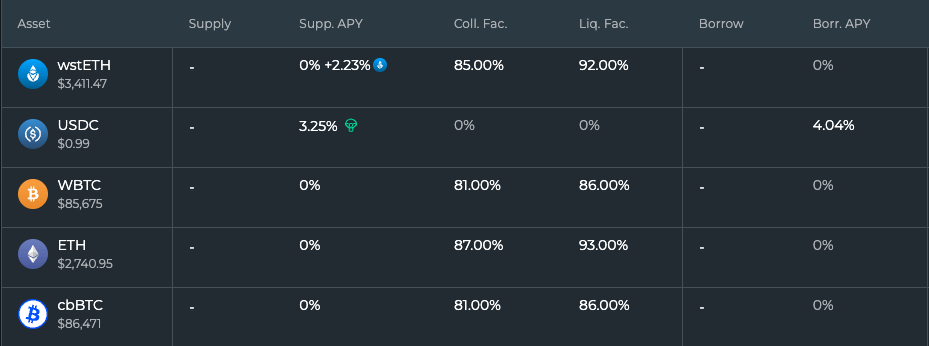
Most DeFi yield asks you to accept a long tail of collateral risk in exchange for a headline rate. This market is built for institutions and is curated to four assets: ETH, wstETH, WBTC, and cbBTC. No exotic listings, no thin-liquidity long tail dragging down the risk profile of the whole pool.
These proven, well-understood assets can run tighter, more favorable parameters than a pool that has to price for a dozen more volatile ones.
How to deposit
Go to app.defisaver.com and connect your wallet.
Find the Compound Institutional Market listing — it should be surfaced directly given the promotion, or under Compound’s market list.
Enter your USDC amount and confirm the supply transaction.
And you’re in!
There’s no minimum deposit or KYC required. The three-month program pays rewards at the end, with early exits still eligible for rewards proportional to the duration of supply.
What to watch
It’s a new market. Live for about a week as of this writing — a shorter track record than Compound’s established retail markets, even though it runs on the same underlying, multi-year-tested Compound v3 codebase.
Liquidation terms differ by asset, not just LTV. ETH carries a tighter liquidation penalty (5%) than the BTC wrappers (10%) — worth factoring in alongside the LTV numbers when choosing collateral, not just comparing borrowing power.
Reward pools move fast. Compound’s own cap filling within days of launch is the clearest evidence that demand here is real — which cuts both ways: it’s a genuine opportunity, and also a reason not to assume DFS’s own allocation stays open indefinitely.
<Farm 5%+ USDC APR on Compound’s Institutional Market>
On the other side: a Higher LTV for borrowers
Everything above is about depositing USDC to earn yield and the reward. If instead you’re supplying collateral to borrow, there’s a distinct opportunity worth knowing, unrelated to the deposit incentive above.
Compound Institutional Market runs higher LTVs than Compound’s retail markets, though it’s uneven by asset:
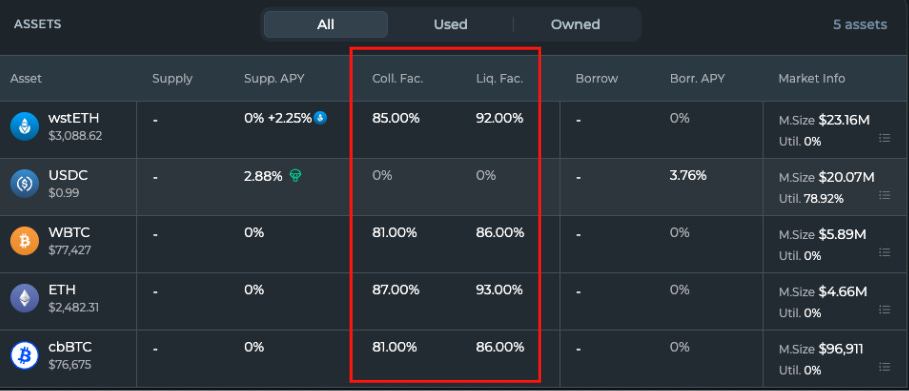
ETH sees the meaningful bump — roughly 5pp points higher than Compound’s retail collateral factor. If you’re leveraging ETH specifically, this is one of the best markets to do it from.
WBTC and cbBTC see a smaller edge — closer to 1pp over retail. Worth knowing going in, so the borrowing case doesn’t get oversold on the BTC side.
For existing DeFi Saver users already running a leveraged position elsewhere on Compound, you don’t have to unwind and rebuild it to take advantage.
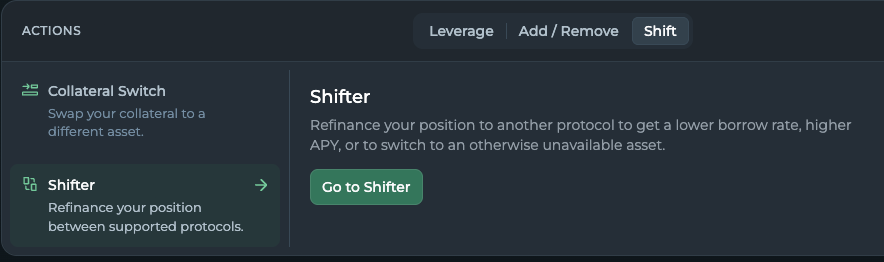
Loan Shifter moves an existing position — collateral and debt both — into this market in a single transaction, instead of the usual withdraw, repay, re-supply, re-borrow cycle. If you’re long ETH and want the higher LTV here, this is the one-click version of that move.
Manage it like everything else on DFS
Once a position is open, DeFi Saver adds automation tools that most interfaces, including Compound’s, don’t offer: Auto-Boost to maintain target leverage, Stop Loss and Trailing Stop for automated exits, and Collateral Switch to rotate backing.
For example, if ETH rises after you borrow USDC against it, your leverage naturally falls as collateral value increases. Auto-Boost automatically re-levers the position back to your target ratio in a single transaction — try it directly on DeFi Saver’s Compound Institutional Market.
That’s the main advantage of using DFS here: the market gets the same automation layer available across DeFi Saver, regardless of the underlying protocol.
<Automate your leverage on Compound Institutional Market>
Today in DeFi is proudly sponsored by DeFi Saver.
Follow @todayindefi to keep up with the latest DeFi news on Twitter.
Disclaimer: Projects or tokens mentioned in this newsletter are often experimental or unaudited. Do your own diligence before using or buying anything mentioned.