

Subscribe for daily free DeFi news covering launches, tradable catalysts, and actionable farming opportunities.
Today’s News Headlines:
- Uniswap activates fee switch
- Curve proposes new syrupUSDC market
- Galaxy launches Monad AUSD credit vault
- Wemix suffers $6.25M breach
Key Takeaways:
Crypto outperformed equities through geopolitical tension.
Crypto notched a fourth straight week of relative strength even as renewed strikes spiked oil and yields. Underneath, USDT and USDC both grew for the first time in a month and funding dropped back below the borrow rate — the crowded-long setup cleared while price rose, meaning this leg was bought on spot, not levered.
Solana led all chains with a $1.19B stablecoin inflow
New regulated issuance drove it — Anchorage’s USDGO crossed $1B in five months — and the dollars didn’t sit idle: Loopscale (11%+ lending) and Exponent absorbed them into looping venues, minting-then-leveraging inside Solana’s yield stack. The chain-by-chain breakdown, in Section 3.
Ondo secured SEC and FINRA authorization to sell tokenized stocks to US investors.
Its broker-dealer can now bring the largest tokenized securities platform ($20B+ cumulative volume) to the one market it was locked out of, landing the same week tokenized holders passed one million. What else moved, in Section 4.

Find and execute the 15%+ stablecoin yields in minutes
Save time without checking every protocol manually. DeFi Saver’s Discover page surfaces rates across Aave, Morpho, Spark, and more, lets you simulate leverage before committing, and handles the full loop in one click. Stop leaving yield on the table.
<Discover Yields on DeFi Saver> | Today in DeFi is Supported by DeFi Saver
1A. Traditional Macro
Oil round-tripped a war scare, and that whipsawed rates. Through last week, renewed US-Iran strikes and Houthi tanker attacks pushed Brent above $100 intraweek — its highest since the June peace deal — dragging the 2-year to ~4.33% and the 10-year near a 2026 peak as an energy-driven inflation scare took hold.
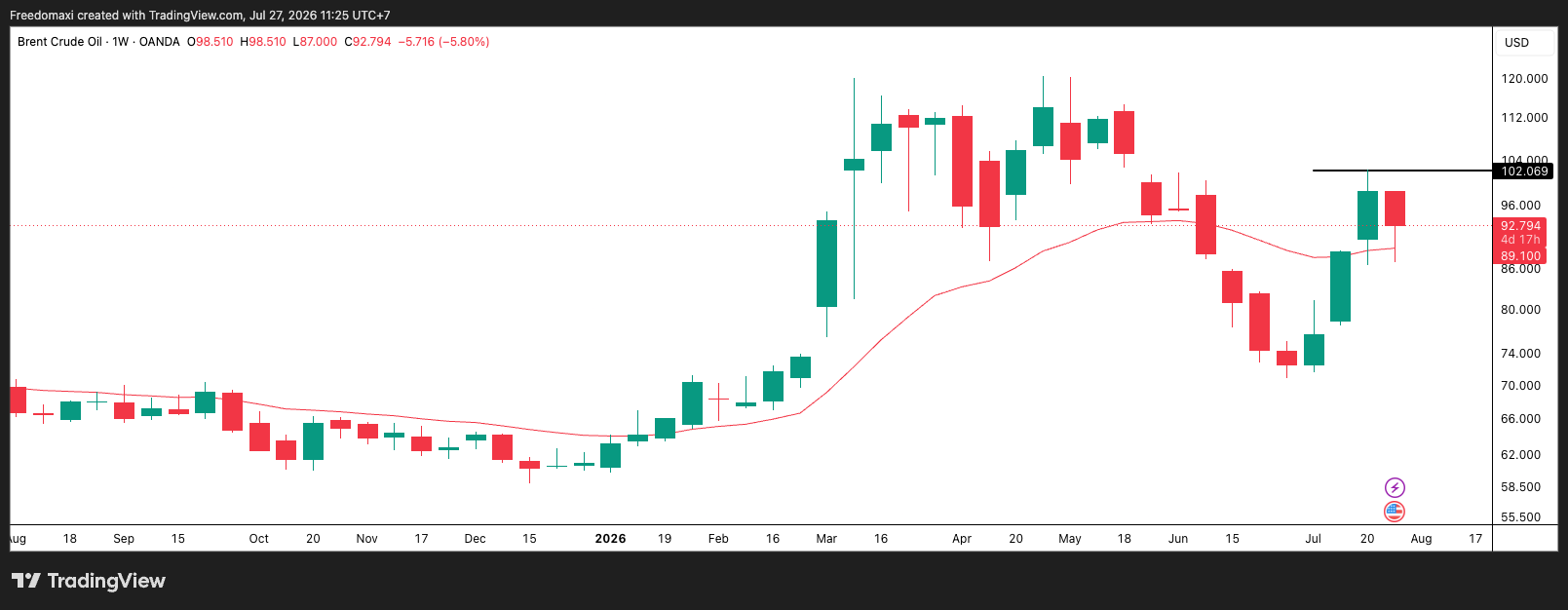
Then it reversed: strikes paused into the weekend, and oil plunged Monday, with Brent back to ~$92 and WTI to ~$85, roughly 5% lower on the day. Prices remain well below the war’s ~$120 peak, and a risk premium is still embedded, but the acute phase eased as fast as it flared.
US 2Y yield
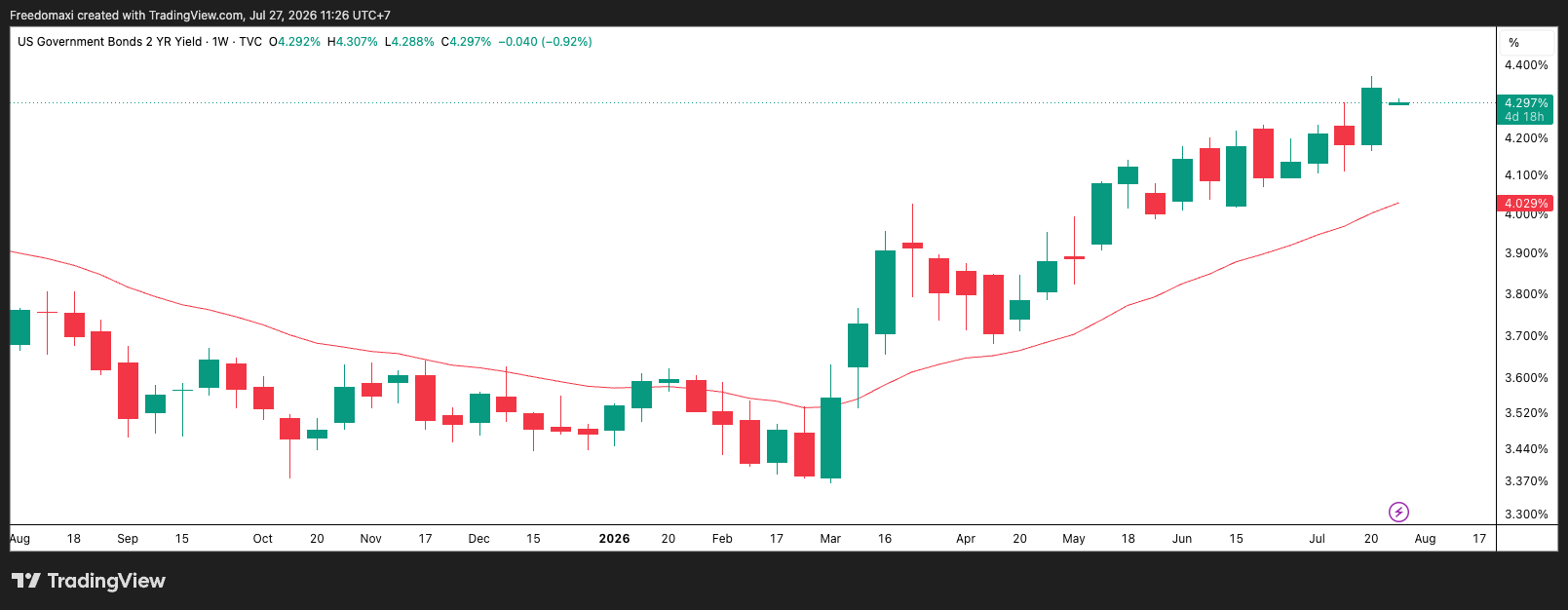
US 2Y yields closed near 4.33%, their highest level since early 2025, after a sharp selloff driven largely by the oil spike. The 2Y briefly reached 4.37%, the 10Y approached 4.7%, and the 30Y touched 5.19%. Similar moves were seen globally as investors priced in higher energy-driven inflation.
However, much of that repricing was tied to an oil shock that has already started to reverse, with Brent falling back toward $92. As a result, the latest yield levels may overstate current macro pressure, especially if oil continues to decline heading into the Fed meeting.
BTC/NQ ratio
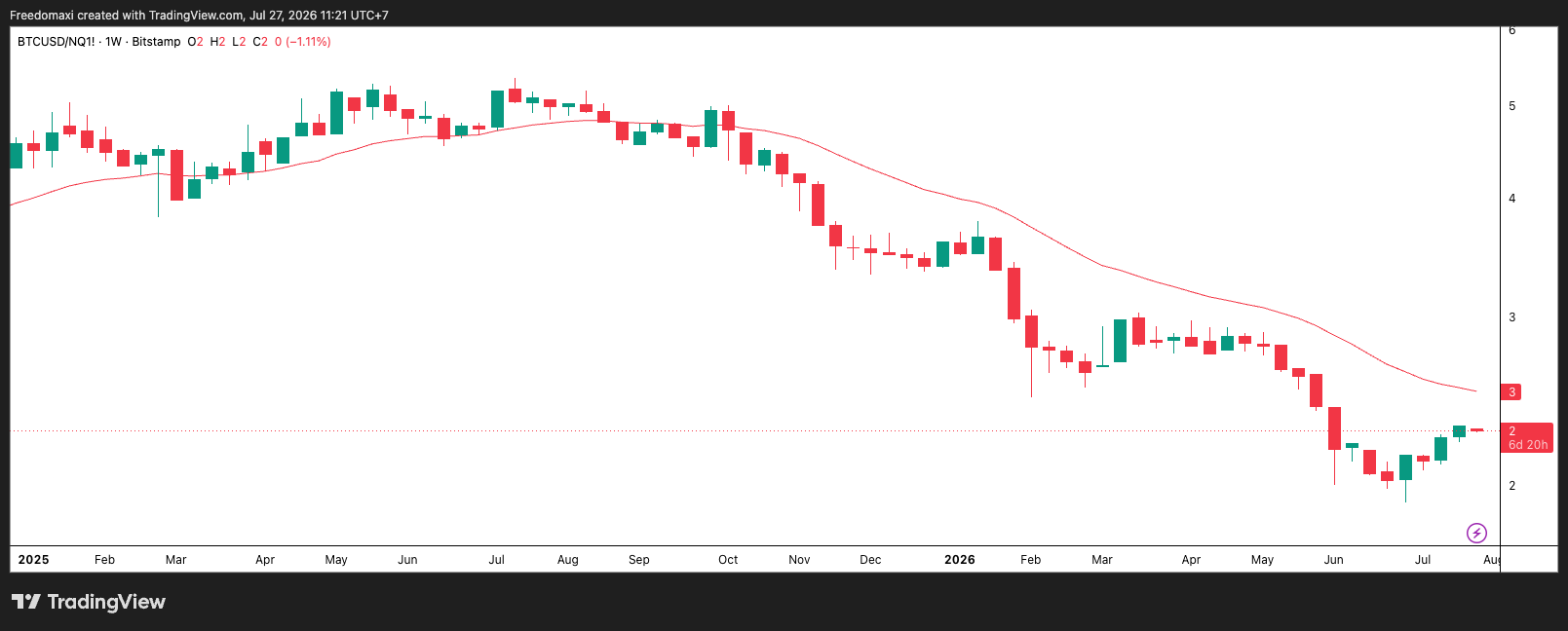
BTC/NQ ratio: a fourth consecutive week of crypto outperforming equities. IMPROVING. The standout, and increasingly hard to dismiss as noise. Four straight weeks of relative strength through a period in which liquidity contracted, yields hit multi-year highs, and the dollar firmed. Whatever is bidding crypto is not coming from the macro backdrop.
The weekly close was risk-negative: e 2Y yield hit cycle highs, but largely driven by a temporary oil scare that is already fading.
The key takeaway is that rates caused most of the pressure and are also the most likely factor to reverse if oil keeps falling. Meanwhile, crypto remained resilient, outperforming equities for a fourth straight week despite the macro volatility.
Token Price Movers - Observations, not trade ideas.
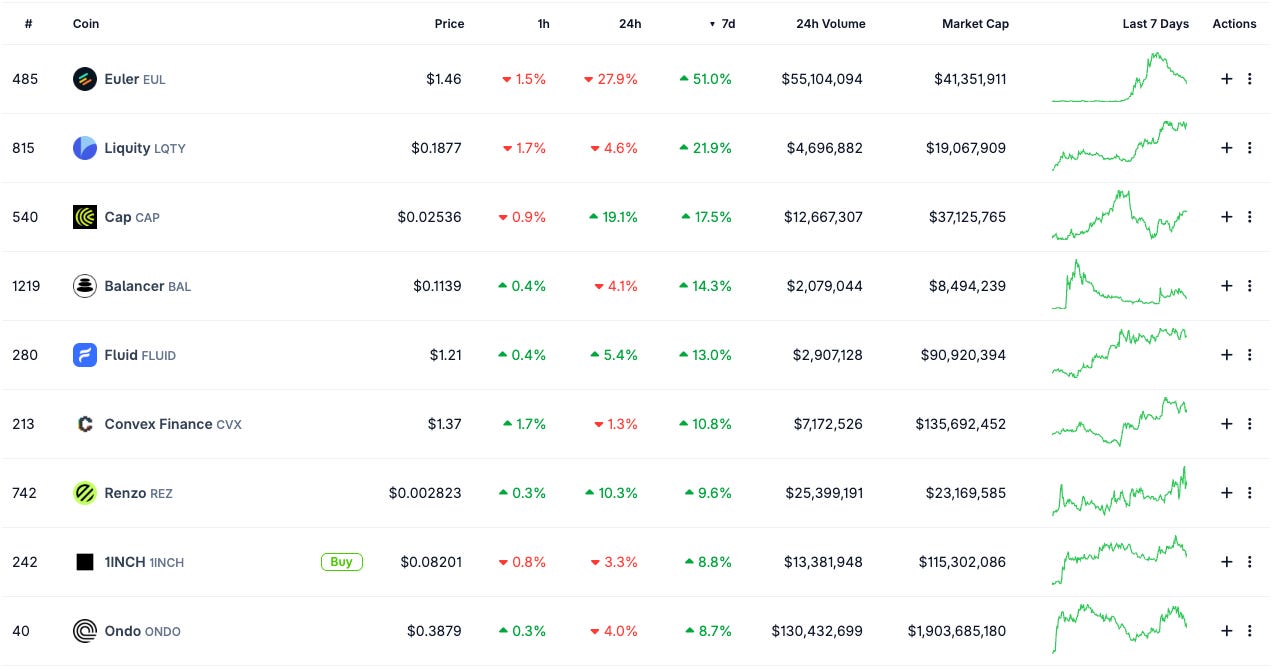
Liquity – LQTY . Liquity’s BOLD stablecoin grows and yields across BOLD-based products move above 10% APR. The key development is that Liquity V2 directs protocol revenue back into the BOLD ecosystem, creating a closer link between borrowing activity, protocol revenue, and stablecoin yields; recent strength in LQTY may reflect growing market attention to that dynamic rather than the yield alone.
Ondo — ONDO . Ondo’s SEC-registered broker-dealer, Oasis Pro Markets, secured authorization to offer tokenized equities and funds to US investors under SEC and FINRA oversight. Ondo Stocks is already the largest tokenized securities platform, with $20B+ in cumulative volume, and the US was the missing market. Landed in a week tokenized holders passed one million and BNY moved toward 24/7 tokenized Treasury settlement. post
Fluid — FLUID Launched Liquidity as a Service on July 23, managing DEX liquidity for stablecoin and RWA issuers using its own capital, with no inventory or impermanent loss for the issuer. A day later, a governance proposal appeared for a partnership with AGI3, the digital-asset arm of Dubai’s Kinetic Group, which would build permissioned institutional markets on Fluid and see Kinetic buy up to 10% of FLUID supply. Note it hasn’t passed governance yet. LaaS
1inch — 1INCH Teased a product where tokens stay in the user’s wallet until a swap fills. No date or specs yet, so this is anticipation pricing.4B. TVL Gainers ($50M+ filter)
1B. Crypto Capital On-Ramp
Total stablecoin supply 7d change (level + WoW)

Total stablecoin supply: +$0.171B (+0.05%). FLAT. A marginal return to inflow after last week’s $1.17B contraction, but the number is small enough to read as neutral. The base has now alternated between positive and negative prints for six straight weeks without establishing a direction.
Weekly ETF flows - Ethereum outpaced Bitcoin, for a second straight week.
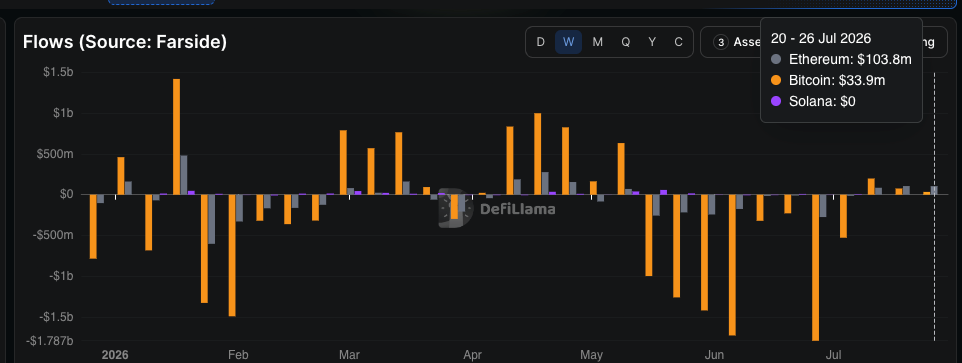
Spot ETFs took in $103.8M on Ethereum against $33.9M on Bitcoin for July 20–26, with Solana flat. Ethereum drawing three times Bitcoin’s inflow is rare, and two consecutive weeks of it is the part worth flagging. For most of 2026 the ETF complex has been a Bitcoin story with Ethereum as an afterthought, usually negative. That has now inverted.
1C. Week-Ahead Catalysts
FOMC decision, July 28–29. The dominant event, and one of the least predictable meetings in years. The committee is roughly split, markets price a ~36% chance of a hike, and Warsh has given no forward guidance about which way he leans. Because there is no guidance to anchor expectations, the reaction function is unusually wide in both directions, and the press conference matters as much as the decision.
PCE inflation, end of week. The Fed’s preferred gauge, landing days after the decision. June CPI came in cool, but this print starts to capture the renewed energy move, making it the first real test of whether the oil shock is feeding into core inflation.
Section 2 — Onchain Risk Regime
IIndividual Stablecoins Flows
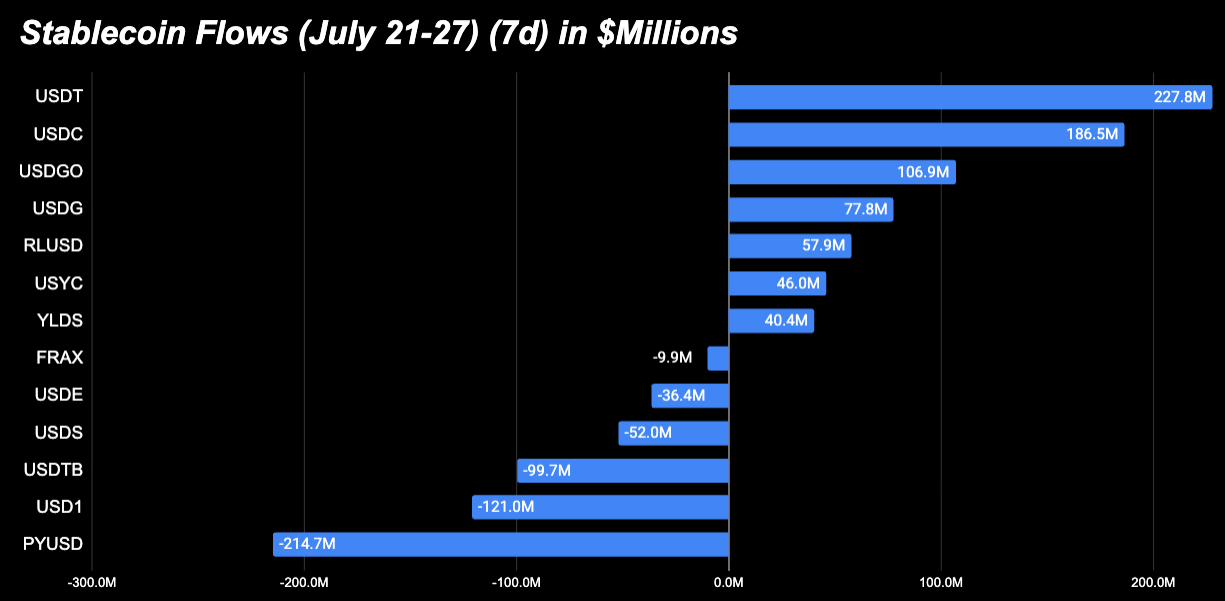
The transactional giants turned positive.
USDT added $227.8M and USDC $186.5M, the first week both have grown together in over a month. Against 30-day context the turn is early rather than established, with USDT still down $1.80B and USDC $187M on the month, but the direction changed and they led the table.
USDGO extended its run, up $106.9M (+10.68%), now +46.2% over 30 days and the fastest-growing dollar in the set for a fourth straight week. USDG added $77.8M (+13.0% on the month) as the Global Dollar rail keeps compounding, and YLDS jumped 7.26%.
The Treasury-yield tier kept draining, and the 30-day numbers are severe. USDtb fell $99.7M on the week, down 58.4% over 30 days. USDS shed $52.0M, down 17.5% on the month. USDe is off 11.0% and USYC 4.1% over the same window. PYUSD posted the largest single weekly outflow at $214.7M.
The composition: Capital is leaving parked, conservative yield instruments and showing up in transactional dollars, which is what deployable capital looks like ahead of being put to work.
Aave / Sphere Rates
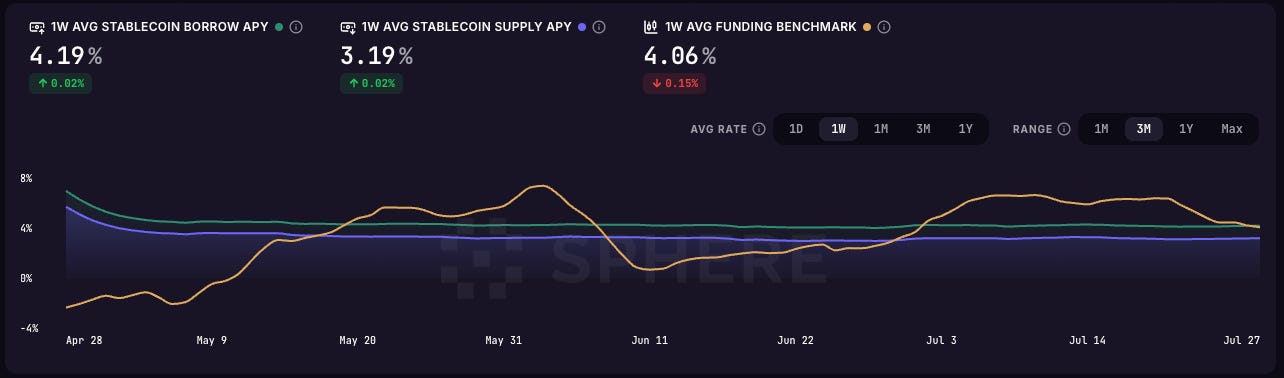
Funding dropped to 4.06%, down 0.15% on the week, and is now below the 4.28% borrow rate for the first time in over a month (supply 3.19%, borrow 4.19%). This is the cleanest positive shift in the section.
Funding has run above borrow since late June, which we flagged repeatedly as crowded-long positioning and a reason not to chase. That condition has now cleared, and it cleared while price was rising.
Falling funding into a rising market means the move is being driven by spot demand rather than leveraged longs paying up to hold positions.
ETHBTC vs 20W MA
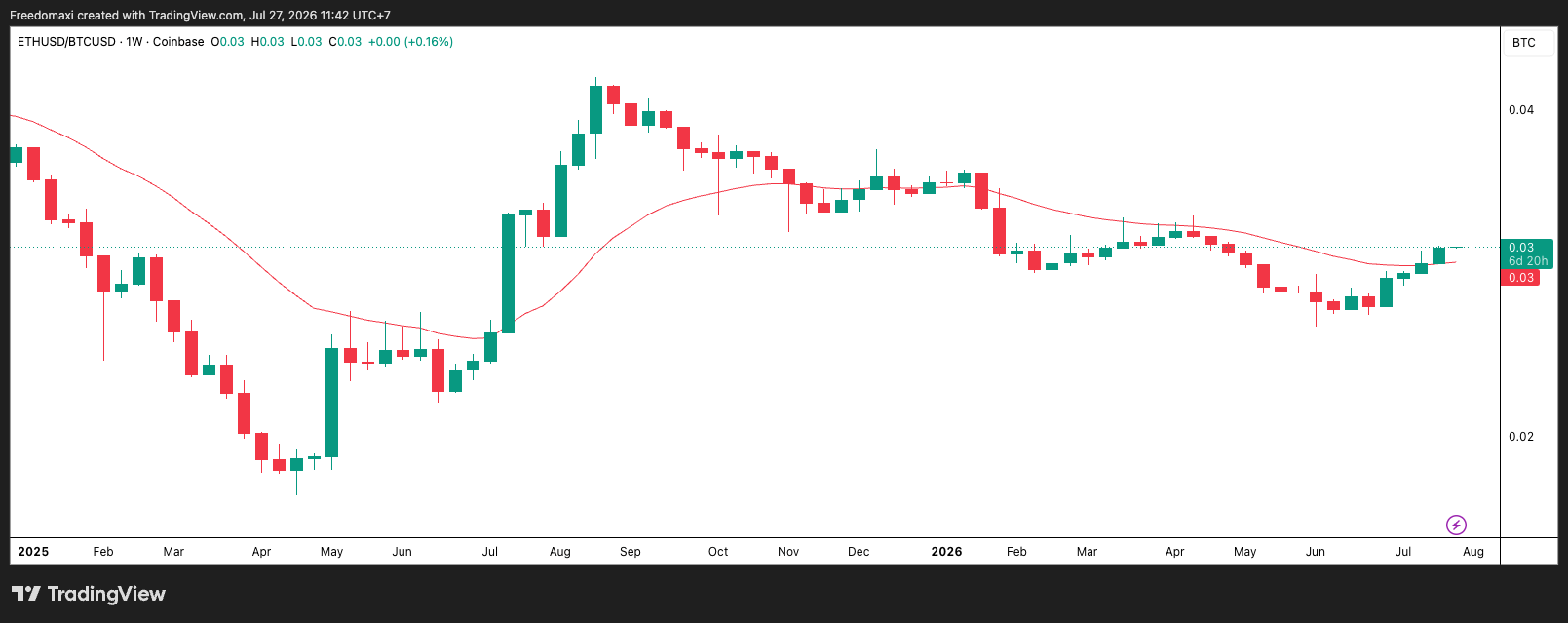
A fifth consecutive green weekly candle, and the ratio has now cleared its 20-week moving average. After spending three weeks testing the line, ETHBTC has pushed through it, the first sustained reclaim since the downtrend began in the spring.
This is the strongest the ratio has looked all year, and it is not an isolated chart signal. Ethereum ETF inflows outpaced Bitcoin’s three to one this week and last. Institutional allocation, spot accumulation, and relative price strength are now aligned. Since ETHBTC functions as the risk-appetite gauge for the broader alt complex, a confirmed break above the MA is the level that historically opens room for alts to move.
Verdict: Onchain regime — RISK-ON.
Three things changed this week, all in the same direction. Funding reset below borrow, clearing the crowded-long condition that had capped the setup for a month. Transactional dollars turned positive while conservative yield instruments kept draining, which is capital repositioning to be deployed. And ETHBTC broke its 20-week moving average on the fifth straight green week, with ETF and exchange-flow data confirming it.
Section 3 — Chain Comparison
3A. Stablecoin flows by chain — table with 7d flow, 7d %, 30d %
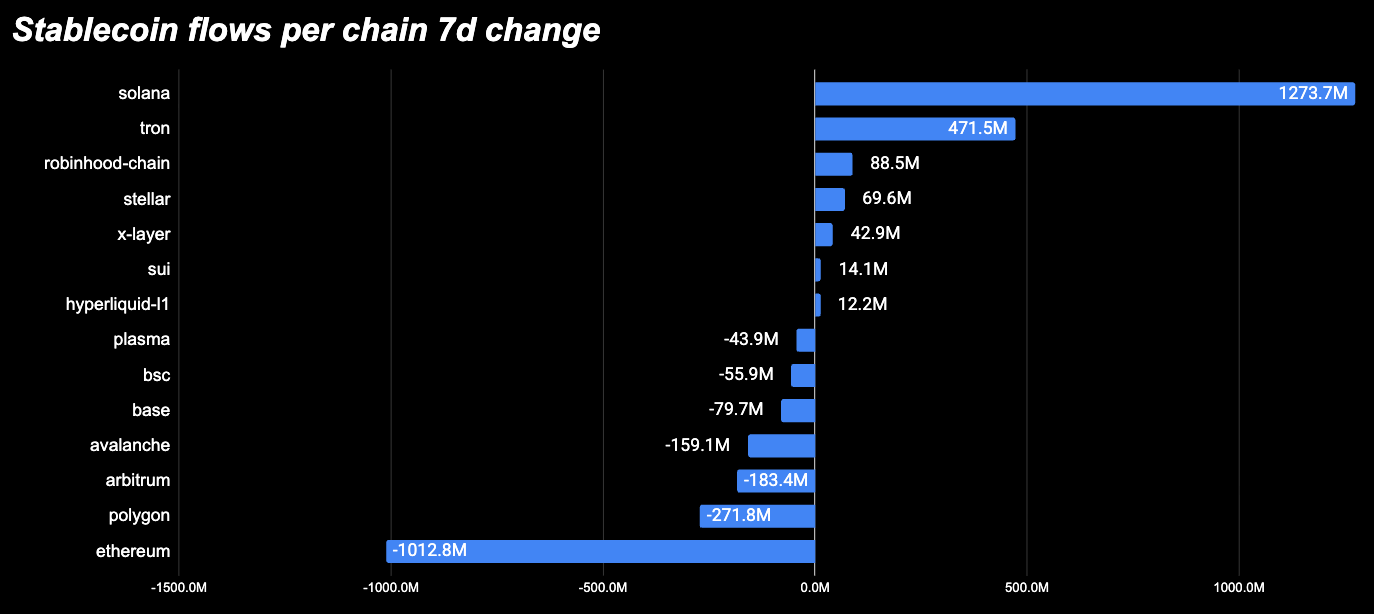
Solana — +$1.19B (+7.54% 7d, +9.47% 30d), to $16.93B
The largest absolute stablecoin inflow this week. The story was two-sided: regulated supply growth and leveraged on-chain demand.
On the supply side, USDGO surpassed $1B in circulation just five months after launching on Solana, while Circle and Tether were largely inactive. This continues Solana’s diversification away from USDC dominance and toward a broader stablecoin mix.
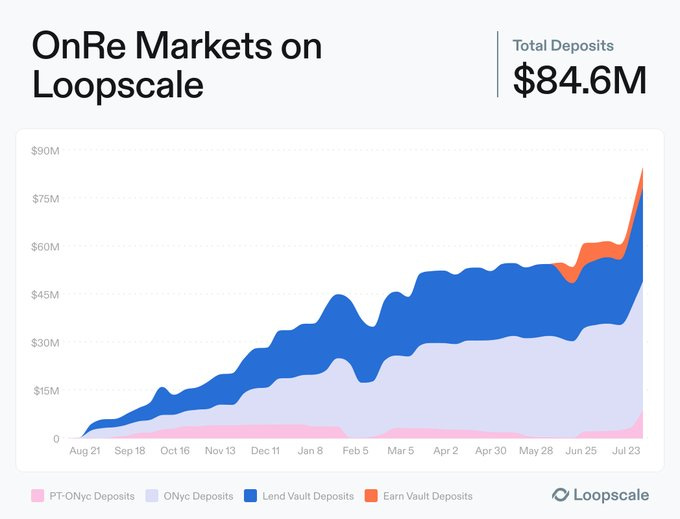
On the demand side, new capital was actively absorbed by yield venues rather than sitting idle. Loopscale — Solana’s fastest-growing fixed-rate lending protocol and Exponent — Solana’s leading fixed-yield and yield-tokenization venue, continued attracting deposits through fixed-yield and looping strategies, reinforcing demand for stablecoin liquidity.
What to watch: Whether USDGO continues gaining share from USDC and whether stablecoin TVL on Loopscale and Exponent keeps expanding. Continued growth would confirm demand is structural rather than incentive-driven.
Robinhood Chain — +$89.8M (+22.82% 7d), to $483.1M stablecoin supply
The second-largest stablecoin inflow came almost entirely from one trade: the Morpho/Ethena USDG lending stack.
Most new supply flowed into a Steakhouse-curated USDG vault on Morpho, supported by Ethena liquidity and Maple’s institutional-credit infrastructure. Despite attention on tokenized equities, lending and looping activity remains the primary driver of both stablecoin growth and TVL.
The setup has attracted capital quickly, but the flow remains concentrated in a single yield structure rather than a diversified ecosystem.
What to watch: Whether Morpho/Ethena TVL continues growing after initial incentives fade. The key durability test is the yield stack, not tokenized-stock adoption.
3B. Structural Shifts - RWA & Institutional DeFi

Key takeaways
TVL growth is overwhelmingly the Morpho/Ethena lending vault and looping demand — lending & asset management is ~81% of protocol TVL.
Tokenized-stock contribution remains minimal — roughly 4% of TVL and ~9% of DEX volume, despite the attention.
The chain’s value is in app-level trading, not base-layer usage; the launchpad lead rotated from Noxa to Pons.RWA perpetuals surpassed crypto perpetuals on Hyperliquid for the first time, driven almost entirely by a single operator focused on tokenized equities. While the milestone is notable, it does not yet represent broad-based market adoption.
Tokenized-equity market cap and transfer volume both reached record levels, while institutional infrastructure continues to move from pilots into production. DTCC processed its first live tokenized securities trades, major exchanges expanded tokenized-stock offerings, and Ondo secured broker-dealer authorization while growing revenue faster than deposits.
The week’s counterexample was Goldfinch’s wind-down, highlighting that private-credit risk still matters. The lesson is that collateral quality, duration, and transparency matter more than headline yields.
What to watch: Whether tokenized-equity activity expands beyond a single operator and whether revenue growth across RWA protocols continues to outpace TVL growth.
Robinhood Chain — Structural Shift

The market narrative remains ahead of reality.
Approximately 80% of TVL sits in lending and asset-management protocols, primarily Morpho and Ethena. Tokenized equities account for only a small share of both TVL and trading activity, while memecoins continue to dominate DEX volume.
What stands out is where value accrues. Despite strong chain activity, application-layer businesses are capturing significantly more revenue than the base layer itself. The recent shift from Noxa to Pons as the leading launchpad reinforces that user attention is concentrating around trading venues rather than infrastructure.
What to watch: Whether tokenized-stock activity grows into a meaningful share of TVL and volume. Until then, Robinhood Chain should be viewed primarily as a lending-and-looping ecosystem with a high-velocity trading front end.
Additional Signals
Fake World Assets (FWA): One of Ethereum’s fastest-growing contract clusters, but emissions end August 4, making it an attention trade rather than a durable yield opportunity.
Pendle Boros: Funding-rate markets continue gaining traction, with volume up more than 3x YTD and fixed arbitrage yields reportedly around 18–21%.
S&P Pantera Index: Signals growing institutional preference for revenue-generating crypto assets, with protocol revenue now a primary screening metric.
Section 4 — Project & Protocol Discovery
Upshift — +$58.2M (+25.8% 7d), to $283.5M · Yield / vault infrastructure
Upshift is the cleanest story in the cohort, and its model is worth stating plainly because it explains the quality of the flow. Rather than pooling deposits, Upshift operates a curated vault marketplace: dedicated vaults are built around each client’s asset mix and risk parameters, run by vetted curators, with positions returned as receipt tokens held in segregated custody rather than rehypothecated.