


This is a special edition op-ed as it’s a holiday in Taiwan. We’ll be back with regularly scheduled news and analysis tomorrow.
By Danger, Founder of Today in DeFi
The Architecture of Dollar Hegemony is Unraveling
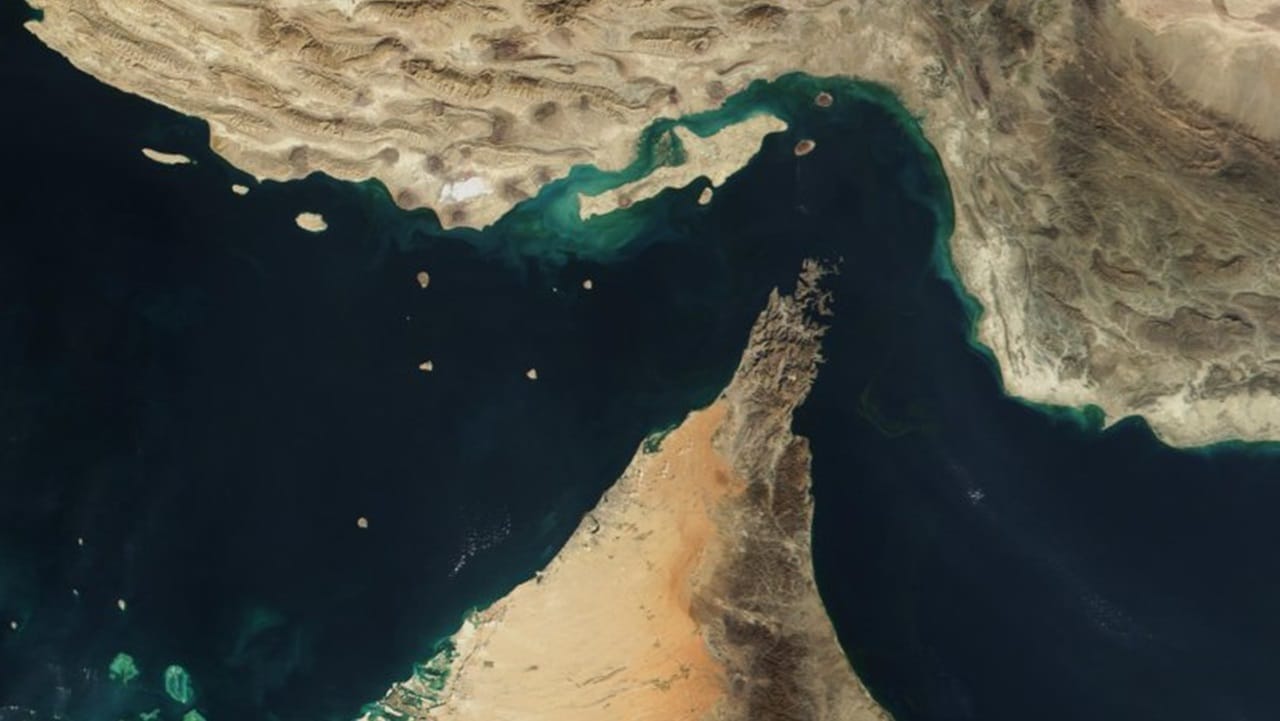
As I write this, the United States and Iran are at war. The Strait of Hormuz — the narrow chokepoint through which a fifth of the world’s oil flows — is under Iranian control. Ships passing through are paying tolls denominated not in dollars, but in Yuan and crypto. Russia has announced it will follow suit, pricing its oil exports in Yuan as well.
These are not abstract geopolitical shifts. They are happening now, in real time, and they are dismantling assumptions about the global financial order that have held for fifty years.
Before this war, the dollar’s dominance seemed permanent. It rested on three interlocking pillars: military reach that guaranteed the safety of global shipping lanes, a petrodollar system that ensured oil was priced and settled in dollars, and a financial infrastructure so deeply embedded in global trade that alternatives were practically unthinkable. These pillars reinforced each other in a self-reinforcing loop — US carrier groups kept shipping safe, safe shipping kept oil flowing, oil priced in dollars kept every importing nation dependent on dollar reserves, and those reserves funded the military that kept the lanes open.
That loop is now breaking on all three fronts simultaneously.
US military dominance, the foundational guarantee, has been visibly stress-tested. Weeks into this war, US bases across the Middle East have absorbed serious strikes. Allies have been hit and could not be protected. The technology of warfare has shifted — drones and precision missiles have fundamentally altered what it means to project power, and the carrier groups designed for a previous era are increasingly costly to operate in contested airspace. Having the US on your side used to mean your shipping was safe. That assumption is no longer self-evident.
The petrodollar is facing its first structural challenge since the 1970s. The Hormuz toll — priced in Yuan and crypto — is not just a political gesture. It is a proof of concept. For the first time in half a century, a critical chokepoint in global energy is operating outside dollar denomination.
And dollar financial infrastructure had already lost its perceived neutrality before this war began. When the US weaponized SWIFT against Russia in 2022 — freezing reserves, severing correspondent banking — it sent an unmistakable signal to every non-allied central bank: dollar infrastructure is a political instrument, not a neutral one. The incentive to find alternatives didn’t begin with this war. This war has simply made it urgent.
It is not yet clear how long this conflict will last, or whether the Strait stays closed, or whether Yuan-denominated oil trade outlasts the ceasefire. But something has already shifted that cannot fully unshift: the three assumptions that made dollar hegemony seem permanent — unchallengeable military power, oil settled in dollars, neutral financial infrastructure — are all now openly questioned, simultaneously, for the first time.
That questioning has consequences. For where value gets stored. And for what comes next.
After the Dollar, What?
The most immediate beneficiary of dollar decline looks, on the surface, like the Yuan. China is Iran’s most important partner, the currency already denominates Hormuz transit tolls, and the gravitational pull of Chinese trade creates real structural demand. In the short term, there is a genuine bullish case. But short-term trade flows are not the same as a store of value. The Yuan is managed, subject to capital controls, and ultimately answerable to a government that has demonstrated both the willingness and ability to reshape its financial system by decree. Long-term savings denominated in a currency controlled by the Chinese Communist Party will appeal to very few.
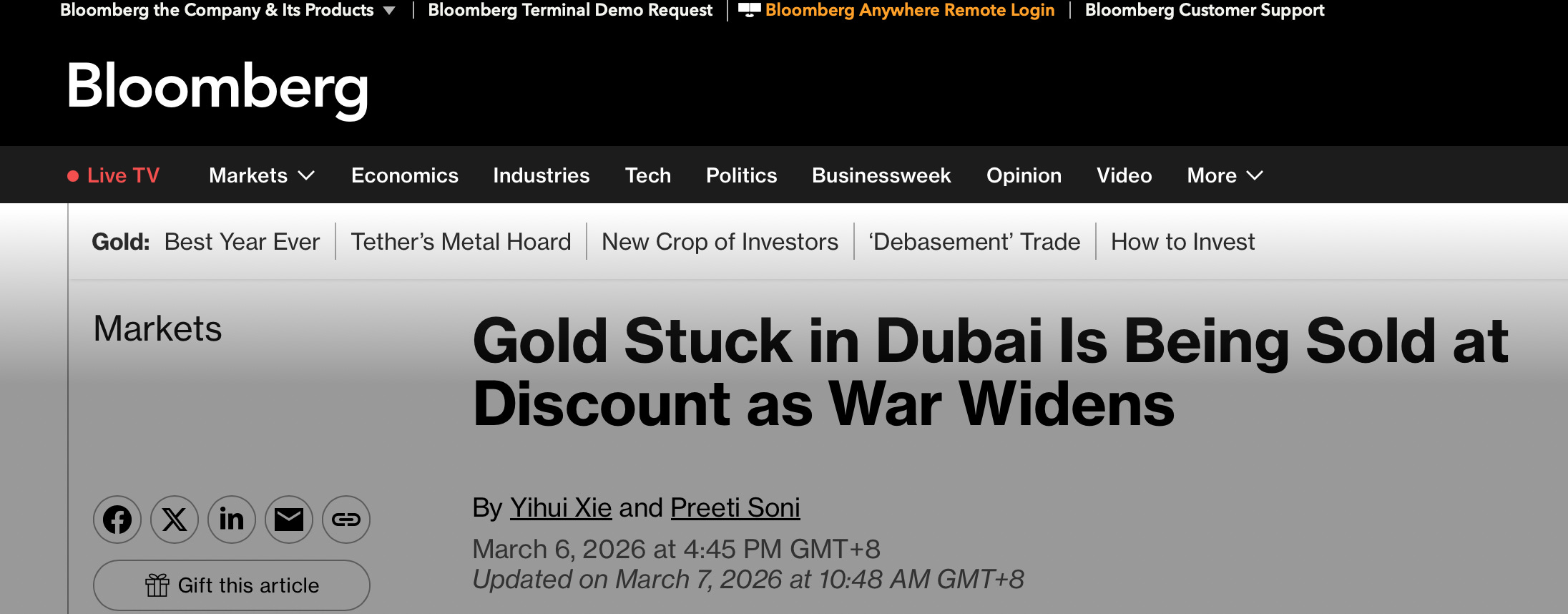
Gold is the older answer, and in the early days of the conflict it behaved exactly as the textbooks predict. But the war immediately exposed what the textbooks don’t cover. Dubai handles roughly 20% of global gold flows. When Iranian strikes grounded flights across the Gulf, that pipeline stopped — precious metals travel in passenger aircraft cargo holds, and with over 21,000 flights cancelled, bullion sat stranded. Gold stuck in Dubai sold at a $30 discount. Logistics costs for rerouted contracts surged 60-70%. The asset was sound. The infrastructure around it wasn’t. And that infrastructure has a deeper structural flaw even in peacetime: gold’s most liquid exit routes — LBMA settlement, COMEX futures — are dollar-denominated. The asset may be neutral. Its plumbing is not.
Other currencies and non-dollar stablecoins offer partial shelter. Stable, politically neutral currencies like the Swiss franc or Singapore dollar may grow in importance, though they remain subject to SWIFT, capital controls, and sovereign discretion — they diversify dollar risk without eliminating it. Non-dollar stablecoins — pegged to non-USD currencies and settled on crypto rails — are an underappreciated asset class that may prove increasingly consequential as the multipolar currency landscape develops. But none of these alternatives solves the deepest problem the new geopolitical landscape is creating: not just which currency holds its value, but which assets remain accessible when the financial system itself becomes a weapon. That is a different problem entirely. And it has a different answer.
The Case for Crypto
In March 2022, ordinary Russians woke up to find their financial lives severed. Not criminals, not oligarchs — students paying rent in Europe, families sending money across borders, workers trying to access savings. Russian banks were cut off from SWIFT. Visa and Mastercard suspended operations. Western banks began closing accounts of Russian nationals preemptively, not because of any individual wrongdoing, but because compliance departments decided the risk of accidentally violating sanctions was too high. It was easier to cut off an entire nationality than evaluate each person individually. This is what it looks like when the financial system becomes a weapon — and it doesn’t discriminate between the powerful and the ordinary.
This is exactly when crypto adoption surged among everyday Russians. USDT became a lifeline — receivable across borders, convertible locally through P2P exchanges, accessible outside the banking system that had just been switched off. Ruble-to-USDT volumes exploded. It wasn’t about evading sanctions. It was about basic financial survival for people caught in the crossfire of a geopolitical conflict they had no part in starting. That story is the clearest illustration of what Bitcoin and Ethereum actually are at their core: value that exists outside the reach of any government, any sanctions regime, any compliance department making a blanket decision about your nationality.
The Only Neutral Assets
Bitcoin and Ethereum are the only major assets that fully deliver this guarantee. Both exist outside any jurisdiction. Neither has an issuer that can be pressured, a settlement layer that runs through dollar infrastructure, or a custody arrangement that can be frozen by court order. You can memorize a seed phrase and walk through any border in the world carrying nothing. No gold bar, no bank transfer, no stablecoin with a blacklist function offers that. At their core, both assets are equivalent in this regard — genuinely uncensorable, genuinely extraterritorial.
But they are not identical. Bitcoin is the purer store of value — a fixed supply of 21 million coins, a monetary policy that cannot be changed, and a decade-long track record as digital gold. Ethereum is something more dynamic. Its inflation is directly tied to network activity — when usage is high, fees are burned and supply contracts; when usage is low, mild inflation returns. Currently running below Bitcoin’s issuance rate, ETH’s supply mechanics mean the asset tightens precisely when its network is most valuable. More importantly, Ethereum is the infrastructure layer on which the broader crypto financial system runs — stablecoins, DeFi, cross-border settlement, and the non-dollar stablecoin ecosystem all live predominantly on Ethereum. If Bitcoin is the reserve asset of the crypto world, Ethereum is its financial system.
Beyond Fiat
There is one further dimension worth naming. Traditional fiat currencies don’t just store value — they fund governments, and governments fund wars. The dollar system is not neutral financial infrastructure; it is the mechanism through which deficit spending finances carrier groups, which enforce shipping lane security, which recycles into treasury demand, which funds the next military operation. Bitcoin and Ethereum sit entirely outside that loop. Holding crypto is not just a hedge against dollar decline — it is a choice to store value in a system that funds nothing except itself, that answers to no government, and that cannot be conscripted into someone else’s geopolitical agenda.
In a world where the dollar’s role is diminishing, where geopolitical fractures are deepening, and where the financial system is increasingly wielded as a weapon, the value of assets that exist outside that system is slowly but unmistakably crystallizing. Censorship resistant, extraterritorial, and beholden to no sovereign — Bitcoin and Ethereum don’t just offer an alternative to dollar hegemony. In a multipolar world, they may be the only truly neutral store of value left.
-Danger
Founder, Today in DeFi April 2026