

Subscribe for daily free DeFi news covering launches, tradable catalysts, and actionable farming opportunities.
Today’s News Headlines:
Trezor found malicious circuit boards in three devices that came through a reseller.
Frax started using protocol revenue to buy back and burn FRAX. frxETH revenue will flow into the program in Q4.
Aave added loan swaps to V4 markets on Ethereum, Base and Avalanche. Borrowers can switch their loan asset without closing the position.
Kamino began rolling out its rebuilt app to select users. Its commodity trade finance vault grew 25x in three months and has earned $729K in interest.
Aztec announced Privacy Pools will deploy on its network. Users will be able to bring popular Ethereum assets into private apps there.
Maple completed its October buyback of $SYRUP. It spent $146,535, which is 10% of its October revenue.
Makina extended its USDC rewards for four more weeks, up to 10% on top of the yield from its tokenized-stock products. A new tokenized SpaceX product is included.
Jupiter turned on incentives for its new USDGO vaults. Jupiter Lend also added USDGO markets powered by Fluid.
HyperLend moved its proposal to deploy Aave V3 on Elysium to a snapshot vote after positive feedback. It would use 50% of its Elysium revenue to buy back HPL.

Find and execute the 15%+ stablecoin yields in minutes
Save time without checking every protocol manually. DeFi Saver’s Discover page surfaces rates across Aave, Morpho, Spark, and more, lets you simulate leverage before committing, and handles the full loop in one click. Stop leaving yield on the table.
<Discover Yields on DeFi Saver> | Today in DeFi is supported by DeFi Saver
TL;DR
The farm: BOLD/USDC on Aero (Ethereum mainnet, 0.04% fee tier). You deposit two dollar stablecoins in a price range you pick, and earn while the price trades inside it. <Open the BOLD/USDC pool on Aero>
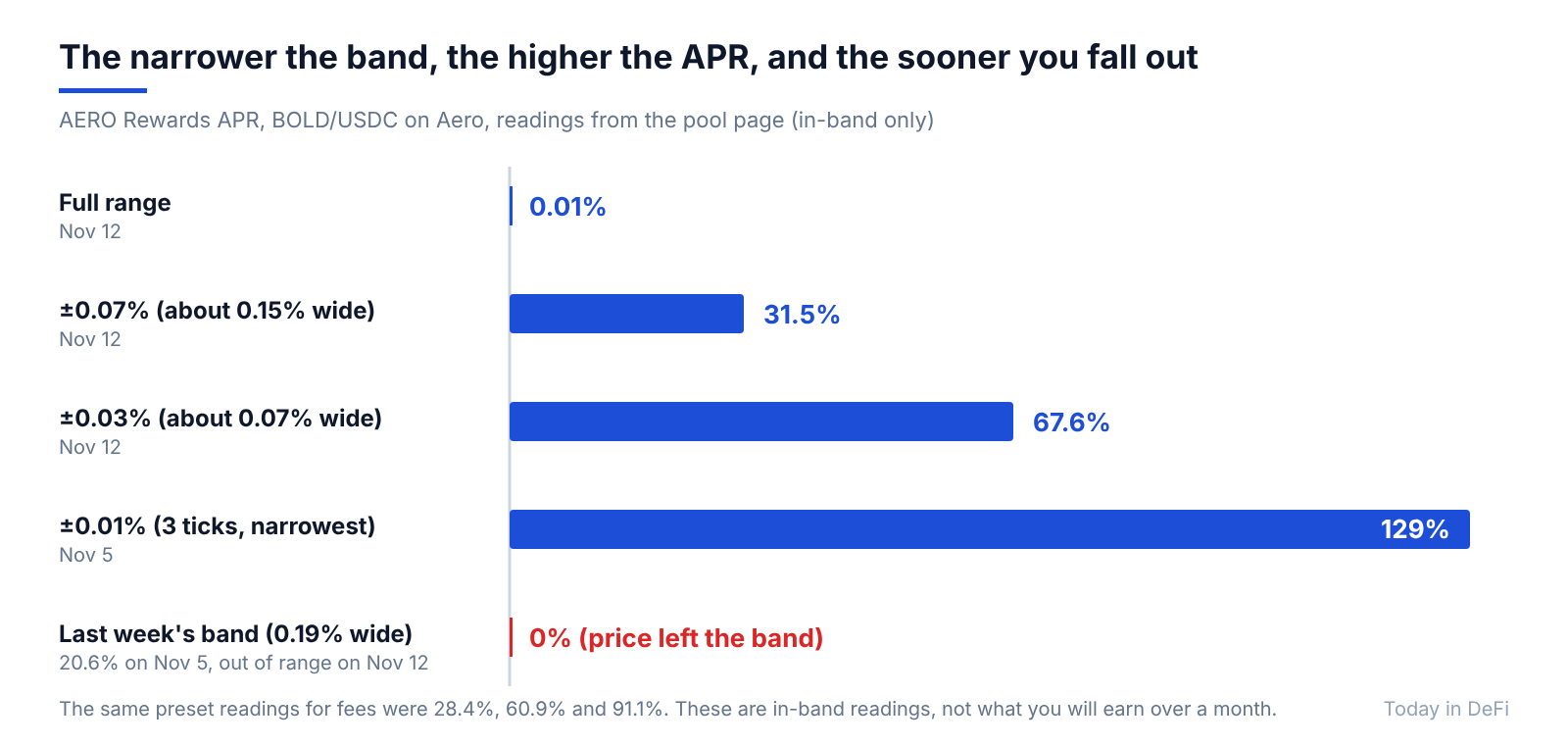
The rate: about 20–30% AERO APR while the price is in range. A range around last week’s trading (about 0.19% wide) showed 20.6% on Nov 5, and the ±0.07% preset showed 31.5% (28.4% in fees) on Nov 12.
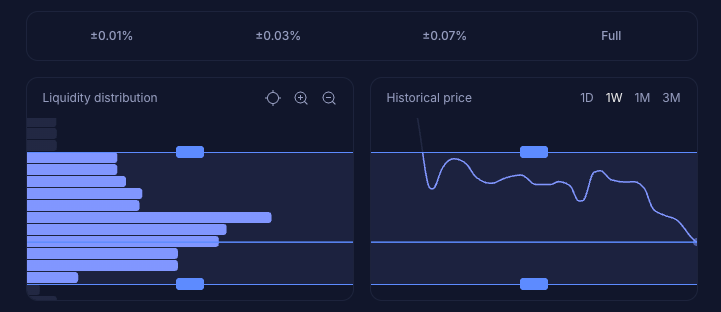
Our pick: set your range where BOLD/USDC usually trades. The pool page’s 1-week price chart shows you that range.
The upkeep: adjust the range only when the price trades outside it consistently. Each adjustment locks in a little impermanent loss and costs gas, so adjusting too often lowers what you actually earn.
The choice: you earn either AERO (staked) or trading fees (unstaked), not both.
How it works:
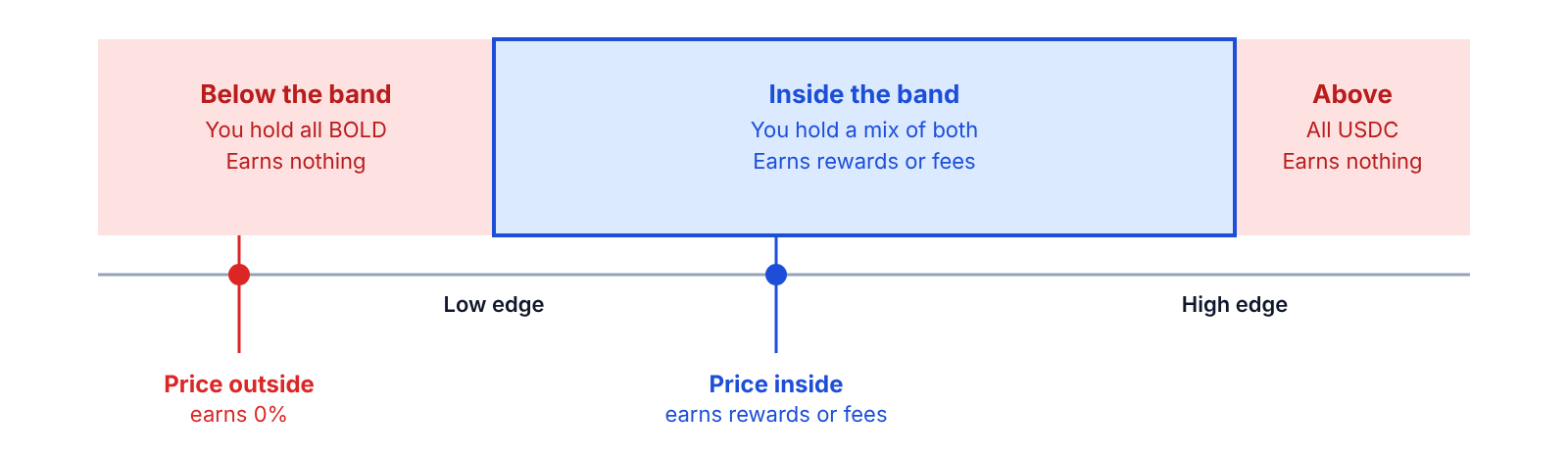
Aero is a concentrated liquidity pool. You choose a price range, and your money earns fees and rewards only while the price trades inside it. Outside the range, it earns nothing until the price comes back or you move the range.
BOLD and USDC both aim for $1, so the pair trades in a small range and your money can sit right where trades happen. Spreading it across every possible price (Aero’s “Full” preset) earned 0.01% on Nov 12, so in practice LPs on this pool pick a range.
On Aero, AERO rewards go only to liquidity in the active tick (the price where trades execute), and they accrue for the time you spend there.
Which range to pick
BOLD and USDC both aim for $1, but different things hold each one there (BOLD by redemptions and borrowers’ interest rates, USDC by its issuer’s reserves). So the pair rarely trades at exactly 1.0000. It drifts within a small range, usually just under a dollar.
Our recommendation: set the range where the price usually trades, roughly its weekly range.
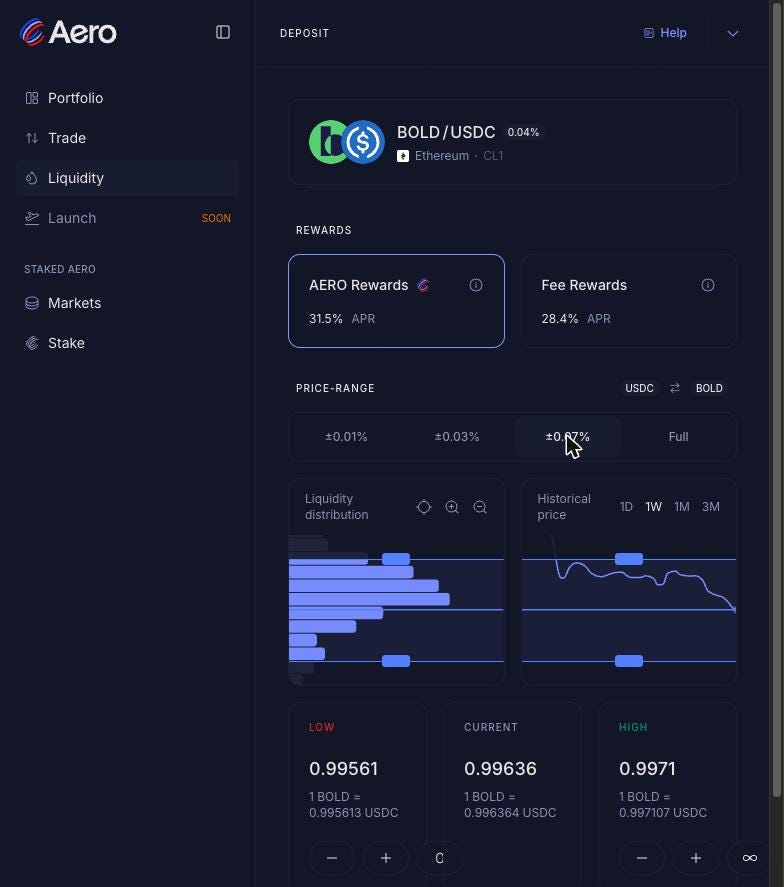
On the pool page, open the Historical price chart and set it to 1W.
Set Low near the week’s low and High near the week’s high, with a little room on each side.
Check that the Current price sits inside, ideally not right at an edge.
For example, BOLD/USDC was at 0.9977 on Nov 5 and 0.9964 on Nov 12. A range of about 0.9960–0.9980 covers both readings. Check the chart for the actual low and high before you set yours.
A tighter range (the ±0.03% or ±0.07% presets) pays more per dollar, but the price leaves it more often, so you adjust more and lose more to impermanent loss and gas. A weekly range pays a little less and needs much less attention.
When to adjust the range
Adjust when the price trades consistently outside your range, not every time it touches an edge. On a stable pair, the price often drifts back on its own.
Good signs it’s time to adjust:
the price has been outside your range for a day or more, or
the 1-week chart shows the pair now trades in a different spot than when you set it.
When you adjust, repeat the weekly-range method from the current chart.
Impermanent loss: small, but it adds up
Impermanent loss (IL) is what you lose versus just holding the two coins, because the pool swaps one for the other as the price moves. With two stablecoins, it’s small, but each adjustment locks it in, plus gas.
So too many adjustments cut your real APR. If each one costs 0.1% of the position, adjusting weekly takes about 5 points a year off (52 × 0.1%).
Pick how you get paid
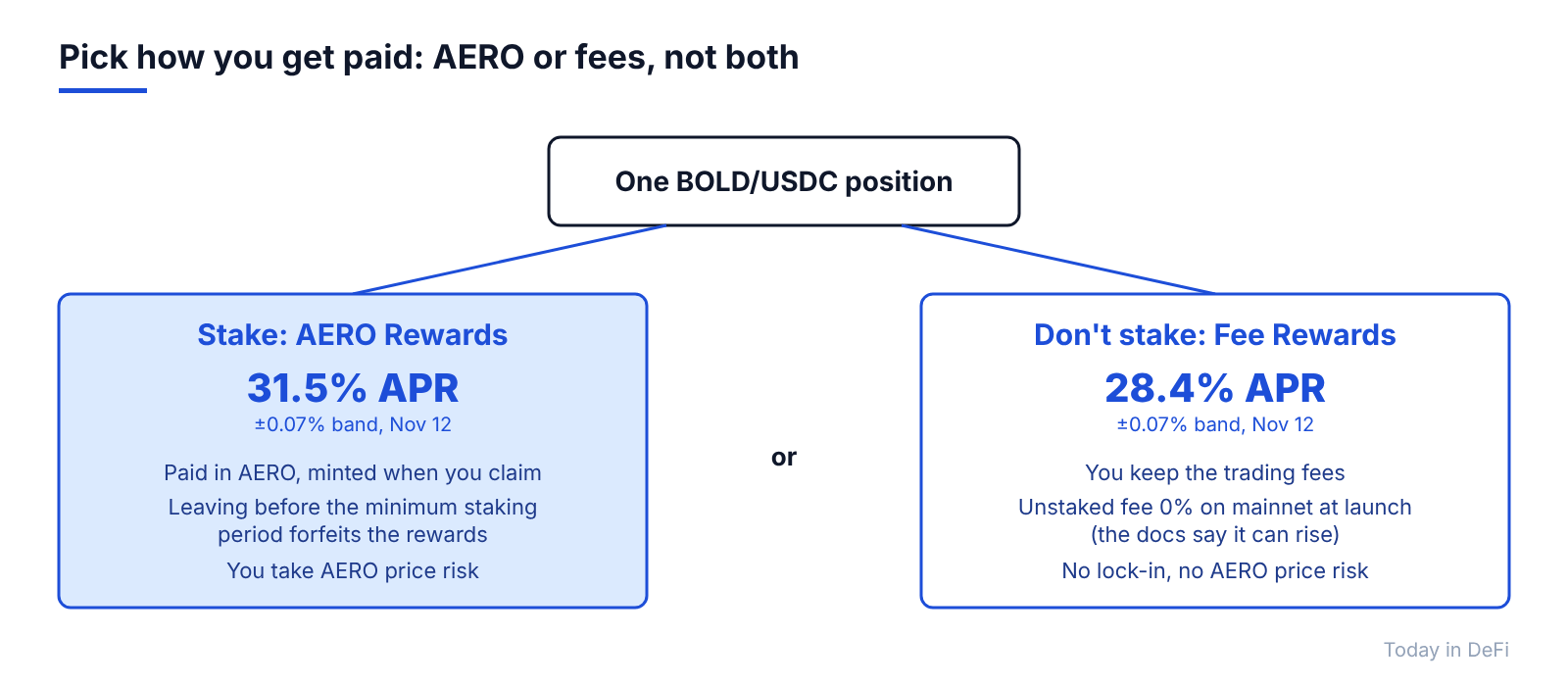
AERO Rewards (staked). You earn AERO instead of trading fees. The Aero docs say AERO rewards are minted only when you claim them, and that withdrawing before the minimum staking period forfeits them. The docs say that period depends on the asset and market conditions. [EDITOR: I did not find the figure for this pool; check the app.]
Fee Rewards (unstaked). You keep the trading fees your position earns, minus an unstaked fee that the docs put at 0% on Ethereum mainnet at launch. The docs say it can rise as pools mature.
If you stake, the fees your liquidity generates go to the AERO stakers who direct rewards to your pool, so you can’t have both. On Nov 12 staking paid about 3 points more at ±0.07%, in exchange for AERO price risk and the lock-in. Staking is not an automatic win.
How to enter, set the band and exit
Open the BOLD/USDC pool on Ethereum mainnet and connect your wallet. <Open the BOLD/USDC pool on Aero>
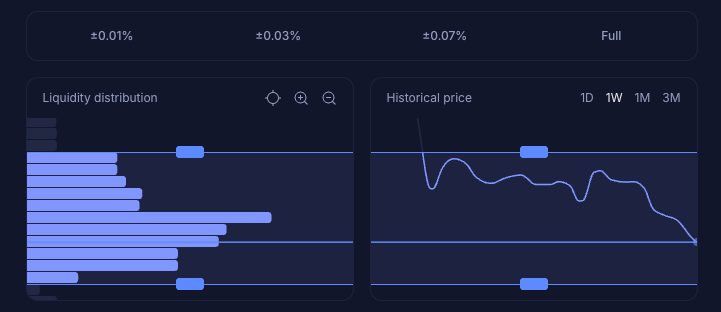
Under Price-Range, choose a preset (±0.01%, ±0.03%, ±0.07% or Full) or set your own Low and High. Check that the Current price sits inside the band, and compare it against the Historical price chart (1W).
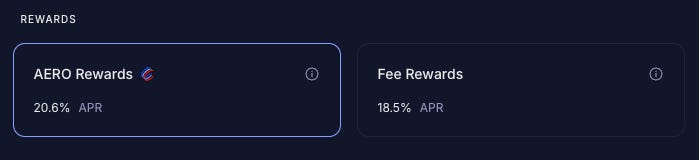
Choose how you are paid: AERO Rewards (staked, the default) or Fee Rewards (unstaked).
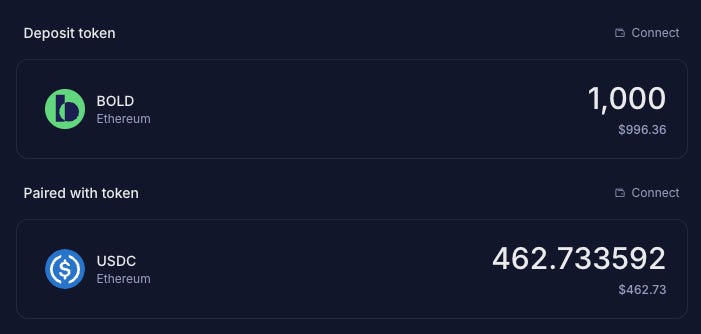
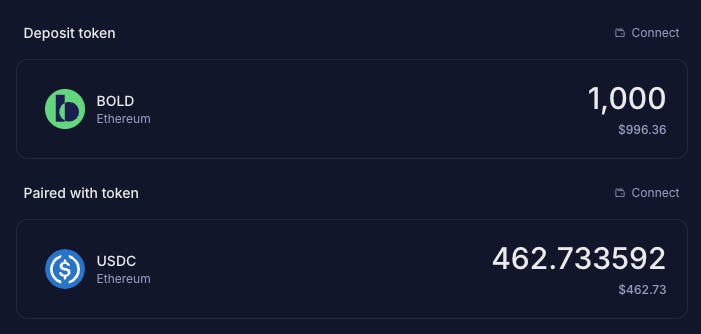
Enter your amount. The page shows how much of each token the band needs (it depends on where the price sits in the band). It has a Deposit token field (BOLD), a Paired with token field (USDC), and a default slippage of 0.05%.
Approve the tokens, then confirm. On mainnet, each step costs gas, so a small position loses a larger share to fees than a big one.
Open the Portfolio page to see the position. AERO rewards are minted only when you claim, so claim when the rewards are comfortably larger than the gas.

Exit. Withdraw from the Portfolio page. If you staked, check the minimum staking period first, because leaving before it forfeits the rewards. What you get back depends on the price: both tokens in the ratio of the current price, or all BOLD below the band and all USDC above it.
Keeping it in range
Nothing manages the band for you, so this is the real work. These are suggestions, not Aero’s rules, so set your own before you deposit.
Watch
The price against the band. Set a price alert on BOLD/USDC. A sensible trigger is the price coming within a quarter of the band’s width of either edge. For a 0.15% band, that’s about 0.04%.
The APR. If AERO rewards fall toward the fee rate, staking’s extra no longer covers the lock-in and AERO price risk.
BOLD’s peg. BOLD is backed by ETH-based collateral, so watch ETH if it moves sharply. Watch Circle news for USDC.
AERO’s price and where stakers direct rewards. Both change what the headline APR is worth.
Reasons to leave
BOLD or USDC loses its peg, and you’d rather not hold the weaker coin.
Resetting the band costs more in gas than the position earns.
AERO rewards fall below what the unstaked fee rate or a no-management alternative pays, or the unstaked fee rises.
An exploit, a freeze, or a serious incident at Aero, Liquity, or Circle.
Aero ships automated management, and you’d rather use that.
What backs the two coins
You’re holding two dollar assets with different backing, which is a point in this pair’s favor. Neither is risk-free.

BOLD is Liquity V2’s stablecoin: overcollateralized and backed only by WETH, wstETH and rETH, with no real-world assets or centralized custody. The minimum collateral ratio is 110% for WETH and 120% for wstETH and rETH. Two things hold the peg: BOLD can always be redeemed for the underlying collateral, and borrowers set their own interest rates, tending to cut them when BOLD trades above $1 and raise them below it.
USDC is issued by Circle and backed by cash and short-duration US Treasuries. It’s the more conventional of the two, but it depends on one company, its banks and its regulators, and a centralized issuer can freeze addresses.
Their failure modes differ: BOLD’s risk is a sharp fall in ETH and a rush of liquidations; USDC’s risk is the issuer. A depeg in either one pushes the price out of your band.
Risks
The stablecoins are the safer part of this farm. The band and the new platform are where it can go wrong.
The band
A tiny band is easy to leave. A small move in BOLD or USDC takes you out, and out of the band you earn nothing. Last week’s band is the example.
No automated management yet. The pool page lists Automated Liquidity Management by third-party partners as “soon”, and Aero’s own article calls it a possible future product with no timeline.
Moving the band costs money: a withdrawal, a new deposit and mainnet gas. A staked position moved before the minimum staking period forfeits its AERO rewards.
You end up in the weaker coin. If the price leaves the band, you hold all of one token: all BOLD if it drops, all USDC if it rises.
The coins
BOLD: depends on ETH-based collateral. A sharp ETH fall, mass liquidations or a loss of confidence can push it off its peg, and the band is only a fraction of a percent wide.
USDC: one issuer, one set of banks and regulators, and a centralized ability to freeze addresses.
The rewards and the platform
AERO reward risk. AERO’s price can fall before you claim. Rewards are minted on claim, and each pool’s rewards are capped at a multiple of the revenue it earns (long-run target about 1.2x). Stakers direct where rewards go, so a pool can lose rewards if they move on.
Rates that move. APRs are estimates that change with the band’s share of liquidity, volume and rewards. The unstaked fee is 0% at launch and can rise.
A very new platform. Aero launched on Oct 21, 2026, with AERO and VELO migrating to a new token. [EDITOR: I did not check audits for the Ethereum mainnet deployment.]
Impermanent loss is small but not zero. For a stable pair it’s usually minor, but a narrow band turns a move across it into a full swap into one token.
What else pays on BOLD/USDC
These need no range management, which is the trade you’re making here. [EDITOR: DefiLlama figures are from Nov 5; refresh them.]
OptionYield (Nov 5)SizeCurve BOLD-USDC pool1.13%$8.8MUniswap v4 BOLD/USDC (0.05%)2.09%$3.9MStake DAO vaultabout 6.5%small balanceYearn vaultabout 6.3%small balance
This is education, not financial advice. The figures come from Aero’s pool page on Nov 12, 2026, with no wallet connected and no deposit tested. Check every link before you sign anything.
Sources: Aero BOLD/USDC pool · Aero economy · The Block: Aerodrome and Velodrome merge into Aero · Liquity docs: BOLD and Earn · DeFi Saver: Liquity V2 minimum collateral ratio · Liquity forum: BOLD pool yields · Glenbrook: USDC reserves · DefiLlama yields
Follow @todayindefi to keep up with the latest DeFi news on Twitter.
Disclaimer: Projects or tokens mentioned in this newsletter are often experimental or unaudited. Do your own diligence before using or buying anything mentioned.