

Subscribe for daily free DeFi news covering launches, tradable catalysts, and actionable farming opportunities.
TL;DR:
Solana now has the widest menu of yield-bearing, dollar-denominated assets in DeFi, sitting alongside deep, cheap stablecoin liquidity, while Ethereum's borrow rates still spike to 14% overnight. Vaults and loops here range from ~7% (passive lending) to ~13% (fixed-rate PT looping), with most still underfarmed compared to Ethereum's crowded pools.
This guide covers how to bridge in, lend, loop, and lock in fixed rates.
Find and execute the 15%+ stablecoin yields in minutes
Save time without checking every protocol manually. DeFi Saver’s Discover page surfaces rates across Aave, Morpho, Spark, and more, lets you simulate leverage before committing, and handles the full loop in one click. Stop leaving yield on the table.
<Discover Yields on DeFi Saver> | Today in DeFi is Supported by DeFi Saver
Smart Money Is Moving to Solana
Solana now has something Ethereum rarely offers in one place: a wide menu of yield-bearing dollar assets (earning 5–12% natively) alongside deep, cheap stablecoin liquidity to borrow against them.

Ethena’s USDe, Maple’s syrupUSDC, Re Protocol’s reUSD and others have bridged over; Figure/Hastra’s PRIME and AUTO launched natively; plain stablecoin supply keeps growing too — USDC alone is ~$6.7B on Solana, and total Solana stablecoin supply is ~$15.4B, up from ~$12B a year ago.
The other edge is stability. Ethereum lending rates can spike hard — Aave’s USDC market hit its 14% cap during the April rsETH incident — while Solana’s markets have stayed calmer, and several now offer fixed-rate borrowing.
Bridge Stablecoins To Solana Smarter
Use Circle’s CCTP, not a liquidity pool bridge — it burns USDC on the source chain and mints native USDC on Solana 1:1, with no slippage.

The easiest front-end is Transporter (Chainlink CCIP), which costs source-chain gas plus roughly $0.25–$1.50 per transfer. Budget 15–20 minutes from Ethereum. Keep some SOL on hand for fees.
Passive Lending Vaults for up to 10% APR:
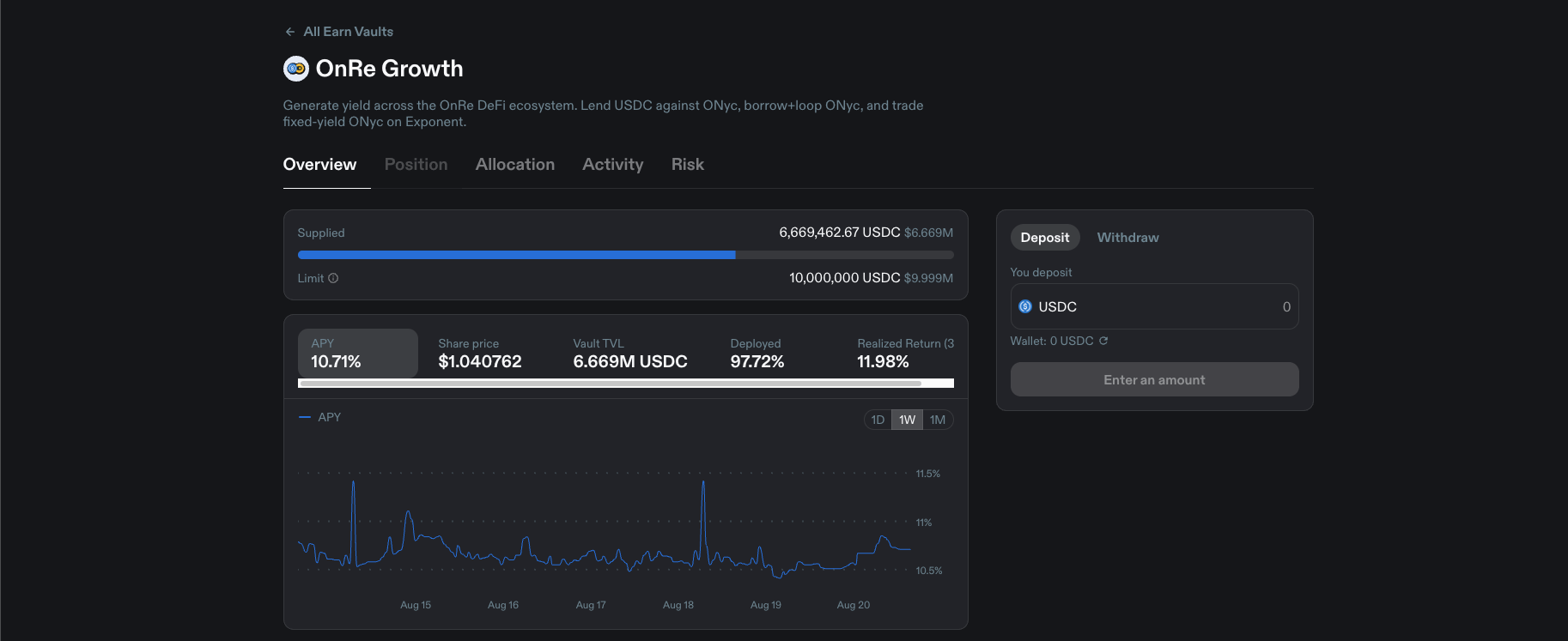
OnRe Growth vault on Loopscale (USDC, ~10.5% APY).
Loopscale is an order-book lending protocol: instead of a pooled utilisation curve, lenders and borrowers are matched at a fixed rate for a fixed term (typically one day, auto-refinanced at maturity), with every loan isolated and collateral priced individually.
The OnRe Growth vault, curated by Loopscale Asset Curation, deposits USDC and lends it against ONyc and Exponent PT-ONyc, and can also hold fixed-yield ONyc on Exponent. At the time of writing, it showed 10.52% APY, a 12.01% realized 30-day return, $6.58M supplied against a $10M cap, and 99% deployment. The vault charges a 0.30% management fee and runs scheduled withdrawal windows (Wednesday and Saturday), with a 0.45% fee for instant withdrawal.
The underlying asset, ONyc, is OnRe’s NAV-accruing token representing a share of a Bermuda-regulated reinsurance pool that earns underwriting premiums on top of stablecoin collateral yield, and it has been the most-borrowed-against RWA on Solana.
Risks: concentrated exposure to a single RWA — reinsurance losses would hit ONyc’s NAV and borrower solvency; withdrawal windows limit exit speed; smart-contract and curator risk.
Steakhouse USDG High Yield on Kamino (USDG, ~7.4% APY)

Kamino Earn vaults are curator-managed: the risk manager sets which isolated markets the vault may supply to and in what proportions, and Kamino rebalances between them. Steakhouse, Kamino’s official risk contributor, runs this one as a “high-yield instant” strategy, lending USDG against a broad set of collateral.
At the time of writing it held $37.7M at 76.9% utilisation, with about 57% in the SOL/BTC (main) market, 27% in the OnRe market, 8% in the new reUSD market, 5% in Maple, and small PAXG/JLP/BTC sleeves. The headline 7.35% APY includes roughly 3.2% in USDG incentives from the Global Dollar Network; the base lending yield is closer to 4%.
The performance fee is 2.5%; there is no management fee. USDG itself is Paxos’s MAS-regulated, cash- and Treasury-backed dollar, non-yielding to holders but revenue-sharing with network partners, from which the incentive budget is funded.
Risks: nearly half the headline APY is campaign incentives that can end; the vault takes credit exposure to whatever collateral its markets accept (RWAs included); high utilisation can slow withdrawals.
Sentora PYUSD on Kamino (PYUSD, ~6.9% APY).

Sentora (formerly IntoTheBlock) runs a conservative PYUSD vault with $113M supplied and 91% utilisation, spread across Maple, SOL/BTC, PRIME, AUTO and JLP. Its 6.93% APY includes ~2.8% in PYUSD rewards, with a 5% performance fee.
PYUSD’s growing Solana supply provides the cheap borrowing liquidity that powers the looping strategies below. Across these vaults, the key distinction is concentration vs. diversification, while a meaningful portion of Kamino’s yield comes from incentives that can end.
PYUSD is Paxos-issued for PayPal, natively minted on Solana as a Token-2022 asset, and its Solana supply has been a steady source of cheap borrow liquidity, which is exactly what the looping strategies below depend on.
Risks: 91% utilisation means a rush for the exit can queue withdrawals; reward-dependent yield; nearly 70% of allocation sits against RWA collateral (syrupUSDC, PRIME, AUTO) whose marks are only as good as their oracles.
Looping — leveraging the yield-bearing collateral
Looping means depositing a yield-bearing dollar asset, borrowing stablecoins against it, buying more collateral and repeating.
Net APY = collateral yield × leverage minus borrow rate × (leverage − 1).
On Solana, you can apply this to reinsurance, institutional credit, HELOCs and auto loans against stables borrowing at 4–8%.
Kamino’s Multiply automates the loop in one transaction. Each asset has its own LTV and liquidation parameters, while borrow rates are variable and figures include displayed incentives.
reUSD / USDG Multiply — up to 5x, ~13.7% max APY.

reUSD is Re Protocol’s price-accruing token: deposits fund collateral for a licensed Bermuda reinsurer, and reUSD is the senior, principal-protected tranche targeting roughly SOFR (or the sUSDe basis, whichever is higher) plus 250 bps.
The Kamino reUSD market, added in mid-August and filled within hours, offers 80% max LTV, 85% liquidation LTV, and USDG borrowing at about 4.5%. Liquidity was thin (about $109K) when checked, so size accordingly. The implied reUSD yield is around 6.3%, so this is a spread trade that relies on cheap USDG.
Risks: at 5x a ~250 bps spread, a modest USDG rate move erases the carry; borrow liquidity was thin (~$109K) when checked, so both entry size and unwind capacity are limited; reUSD’s principal protection is a structural seniority claim, not a guarantee — severe reinsurance losses can still impair it.
syrupUSDC / USDG Multiply — up to 8.3x, ~12.8% max APY.

syrupUSDC is Maple’s vault token for overcollateralized institutional lending (NAV about $1.18, roughly 4–5% yield lately). Because its yield is smooth and its price barely moves, Kamino’s Maple market offers the most aggressive parameters here: 88% max LTV and 90% liquidation LTV.
USDG borrows at about 3.7%, the lowest rate on this list, which is why 8x leverage on a 4.8% asset still clears 12%. The trade-off is that at 88% LTV, a 2% move in the syrupUSDC/USDG price ratio is your whole buffer, so this is a trade for assets you trust to stay pegged, not one to run at max. Average leverage taken is 5.5x.
Risks: at 88/90 LTV the buffer to liquidation is roughly 2% — an oracle mark-down of Maple’s loan book, or a temporary syrupUSDC/USDG price dislocation, can liquidate max-leverage positions; a USDG borrow-rate spike flips the thin spread negative fast; run well below max.
PRIME / CASH Multiply — up to 8.3x, ~13.0% max APY.

PRIME is Figure and Hastra’s Solana-native token: stake wYLDS (a permissionless wrapper of Figure’s SEC-registered YLDS certificate) and receive PRIME, whose price accrues yield from Figure’s HELOC lending pool, with over-collateralized, standardized HELOC collateral and live marks. Launched in December, it reached $350M in TVL in about three months.
The debt asset is CASH, Phantom’s Bridge-issued stablecoin, borrowing at around 5.3%. Parameters are 88% max LTV, 91% liquidation LTV, and the implied PRIME yield is about 6.3%.
This pair was created by the Figure RWA consortium (Kamino, Raydium, Chainlink, Phantom), so expect it to be one of the better-supported markets.
Risks: the same razor-thin ~3% liquidation buffer at max leverage; HELOC performance is housing-cycle exposure marked by Figure, not by a public market; CASH is a young stablecoin with modest ($123M) supply, so its borrow rate and depth can move abruptly.
The PT loop — fixing both legs
The cleanest version fixes both the asset yield and the borrow rate. Exponent is Solana’s Pendle-style yield-splitting protocol: deposit ONyc to mint a PT that redeems 1:1 at maturity, with the discount representing its fixed yield.
Loopscale’s PT-ONyc / USDC loop offers up to 3.3x leverage and ~30.8% max APY, with an ~8.5% fixed borrow rate, $2.2M available and ~$10M PT deposited. The implied PT yield is roughly 15%.
This is one of the more predictable farms because both sides are fixed. The main risks are ONyc NAV changes, entry/exit costs and refinancing at maturity. The current PT expires September 10, so the annualised APY overstates the remaining absolute return. The structure is more interesting than this specific maturity.
What to keep in mind
Every farm here is a dollar-in, dollar-out position, but the yield sources are very different: reinsurance underwriting (ONyc, reUSD), institutional crypto credit (syrupUSDC), HELOCs (PRIME), auto loans (AUTO).
The collateral can mark down, the incentives can end, and the variable-rate loops on Kamino still depend on PYUSD, USDG, CASH and USDC staying cheap to borrow.
Solana’s edge right now is that all of this sits on one chain with deep stable liquidity, a 1:1 bridge to get in, and, increasingly, fixed-rate tools to take the rate risk out. Check the live numbers before entering; they move weekly.
Today’s News Headlines:
- World Liberty launches USD1 perps
- User loses 1,010 ETH via phishing
- AftermathFi launched Perpetuals V2
- Pendle refreshes $MON incentives on Monad
- Solana Mobile launches $USDC Earn Vault
- Coinbase integrates Hyperliquid into its Base App