

Subscribe for daily free DeFi news covering launches, tradable catalysts, and actionable farming opportunities.

Find and execute the 15%+ stablecoin yields in minutes
Save time without checking every protocol manually. DeFi Saver’s Discover page surfaces rates across Aave, Morpho, Spark, and more, lets you simulate leverage before committing, and handles the full loop in one click. Stop leaving yield on the table.
<Discover Yields on DeFi Saver> | Today in DeFi is Supported by DeFi Saver
Euler - Sentora Managed Lending Vaults (Ethereum)
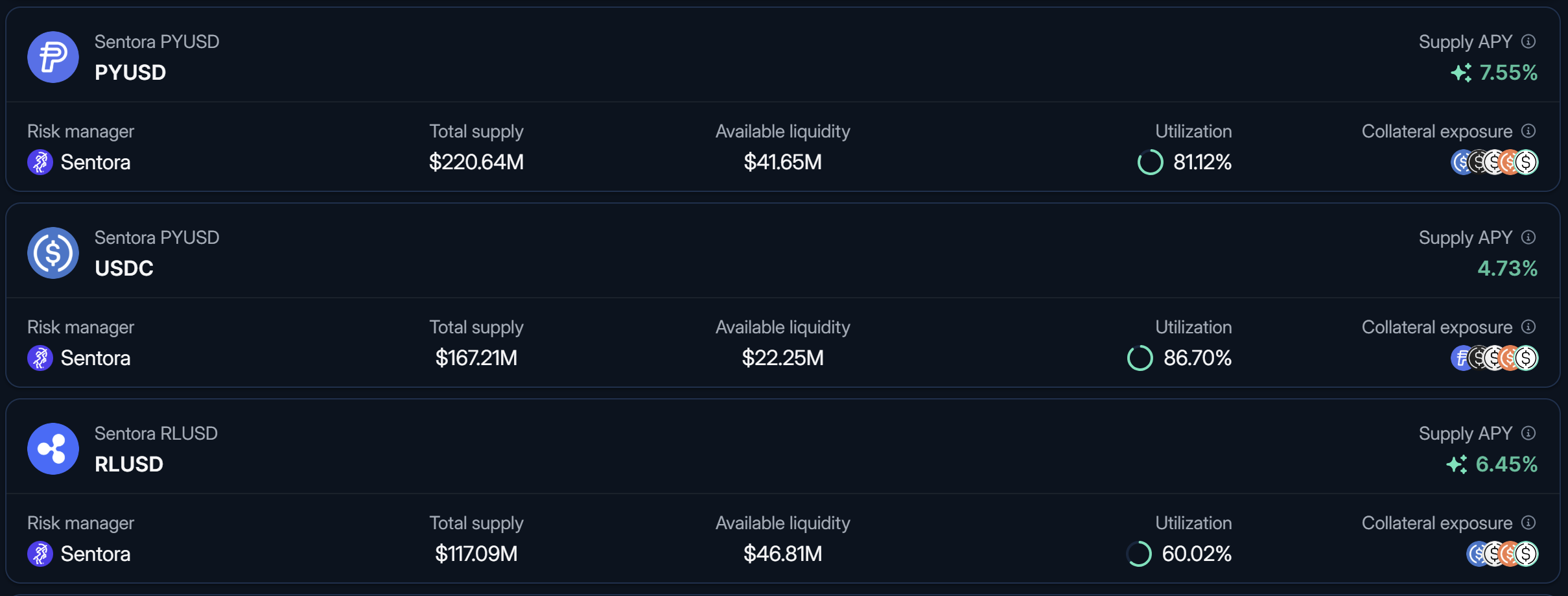
Deposit Yield: ~6–7%
Assets: PYUSD, USDC, RLUSD
What is it: Sentora-curated Euler vaults with tight collateral exposure (Maple + Ethena). Lenders earn yield from interest paid by borrowers, who deposit collateral assets into Euler’s credit markets.
Potential Concerns: Curator risk — Sentora sets parameters. Ethena collateral (sUSDe/USDe) is under peg pressure this week from the broader Aave unwind. If USDe drops significantly, collateral ratios tighten. Watch collateral composition of the vault.
Curve LP, Amplified on StakeDAO (Ethereum)
What is Curve + StakeDAO? Curve is the deepest stablecoin DEX, built specifically for stable-to-stable trading so impermanent loss on stable pairs is near zero. To earn max CRV rewards you'd normally need to lock CRV for up to 4 years yourself.
StakeDAO and Convex do that locking for you collectively — deposit your Curve LP tokens into their vaults and you get the full veCRV boost (2–3x rewards) plus auto-compounding, without locking anything.
USDT/USDe (Curve, via StakeDAO)

Current APR: 9.37% total
Breakdown: 6.67% trading fees + 2.70% CRV APR (2.10x boost)
What it is: Stable pool pairing Tether’s USDT with Ethena’s USDe.
Potential Concerns: Ethena peg pressure right now from the KelpDAO unwind cascade. USDe has held $1.00 historically, but monitor this week. Minimal IL in normal conditions.
GHO/crvUSD

Current APR: 8.41% total
Breakdown: 3.77% trading fees + 4.64% CRV APR (2.24x boost)
What it is: Two of the cleanest decentralized stables in DeFi. GHO is Aave’s native stablecoin (overcollateralized by crypto you lock in Aave). crvUSD is Curve’s own stablecoin (also overcollateralized, mostly by ETH and LSTs). Neither has Ethena exposure.
Potential Concerns: No Ethena exposure, both stables are overcollateralized and battle-tested, and the CRV boost is strong. Standard Curve smart contract risk.
PYUSD/crvUSD

Current APR: 8.21% total
Breakdown: 0.30% trading fees + 0.94% CRV APR (1.58x boost) + 6.97% YB APR from Votemarket Liquidity Mining
What it is: PayPal’s PYUSD (issued by Paxos, fully regulated under NYDFS, backed 100% by cash and short-duration US Treasuries) paired with crvUSD.
Potential Concerns: Lower CRV boost means most of the yield is coming from Votemarket bribes — these are incentives paid by other protocols to direct CRV emissions here, and they can dry up any week. PYUSD itself is one of the safest stables in DeFi.
USDT/crvUSD

Current APR: 7.90% total
Breakdown: 1.46% trading fees + 6.44% CRV APR (2.36x boost)
What it is: Tether paired with Curve’s own stable.
Potential Concerns: Tether counterparty risk (centralized issuer, reserve composition has been debated over the years). The high CRV boost can be temporary and time sensitive.
Kamino Liquidity Providing (Solana)
Kamino has three separate products — K-Lend (lending/borrowing), Multiply (leveraged positions), and Liquidity Vaults (LP). All yields below are from Kamino’s automated concentrated-liquidity LP vaults — they sit on top of Raydium or Orca, manage a tight price range, auto-rebalance, and auto-compound.
These are LP positions, not lending. You earn trading fees + token incentives, with impermanent loss mechanics (minimal on stable-stable, not zero during depegs).
USDS/USDC (Kamino on Raydium)

Total APY: 8.32%
Breakdown: 0.25% 7D fees + 8.07% USDS rewards (32.50K weekly)
TVL: $21M
What is USDS: Sky Protocol’s stablecoin — the rebrand of DAI. Overcollateralized, decentralized, battle-tested since 2017 (as DAI). One of the most proven stables in DeFi.
Potential Concerns: Low trading-fee contribution — most yield is USDS incentives, which can taper. Concentrated liquidity can go out-of-range during sharp moves (Kamino auto-rebalances but there’s some drag). Two of the most established stables = very low peg risk. Good base-layer allocation.
PYUSD/USDC (Kamino on Orca)

Total APY: 6.34%
Breakdown: 0.39% 7D fees + 5.95% PYUSD rewards (20K weekly)
TVL: $17.52M
What it is: Paxos’ PYUSD paired with Circle’s USDC on Orca.
Potential Concerns: This is probably the lowest-risk pool on the entire list — both stables are fully-regulated, T-bill-backed, with deep redemption liquidity. The lower yield reflects the safer profile. Ideal for capital preservation with yield.
USDu/USDC (Kamino on Orca)

Total APY: 10.02%
Breakdown: 0.05% 7D fees + 9.96% USDu rewards (7K weekly)
TVL: $3.71M
What is USDu: UAE Central Bank’s first approved USD-pegged stablecoin, issued by Universal Digital and regulated by ADGM FSRA, backed 1:1 by reserves CoinGecko. Reserves are held 1:1 in safeguarded onshore accounts at Emirates NBD and Mashreq, with Mbank as strategic banking partner Aquanow. Launched January 2026 — UAE’s answer to USDC.
Potential Concerns: Newer stablecoin — less than 3 months old, with a smaller $3.71M pool. Structurally sound (1:1 fiat-backed, central-bank approved, UAE bank custody) so the backing quality is high. The risk isn’t the backing — it’s the shorter track record and thinner secondary liquidity. Peg hasn’t been stress-tested in a major market event yet. Size smaller than you would for USDS or PYUSD pools until the track record builds.
Balancer LP Pools
USDp/USDC, Merkl-boosted (HyperEVM)
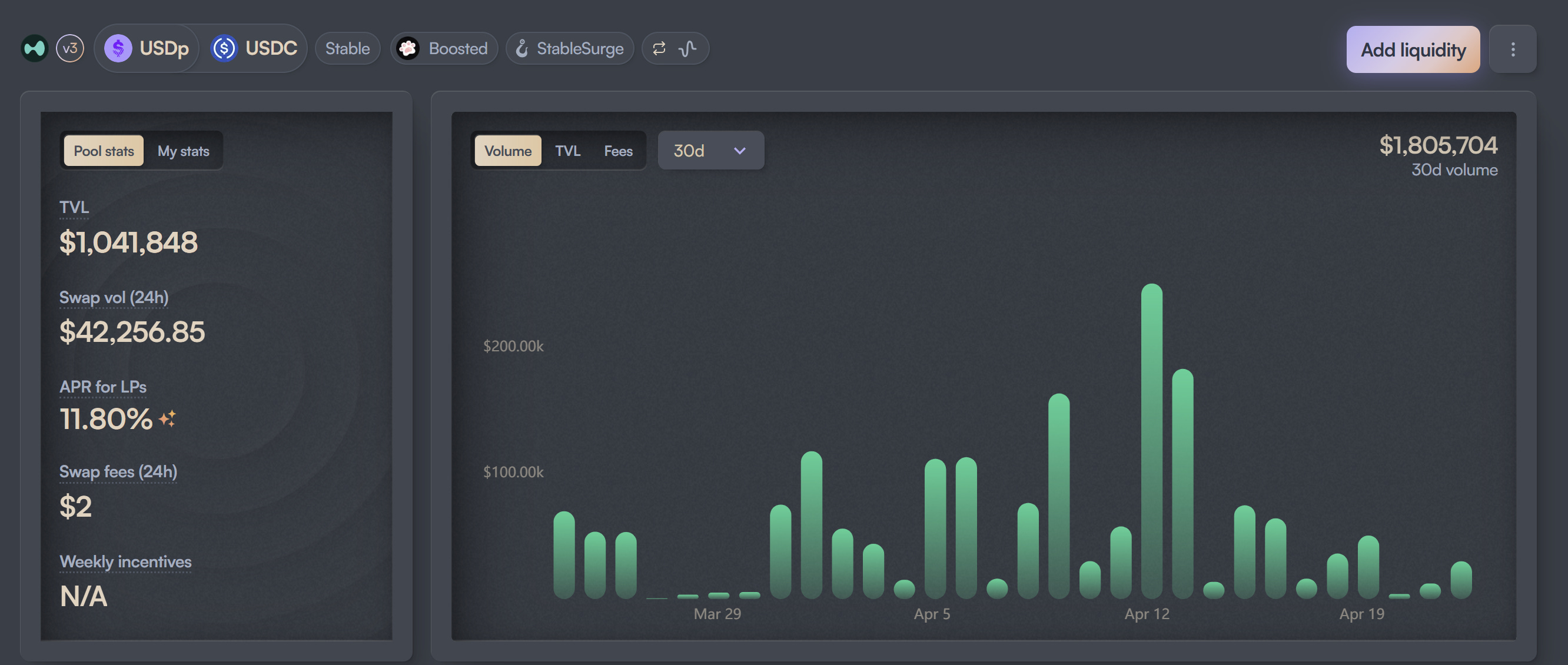
Current APR: 11.82% total
Breakdown: 0.01% swap fees + 1.36% yield-bearing tokens (eUSDC-3 from Euler’s lending) + 10.45% Merkl.xyz incentives
What is USDp: Parallel Protocol’s decentralized stablecoin — note the lowercase “p” distinguishes it from Paxos’ USDP. USDp is issued via Parallel V3’s Parallelizer module, a Price Stability Module (not a CDP) that lets users mint/burn against a diversified basket of approved reserve stablecoins with dynamic fees Parallel. Think of it as a “basket-backed” decentralized stable with no liquidation risk by design.
Potential Concerns: USDp is a newer stablecoin (V3 launched on Avalanche late 2025). Parallel’s governance involves centralized multisigs, introducing counterparty risk. Most APR is Merkl bribes which can taper. Thinner liquidity than major stables. Still attractive risk/reward if sized appropriately.
USDC/USDp, Staking incentives variant (Avalanche)
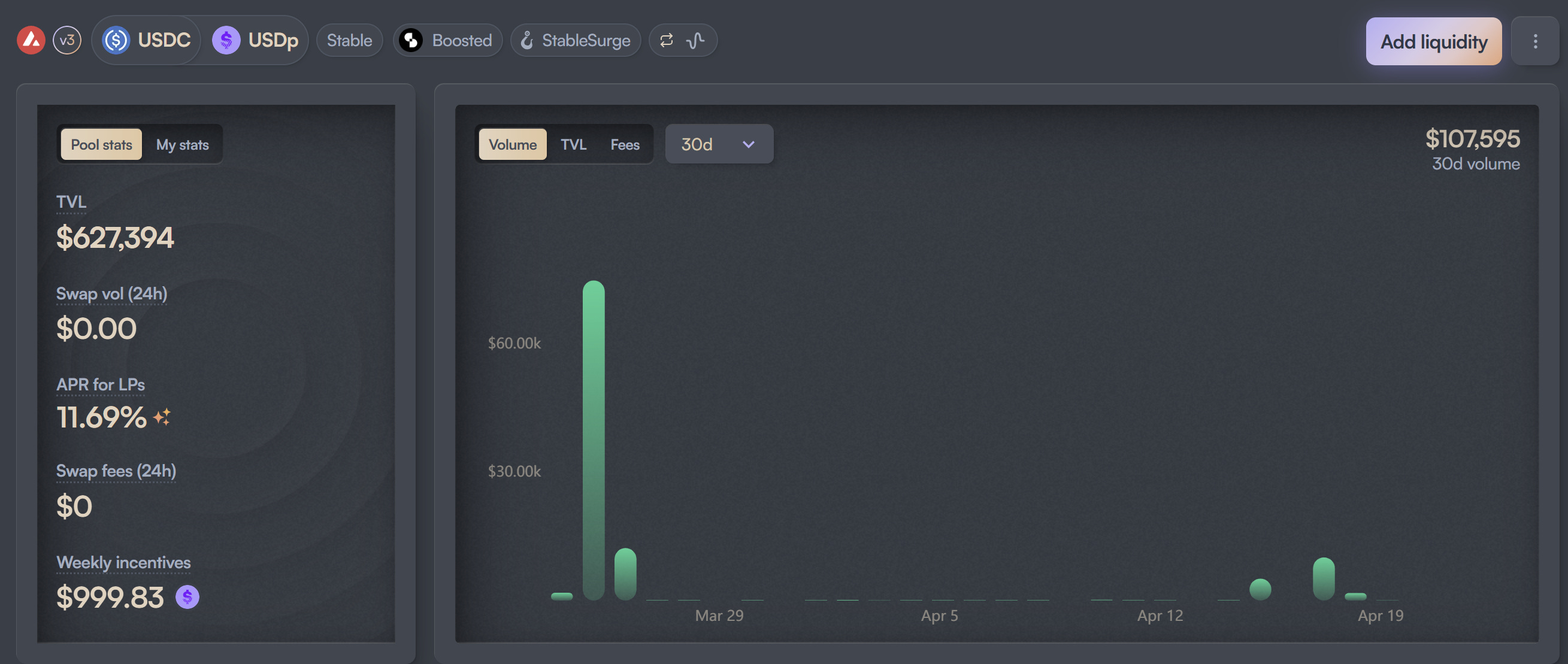
Current APR: 11.69% total
Breakdown: 9.89% USDp native staking incentives + 1.80% yield-bearing (Gami-USDC)
What it is: Same USDp/USDC pair, different reward construction — uses USDp-native emissions instead of Merkl bribes.
Potential Concerns: Same as above — newer stable, thinner liquidity, incentive-heavy yield.
🚨 RISK REMINDERS
KelpDAO contagion is still live — expect Aave liquidity stress for another 1–2 weeks. Anything Aave-adjacent has elevated risk right now.
“Stable” ≠ stable. apxUSD (STRC-volatile around $100), reUSD/reUSDe (redemption queues), jupUSD (short history), USDe (current peg pressure) — all hold 99% of the time.
Incentive yields compress. Headline 15%+ on a stable is usually points + token subsidies. Model ex-incentive for your real base.
Off-chain counterparty is real risk. apxUSD = Strategy corporate credit. reUSD = licensed reinsurers + trust accounts. Different from smart contract risk, equally underwriteable.
Leverage rule: simulate a 1% depeg of your borrow asset. If it liquidates you, reduce leverage.