

Subscribe for daily free DeFi news covering launches, tradable catalysts, and actionable farming opportunities.
Today’s News Headlines:
- Cap opens Homestead stabledrop claims
- Apyx snapshot set for October 11
- BlackRock launches tokenized money funds
- Coldcard hack losses approaching $114M
- Reya removes platform deposit fees
Key Takeaways:
Crypto broke from equities on a self-custody scare.
Bitcoin fell 3% and closed below its 20-week average while stocks finished higher, after a hardware wallet exploit pushed coins back onto exchanges. Capital flows weakened as net liquidity fell 1.55%, ETF flows were negative, and stablecoin supply shrank by $2.79B, the largest decline since June.
Monad led stablecoin inflows despite the broader outflows.
The pull is a live incentive program paying up to 9.14% on stablecoin deposits into Aave, with one lending pool alone absorbing $115M. Mantle posted a smaller gain of $50.9M (+9.6%) on a similar mechanism, with different terms. The chain-by-chain breakdown, in Section 3.
Uniswap’s daily protocol revenue jumped >6x in three days.
The July 27 expansion of the fee switch to v4 pools pushed 30-day protocol fees up 133.5%, while Aerodrome, PancakeSwap, and Curve all saw fee declines. The increase came mainly from the fee-switch rollout rather than higher trading volume.

Find and execute the 15%+ stablecoin yields in minutes
Save time without checking every protocol manually. DeFi Saver’s Discover page surfaces rates across Aave, Morpho, Spark, and more, lets you simulate leverage before committing, and handles the full loop in one click. Stop leaving yield on the table.
<Discover Yields on DeFi Saver> | Today in DeFi is Supported by DeFi Saver
DeFi Token Price Movers - Observations, not trade ideas.

Cap (CAP). No clear catalyst emerged this week. The move appears to be a continued recovery from July’s Stabledrop controversy, which reduced rewards and excluded several participant groups. At a roughly $44M market cap, the price action looks more like a repricing than a reaction to new developments.
Turtle (TURTLE). Turtle directs deposits into a third-party delta-neutral vault advertising 10–20% APY on USDT and USDC with a 30-day lockup. The yield claims have not been independently verified. With a $6.8M market cap and around $1.1M daily volume, liquidity remains a key consideration.
Ethena (ENA). USDe expanded to Robinhood Chain and Monad, assets on Robinhood Chain surpassed $200M, and the Coinbase USDe vault exceeded $250M. Ethena also removed mint/redeem fees for eligible users and reported over $750M in cumulative rewards generated since launch.
Lista DAO (LISTA). Lista expanded support for tokenized-equity collateral and continued weekly LISTA buybacks.
Pump.fun (PUMP). No confirmed catalyst emerged during the week. Features often cited as drivers, including the USDC trading pair and multichain expansion, launched earlier in 2026. The move appears to reflect a market re-rating rather than a specific new development.
1A. Traditional Macro
Liquidity contracted for the 2nd consecutive week.
FRED:WALCL-(FRED:RRPONTSYD+FRED:WTREGEN)
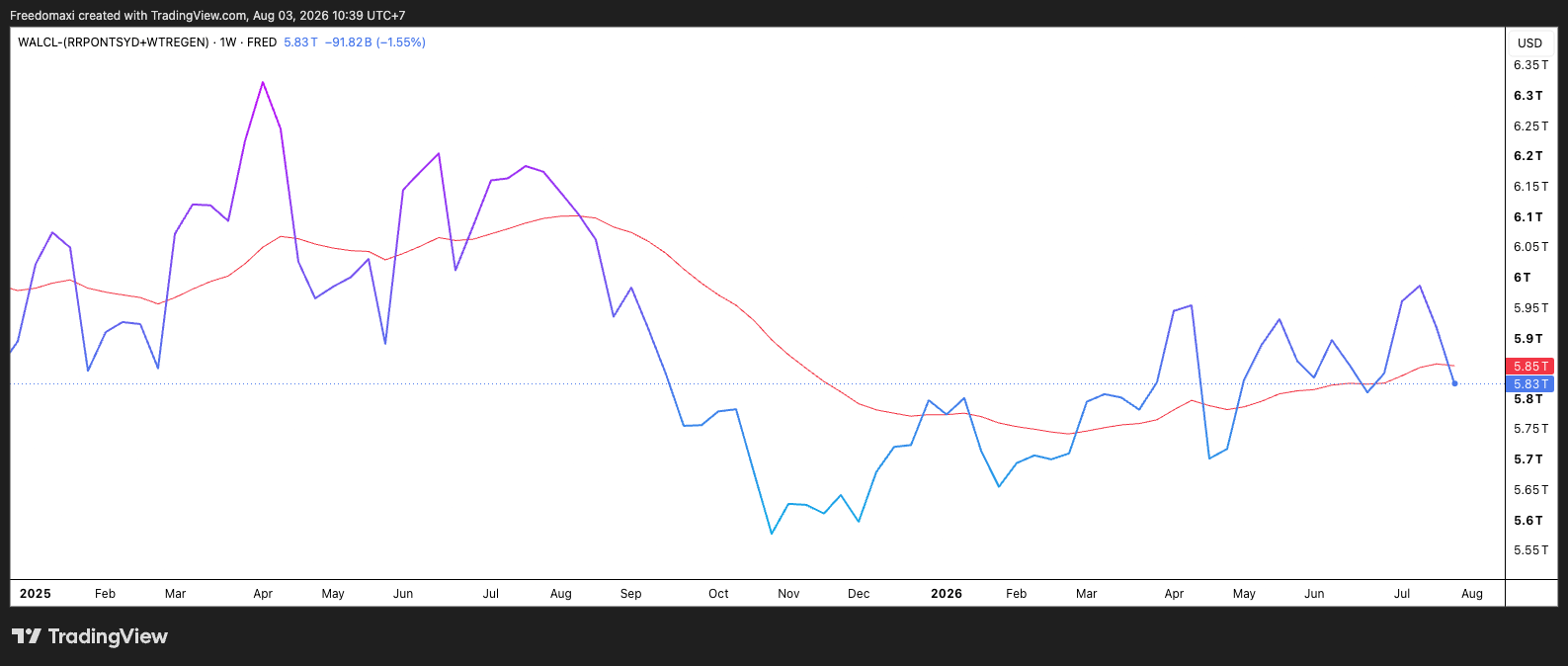
The driver is scheduled- Treasury estimated $671 billion of privately held net marketable borrowing for July–September, assuming a $950 billion end-September TGA balance. Every dollar into the TGA drains reserves one-for-one, so this isn’t a market-driven wobble — it’s a funding calendar. The drain has weeks left to run regardless of what happens at the September meeting.
BTC/NQ ratio - Equities and bitcoin split on the week.
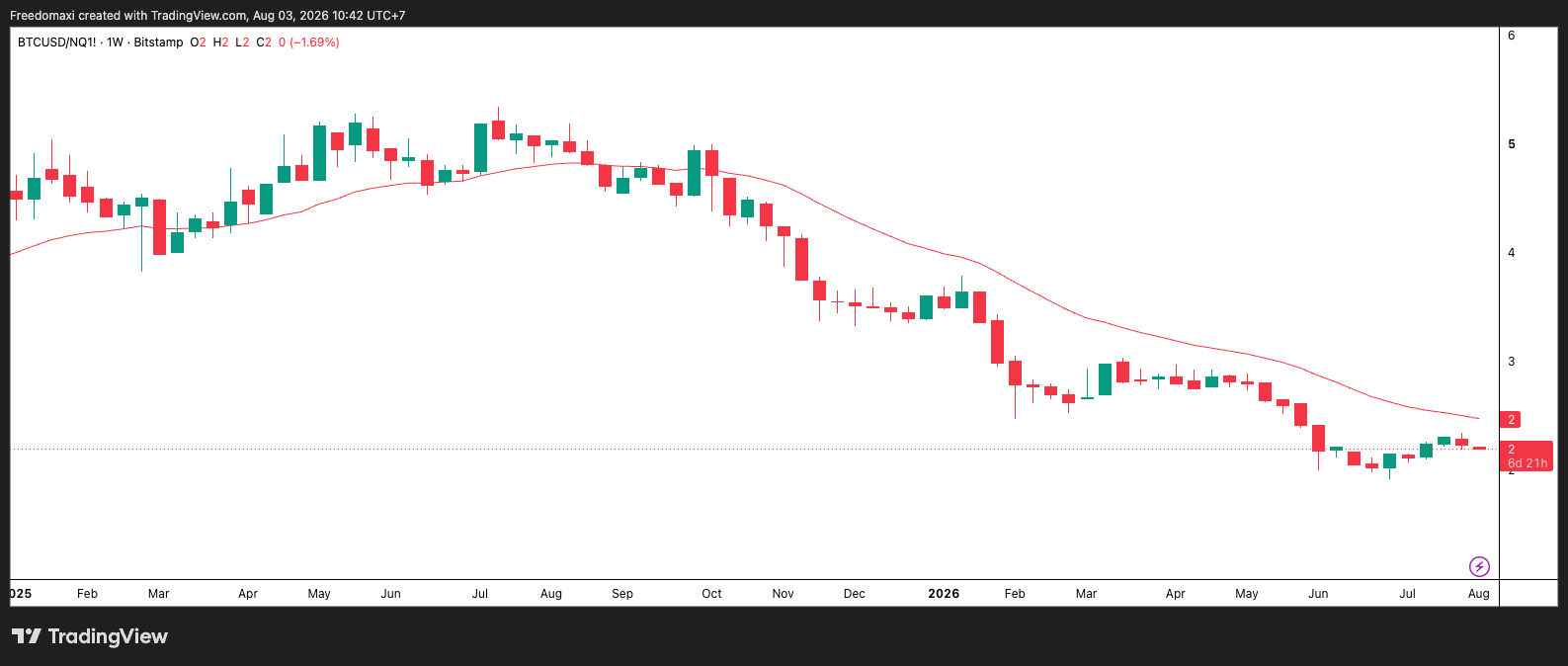
Bitcoin traded down as the hawkish Fed hold met the September hike debate. That evening, an attacker drained roughly 594 BTC from around 500 wallets in a 25-minute sweep, all secured by Coldcard devices whose firmware had bypassed its own random number generator since March 2021.
Big Tech earnings did the rest, with the four hyperscalers guiding to $720–745 billion of 2026 capital spending. By Friday the premium was rebuilding: Brent recovered above $88 after fresh US strikes on Iranian targets. Equities held their gains, yet Bitcoin struggled from crypto-native issues
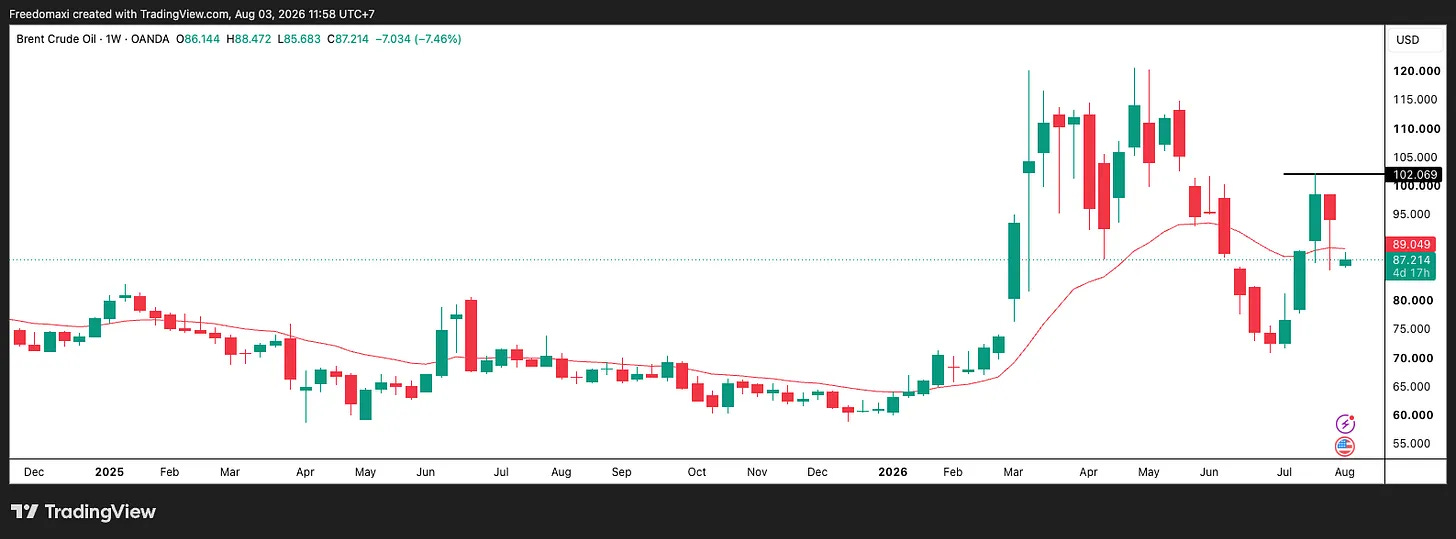
Brent and WTI each fell more than 7% on Monday, July 27, after the US paused strikes on Iran and Tehran said it had halted retaliatory action — a de-escalation that cut the inflation input equities had been pricing.
1B. Crypto Capital On-Ramp
Total stablecoin supply 7d change (WoW)
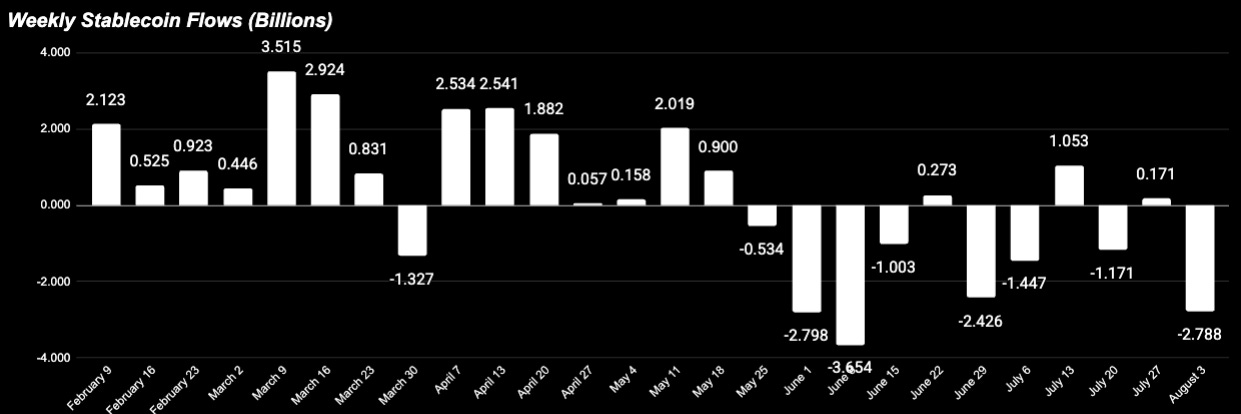
Stablecoins lost $2.788B is the largest weekly contraction since June 8 (−$3.654B), and the run since June 1 totals roughly −$13.8B across ten weeks with only three positive prints.
Compare February through May: almost every week positive, including +$3.5B and +$2.9B in March. The on-ramp flipped from expansion to contraction in June, and this week is the sharpest leg of it.
BTC and ETH Exchange Flows

Bitcoin exchange reserves reversed higher, rising roughly 14,800 BTC from their July 28 low to 2.717M BTC and moving back above the 21-day EMA after a month-long decline. The move coincided with the Coldcard exploit, which has reportedly drained 1,367 BTC (~$89M) from more than 4,500 addresses through a firmware vulnerability affecting wallet seed generation.
The reserve increase is typically interpreted as rising sell-side pressure. However, the Coldcard incident may be distorting the signal, as some holders could be moving funds onto exchanges or into alternative custody solutions to reduce self-custody risk rather than to sell. The result is a near-term rise in exchange balances, but with less certainty than usual about how much represents actual liquidation intent.

Ethereum reserves moved the other way, falling from 15.55M on July 5 to 15.08M — roughly 470k ETH, near $870M — in a continuous month-long decline.
ETF flows

Spot Bitcoin ETFs recorded $61.53M in net outflows for the week while Ethereum ETFs added $10M, extending ETH’s streak to four weeks. Weekly ETH inflows have decelerated from $105M in mid-July and $103.9M the following week to under $30M.
1C. Week-Ahead Catalysts
Monday, Aug 3, 3:00pm ET — Treasury financing estimates.
Updates the Q3 borrowing figure and the end-September TGA target. Higher targets mean a deeper reserve drain than the $671B already flagged.
Wednesday, Aug 5, 8:30am ET — Quarterly Refunding Announcement.
Most relevant release for onchain liquidity. A bills-heavy mix routes the borrowing through money market funds and leaves bank reserves largely intact. A coupon-heavy mix drains them. Bill supply also competes directly with stablecoin issuers, who are among the largest T-bill buyers, so the outcome feeds straight back into the supply contraction in 1B.
Section 2 — Onchain Risk Regime
Individual Stablecoins Flows
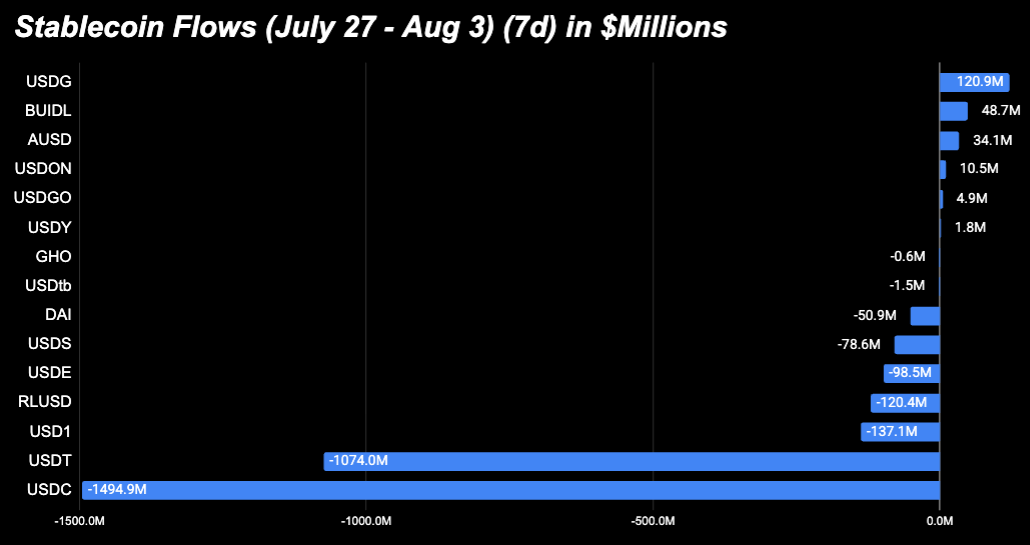
USDC fell $1.49B (−2.03%) and USDT fell $1.07B (−0.58%), together accounting for 91% of the week’s $2.84B contraction. Both figures exceed their own 30-day declines, meaning each was flat to higher through late July before reversing in a single week. USDC fell at 3.5x USDT’s percentage rate: deployment capital left faster than parked capital.
Behind them, USD1 shed $137M (−3.32%), RLUSD $120M (−7.58%), USDe $99M (−2.48%), and USDS $79M (−1.20%). USDS is down 16.11% over 30 days and USDe 12.76%.
The gainers ran the other way, all yield-bearing or treasury-backed. USDG added $121M (+3.74%, +16.91% over 30d), BUIDL $49M (+1.85%, +19.79%), AUSD $34M (+15.04%, +38.17%), and USDGO $5M (+27.70% over 30d).
Aave / Sphere Rates
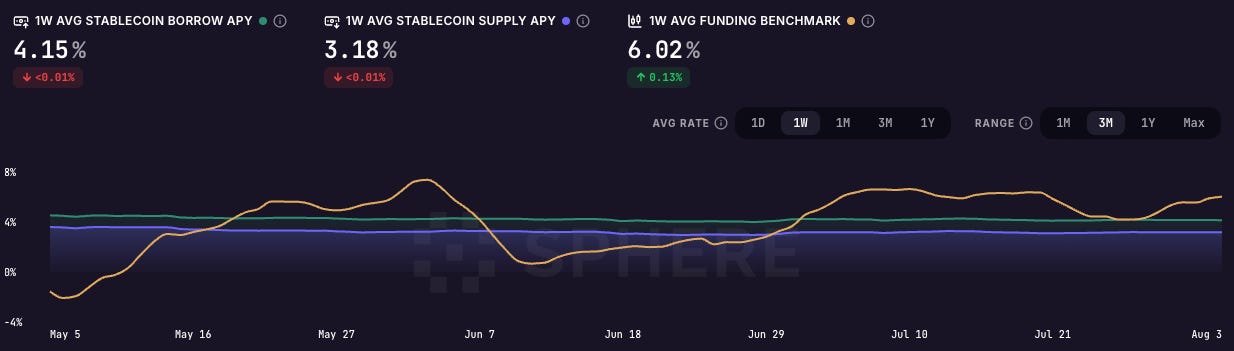
Sphere’s 1W average stablecoin borrow APY held at 4.15% and supply APY at 3.18%. The funding benchmark rose 0.13pp to 6.02%, widening the spread over borrow to 1.87pp. Traders paid more to hold leveraged perp exposure while the cost and yield of onchain credit stayed still.
Verdict: Dollar liquidity left the two largest stablecoins at the fastest weekly pace of the quarter and rotated into treasury-backed tokens paying more than onchain lending. Perp funding rose while borrow rates stood still.
Section 3 — Chain Comparison
3A. Stablecoin flows by chain
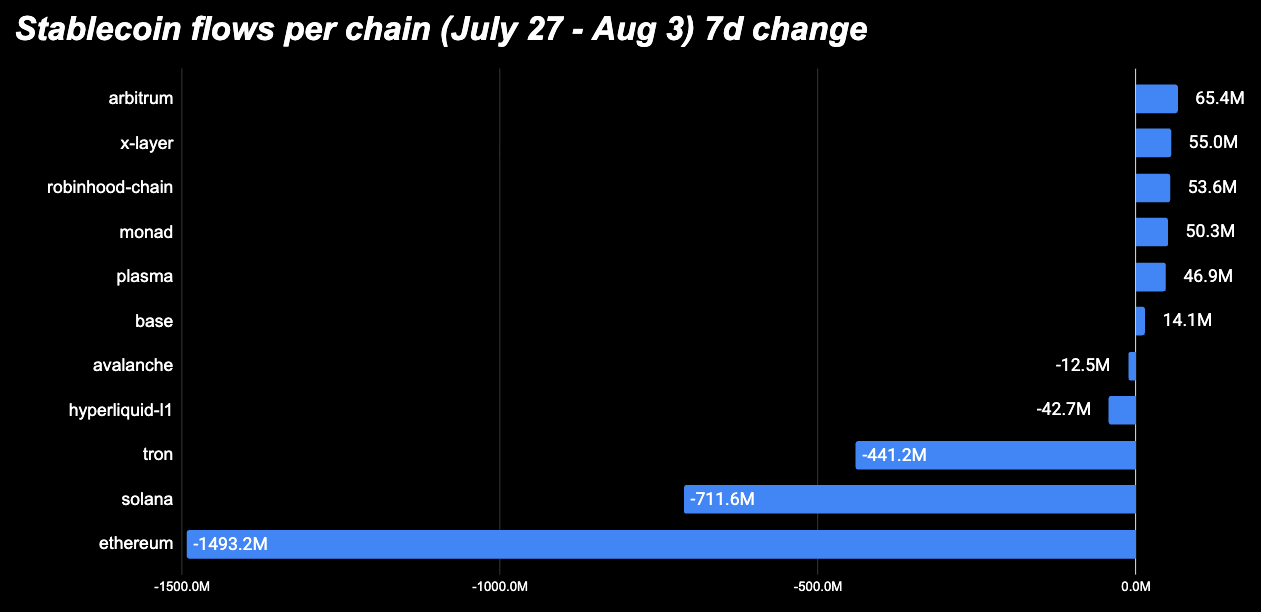
Monad: +$72M (+12%) to $629.5M

Monad recorded the most meaningful stablecoin inflow this week, extending a trend driven by Aave V3’s July launch and ongoing incentive programs. Incentives remain heavily concentrated on stablecoin lending rather than ETH, supporting strategies such as syrupUSDC carry trades and Ethena leverage loops.

The key distinction is that a meaningful portion of capital has also flowed into Valos’ RWA-backed lending product, now the chain’s largest incentivized pool, making part of the inflow more durable than a typical yield farm.
Robinhood Chain: +$53.6M (+14%) to $535M

Stablecoin growth continues to be driven by Robinhood Earn, which pays up to 7% on USDG and routes deposits into Morpho vaults.
The data shows that capital is primarily being deployed into yield-bearing stablecoins such as USDe, syrupUSDG, and spUSDG, while tokenized equities remain negligible. The dominant trade remains stablecoin looping, with retail deposits supplying funding and leveraged users capturing the spread.
Mantle: +$50.9M (+9.87%) to $578M

Mantle’s weekly inflow accounted for almost all of its monthly growth. The inflow reflects a combination of expanding RWA activity and Aave incentive programs.
Notably, one of the main reward programs specifically targets leveraged positions rather than passive lenders, helping sustain demand for stablecoin borrowing and leverage loops. The result is a stablecoin inflow supported by both long-term RWA growth and shorter-term incentive-driven activity.
3B. Structural Shifts from Onchain Activity
Uniswap: Fee Growth, Fee Switch, and Market Share Gains
UNI is up 26.5% over the past 30 days, driven by three factors: accelerating fee growth, the July 27 fee-switch expansion, and rising DEX market share. Uniswap generated $96.3M in 30-day fees (+133.5%) while major competitors saw fee declines.
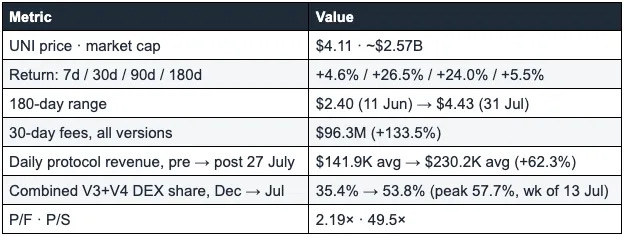
Combined V3/V4 market share increased from 35.4% in December to 53.8%, making Uniswap the dominant DEX by volume.
Driver one: the fee inflection
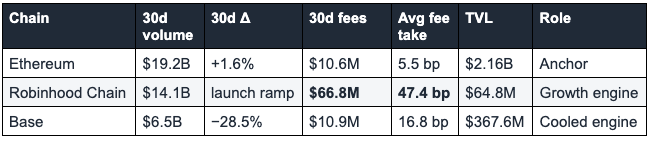
Fee growth remains the core driver. Uniswap processed $52B in 30-day volume, with Robinhood Chain emerging as the main growth engine. Despite holding only a fraction of Ethereum's TVL, Robinhood Chain generated the majority of protocol fees thanks to higher-fee assets such as tokenized equities, USDG pairs, and memecoins.
Driver two: the switch — fees become revenue
The fee switch is a phased program. UNIfication passed 25 December 2025 — 100M UNI burned, Ethereum’s switch live — and five chains followed by June 2026.
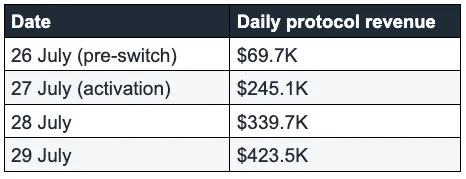
The July expansion completed Proposals 100 (v4 fees) and 99 (Robinhood Chain) passed near-unanimously and went live 27 July, directing one-sixth of swap fees to TokenJar contracts claimable only by burning UNI
Driver two: the switch — fees become revenue
Market share continues to consolidate. Uniswap's gains came largely at the expense of Curve, PancakeSwap, and smaller DEXs, while Robinhood Chain remains heavily dependent on Uniswap, which processes over 96% of the chain's DEX volume. This concentration has been a major contributor to recent fee growth.
Driver three: consolidation
Market share continues to consolidate. Uniswap's gains came largely at the expense of Curve, PancakeSwap, and smaller DEXs, while Robinhood Chain remains heavily dependent on Uniswap, which processes over 96% of the chain's DEX volume. This concentration has been a major contributor to recent fee growth.
Valuation: cheapest on fees
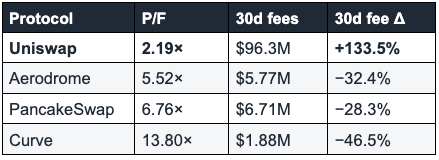
Valuation remains the key bull argument. UNI trades at roughly 2.2× annualized fees, the lowest multiple among major DEX tokens despite being the only platform delivering meaningful fee growth. The investment case depends on whether post-switch revenue can remain above current levels rather than reverting toward pre-expansion averages.
Catalysts to monitor: daily protocol revenue after the fee-switch rollout, Robinhood Chain trading activity, LP migration between v3 and v4 pools, Uniswap’s market-share trend, and the sustainability of fee generation from Robinhood Chain.